


A Teflon part measures differently in July than it did in January. That is not a defect. It is the price of the most chemically inert, lowest-friction plastic ever commercialized — and most of the problems buyers have with custom Teflon parts come from specifying them the way you would specify aluminum.
If you are sourcing PTFE components — seals, insulators, valve seats, lab equipment, medical device features, non-stick contact surfaces — this guide covers what the material actually does, which tolerances it honestly holds, how machining works, and where projects go wrong. XY-GLOBAL machines PTFE (Teflon) alongside PEEK, POM, PPS and other engineering plastics under the same ISO 9001:2015 and ISO 13485 systems as its metal work; the full list is on our materials page.
Quick Answer: What Are Custom Teflon Parts?
Custom Teflon parts are components machined, molded, or formed from PTFE (polytetrafluoroethylene) to a customer's own geometry — rather than picked from a catalog of O-rings and sheet gaskets. The custom route exists because PTFE earns its place in a design for four properties no other plastic matches all at once:
- Friction as low as 0.05–0.10 — the slipperiest solid material in common use
- Chemical inertness against nearly everything — untouched by acids, bases, and solvents; attacked only by molten alkali metals and elemental fluorine
- A working range of roughly −200 °C to +260 °C — no other unfilled plastic spans it
- Excellent electrical insulation with a dielectric constant near 2.1 that barely moves with frequency — prized in RF and high-voltage work
The catch, and the reason this guide exists: PTFE is soft, creeps under load, moves with temperature about ten times more than steel, and cannot be glued without exotic surface treatment. Everything in sourcing it follows from those facts.
Where Custom Teflon Parts Earn Their Keep
| Industry | Typical Custom PTFE Parts | Why PTFE and Not Something Else |
|---|---|---|
| Chemical processing | Valve seats, seals, bellows, lined fittings | Survives aggressive media that destroys elastomers |
| Medical & lab | Labware, manifold components, insulating spacers, low-friction guides | Chemically inert, sterilizable, FDA-compliant grades (21 CFR 177.1550) |
| Electrical / RF | Insulators, standoffs, coaxial spacers, capacitor films | Dielectric constant ~2.1, stable across frequency and temperature |
| Food & packaging | Non-stick contact surfaces, guide rails, scraper blades | Nothing sticks, food-contact grades available |
| Semiconductor | Wafer handling features, chemical delivery fittings | Purity, inertness, no particle shedding |
| Aerospace & industrial | Bearings, wear pads, pivot liners | Low friction without lubricant (use filled grades) |
One caution belongs in this table: unfilled PTFE is a poor choice for dynamic wear parts. Virgin material wears quickly under sliding load; filled grades exist precisely for that job.
Virgin vs Filled PTFE: Picking the Grade Before the Quote
"Teflon" is not one material. The filler decision changes strength, wear, creep, and cost more than anything else in the spec.
| Grade | Composition | What It Improves | Where It Belongs |
|---|---|---|---|
| Virgin PTFE | No filler | Best chemical purity, best dielectric, lowest friction | Seals, insulators, lab and medical contact, RF parts |
| 25% glass-filled | 15–25% glass fiber | Much lower creep and wear, better dimensional stability | Valve seats, pump parts, structural-ish features |
| Carbon / graphite-filled | 15–25% carbon | Wear resistance, thermal conductivity, low static buildup | Bearings, wear rings, sliding pads |
| Bronze-filled | 40–60% bronze | Highest compressive strength and thermal conductivity, still low friction | High-load bearings, hydraulic components |
| MoS₂ / specialty fills | Small percentages | Targeted hardness or wear tweaks | Niche cases — specify by test data |
Two consequences worth knowing before you RFQ. First, fillers trade purity for performance — a bronze-filled part is not acceptable in high-purity chemical or medical contact paths. Second, filled grades machine to tighter, more stable tolerances than virgin material, so if your drawing carries metal-like tolerances on a wear part, the filler choice has already been made for you.
The Property Nobody Warns You About: Creep
PTFE flows. Under sustained load — a bolted flange, a compressed gasket, a press-fit bushing — the material keeps deforming over time, a behavior called creep or cold flow. A gasket torqued to spec in March can be noticeably relaxed in September.
This is not a defect to reject; it is physics to design around:
- Gaskets: use filled grades, designs that restrain the material, or spring-loaded flange arrangements
- Press fits: expect them to relax; design mechanical interlocks instead of relying on interference fit alone
- Loaded contacts: keep sustained stress to a small fraction of the short-term compressive strength
- Fastening through PTFE: spread the load with washers or flanged bosses — never point-load a screw head on virgin PTFE
The suppliers who get PTFE right are the ones who ask "what load does this part carry over time?" before quoting — because the answer changes the grade, the geometry, and sometimes whether PTFE should be there at all.
Tolerances: What PTFE Actually Holds
Here is the reality check. PTFE's thermal expansion is roughly 130 × 10⁻⁶/°C — about ten times steel and five times aluminum. A 100 mm PTFE feature grows about 0.13 mm across a 10 °C temperature swing. Any tolerance tighter than the environment allows is fiction.
| Feature | Realistic Capability | Notes |
|---|---|---|
| General dimensions, small parts | ±0.05–0.10 mm | Virgin PTFE, after stress relief |
| Filled grades, small parts | ±0.025–0.05 mm | Glass or bronze fill stabilizes the material |
| Large or thin-walled parts | ±0.1–0.5 mm | Scale grows with size and wall thinness |
| Machined holes and bores | ±0.02–0.05 mm | With sharp tooling and light cuts |
| Flatness on faces | 0.1–0.3 mm per 100 mm | Material distorts when clamped too hard |
| Thickness of skived film | down to ~25 µm | Forming route, not machining |
Three specification rules follow:
- Do not copy metal tolerances onto a plastic drawing. Tolerance bands tighter than ±0.025 mm on virgin PTFE push the quote up or push the supplier to promise something the warehouse temperature will undo.
- Say what the tolerance is for. A seal face needs different precision than a cosmetic surface; suppliers can only protect the features you mark as critical.
- Define the measurement temperature. If acceptance happens at 20 °C and service happens at 80 °C, write both down.
For how to put finish callouts on the drawing the same way, the surface finish symbols and Ra values guide applies to plastics as much as metals.
How Custom Teflon Parts Are Actually Machined
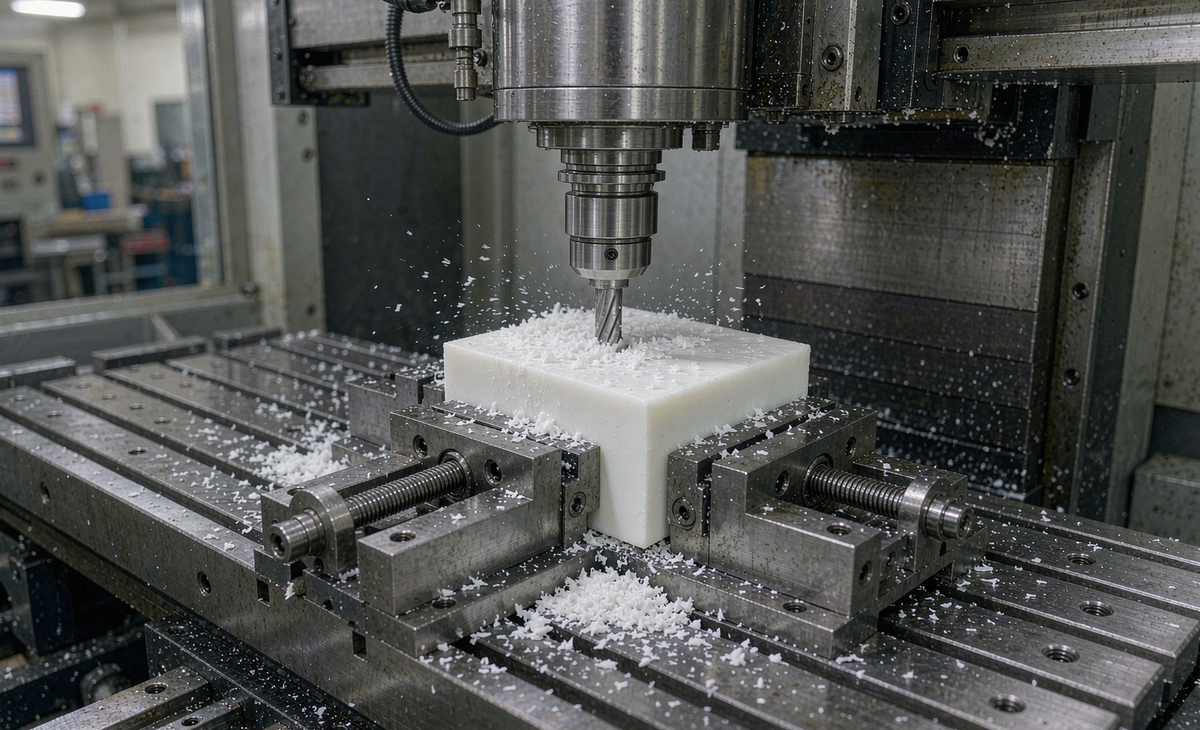
PTFE machines easily — it cuts like soft cheese — and that is exactly why it machines badly in careless hands. The material is soft enough to push out of shape under clamping pressure, and cutting stresses stay stored in the part and show up later as distortion.
What a disciplined PTFE machining process looks like:
- Stress-relieve the stock first — billets are typically annealed around 230–270 °C with a slow, controlled cool before machining, so the part does not move after the final cut
- Sharp tools, light cuts, high surface speed — dull tools smear PTFE instead of shearing it, and smeared surfaces hide dimensional error until inspection
- Gentle, even clamping — soft jaws, collets, or fixture plates; hard chucking on virgin PTFE leaves a permanent waist
- Sharp internal corners avoided — like all semi-crystalline plastics, PTFE prefers radii; corners are where cracks and distortion start
- Finish passes at minimal depth — the last cut removes hundredths, not tenths
- Cool-down before inspection — parts are measured at a defined temperature, after they have stopped moving
For complex thin-wall or deep-pocket geometries, machining can be combined with forming routes — but that decision belongs before tooling, not after the first scrap batch.
Machining vs Molding: Which Route for Your PTFE Part?
PTFE does not melt-process like normal plastics (it sinters), so the "molding" routes differ from what you may know from ABS or nylon.
| Route | Best For | Trade-offs |
|---|---|---|
| CNC machining | Prototypes, low-to-mid volumes, tight features, quick revisions | No tooling; unit cost higher at volume |
| Compression molding / isostatic forming | Volume parts, large or thick sections | Tooling cost; looser tolerances |
| Skiving | Thin film and tape down to ~25 µm | Flat forms only |
| Ram extrusion | Rods and tubes in standard profiles | Round and straight only |
The decision rule is the same as anywhere in manufacturing: machining buys freedom and precision; molding buys unit cost at volume. Many programs start with CNC prototypes to prove the geometry, then move to a molded production route once the design freezes. If your part may later suit injection-molded engineering plastics instead, this overview of custom injection molding services shows what that route looks like — and this comparison of CNC machining vs injection molding for ISO 13485 medical work covers the regulatory side.

The Joining Problem: You Can't Glue PTFE
PTFE's non-stick magic is also an assembly problem. Standard adhesives will not bond to untreated PTFE — the same surface energy that keeps food off a pan keeps epoxy off a flange.
Your options, in order of preference:
- Design the joint mechanically — bolts, clamps, interlocks, heat-staked features. Cheapest and most reliable
- Specify sodium treatment — a chemical etch (sodium naphthalene in a solvent, per ASTM D2093 practice) activates the surface for bonding. It works, but the treated surface darkens, the treatment is sensitive to handling, and it adds a controlled process step
- Use modified or treated-surface variants — some grades accept plasma treatment for lighter bonding duty
If your drawing shows an adhesive bond line on a PTFE part, expect a supplier DFM comment — this is one of the most common design reviews on plastic part assemblies.
The PFAS Question Buyers Are Starting to Ask
PTFE is a fluoropolymer, which places it inside the broad PFAS family now under regulatory scrutiny in the EU and several US states. The honest status: proposed restrictions are in motion, fluoropolymers are widely argued to merit carve-outs because they are manufactured, used, and disposed of differently from short-chain PFAS, and nothing is settled.
What this means for sourcing today:
- Existing PTFE part programs are not being banned overnight
- New designs for sensitive markets (consumer, medical in some geographies) increasingly ask suppliers for a PFAS position statement as part of the RFQ
- Alternatives exist where the performance requirement allows: PFA, FEP, PCTFE for fluorochemistry; UHMW-PE and PEEK where the chemical window is milder
Ask the question early, get the supplier's current compliance answer in writing, and do not design a whole product line around an assumption in either direction. For parts that need extreme-environment performance without fluorochemistry, XY-GLOBAL also machines technical ceramics — see the ceramic CNC machining service.
Seven Design Tips That Cut the Cost of Custom Teflon Parts
- Choose the grade first, tolerance second — a glass-filled grade may hold the tolerance you wanted from virgin material without fight
- Loosen every tolerance you don't fight for — metal-copy drawings are the number one cost inflator on plastic parts
- Add radii everywhere — internal corners especially; sharp corners crack and distort
- Avoid deep thin walls — PTFE's stiffness is low; a wall that tents or bows will fail inspection no matter how it was cut
- Design clamping in — flat parallel contact zones let the shop hold the part gently instead of crushing it
- Combine features to reduce setups — fewer re-clamps means less accumulated distortion on a soft material
- State service conditions, not just dimensions — temperature range, sustained load, media contact. Suppliers can only engineer around what they know
Tip 7 is also how you get a useful quote instead of a padded one. A supplier who knows the part sees 80 °C service and sustained compression will spec the right grade and stress-relief schedule — a supplier quoting blind specs the cheapest route and hopes.
What to Put in an RFQ for Custom Teflon Parts
- 3D CAD (STEP) plus 2D drawing with datums and tolerances — realistic ones, per the table above
- Grade: virgin or filler type and percentage (or the performance target and let the supplier propose)
- Regulatory needs: FDA food contact, USP Class VI, RoHS/REACH declarations, PFAS position
- Service conditions: temperature range, sustained loads, chemical exposure, wear duty
- Critical features marked as-cut, with measurement temperature defined
- Cosmetic requirements: visible surfaces, acceptable tool marks
- Volume: prototype quantity, first order, annual forecast
- Inspection level and documents: dimensional report, material certs, CMM where needed
Incomplete RFQs get padded quotes. Complete ones get engineering comments back — which is the more valuable document.
Custom Teflon Parts at XY-GLOBAL
| Capability | XY-GLOBAL |
|---|---|
| PTFE grades | Virgin and filled PTFE (Teflon), plus PEEK, POM, PPS, Nylon, PC, PP and other engineering plastics |
| Routes | CNC machining; injection molding and micro-molding for volume and miniature parts |
| Tolerance | Metal work to ±0.005 mm; plastics specified to what the material honestly holds |
| Support | Free DFM review — grade selection, tolerance sanity-check, joining and creep advice before production |
| Quality | ISO 9001:2015 and ISO 13485:2016 systems; CMM inspection and documented reports |
| Volume | Prototype through production, no MOQ |
| Bases | Shenzhen, China + Malaysia |
The part that matters with PTFE is the review before production: grade, creep load, tolerance realism, and joining method get settled on the drawing, not in a scrap bin. For rapid early-stage parts, the rapid CNC prototyping service covers the validation stage, and complex geometries are handled by the team behind CNC machining for complex parts. Parts that mix PTFE with metals sit under the same roof as our precision machining services for high-tolerance custom parts.
FAQ
Q: What are custom Teflon parts made of?
Polytetrafluoroethylene (PTFE), sold as Teflon by Chemours. Parts are cut from stock shapes by CNC machining, or compression-molded from PTFE powder and sintered. Fillers — glass fiber, carbon, bronze — are added to reduce creep and wear; virgin PTFE is used where purity and dielectric properties matter most.
Q: What tolerances can custom Teflon parts hold?
Typically ±0.05–0.10 mm on small virgin PTFE parts after stress relief, and ±0.025–0.05 mm on filled grades. PTFE's thermal expansion is about ten times steel's, so tolerance always needs a temperature context. Tighter bands are possible on small machined features but should be reserved for genuinely critical surfaces.
Q: Why does my PTFE gasket keep loosening over time?
Creep, also called cold flow. PTFE continuously deforms under sustained compression, so bolt loads relax over weeks and months. The fixes are filled grades, load-spreading geometry, spring-loaded flanges, or restraining the material mechanically instead of relying on compression.
Q: Can PTFE parts be glued?
Not without surface treatment. Untreated PTFE is famously non-stick to adhesives as well as to fluids. Sodium etching (ASTM D2093 practice) or plasma treatment activates the surface, but a mechanical joint is cheaper and more reliable wherever the design allows one.
Q: Is PTFE safe for food and medical applications?
Yes — virgin PTFE meets FDA food-contact requirements under 21 CFR 177.1550, and USP Class VI grades exist for medical use. Note that fillers change the picture: filled grades must be evaluated for the specific contact path, and high-purity applications usually stay virgin.
Q: Is PTFE being banned as a PFAS?
PTFE is a fluoropolymer within the broad PFAS family, and restriction proposals are under discussion in the EU and some US states. Fluoropolymers are widely argued to deserve exemptions, but rules are not settled. For new designs in regulated markets, ask suppliers for a current compliance statement rather than assuming either way.
Q: How do I reduce the cost of custom Teflon parts?
Specify filled grades where wear and creep — not purity — drive the requirement, copy metal tolerances only where function demands them, add radii instead of sharp corners, design gentle clamping surfaces, and state service conditions so the supplier can pick the right grade the first time.
Get a Quote for Custom Teflon Parts
Send a STEP file and a 2D drawing with your service conditions — temperature range, loads, media. Our engineers will review the grade choice, sanity-check the tolerances against what PTFE honestly holds, and quote the right route: machining for precision and prototypes, molding for volume.
📧 market@xy-global.com | 🌐 Contact XY-GLOBAL
PTFE rewards the buyers who respect what it can't do. Everything slippery starts there.

分享:
Zinc Casting Suppliers: How to Vet a Hot-Chamber Partner Before You Cut Steel
Self-Centering Chuck for a Lathe: What Actually Decides Your Runout