


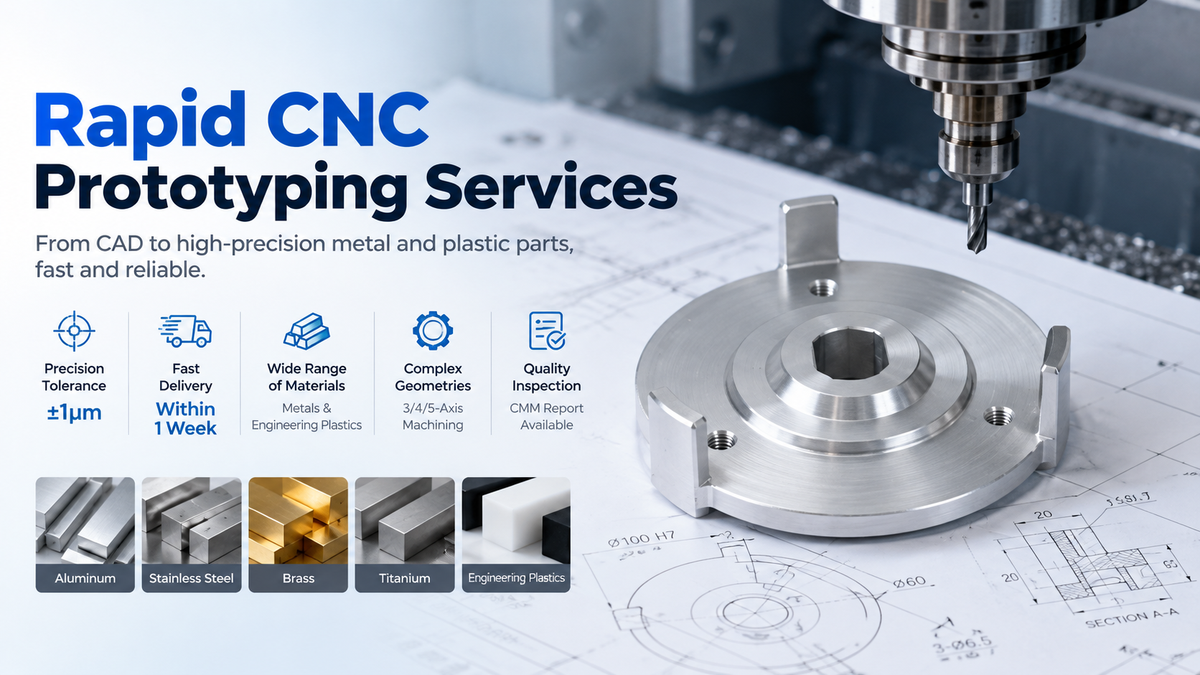
Imagine spending weeks refining a design, only to find out after the first physical part arrives that a hole does not line up, or a critical fit simply does not work.
Rapid CNC prototyping is extremely useful. Instead of moving CAD to tooling or full production, CNC prototyping provides a way to turn the design into physical parts for these checks. The part can then be checked for fit, function, strength, assembly, surface condition, and dimensional accuracy before larger production commitments are made.
XY-GLOBAL, as a trusted one-stop on-demand manufacturer, we see CNC prototypes as more than one-off samples. Read this article for a practical overview of CNC prototyping, from the basic definition and machining process to commonly used materials, cost and lead time, and how to choose the right CNC prototyping manufacturer. Drawing on decades of hands-on manufacturing experience, we will explain each topic clearly and focus on what actually matters in real projects.

What Is Rapid CNC Prototyping?
Rapid CNC prototyping is the process of machining prototype parts directly from CAD data using CNC milling, CNC turning, drilling, grinding, or other computer-controlled machining processes.
The main advantage is that dedicated molds or production tooling are usually not required. Once the design is ready, the machining program can be created and updated relatively quickly. If the prototype reveals a problem, the CAD model can be revised and another version can be machined without rebuilding an entire mold.
Think of a CNC prototype as a physical checkpoint between design and production.
It allows engineers to move beyond what looks correct on a screen and test how the actual part behaves in the real application.
This is especially useful when the prototype must closely represent the final production part in terms of material, dimensions, surface finish, or mechanical performance. In all, CNC prototypes are the first step toward engineering validation, small-batch manufacturing, and eventually stable production.
How Does the CNC Prototyping Process Work?
The exact workflow varies from project to project, but most CNC prototype machining follows the same general path.
It starts with the 3D CAD model and, in many cases, a 2D drawing.
The 3D model defines the geometry, while the 2D drawing is especially important when the part contains critical tolerances, GD&T, surface finish requirements, threads, special fits, or inspection notes.
Before machining begins, the drawing should be reviewed for manufacturability.
This DFM stage helps identify features that may create unnecessary cost or machining difficulty, such as extremely deep pockets, very thin walls, small internal corner radii, hard-to-reach holes, or tolerances that are tighter than the function really requires.
Once the design is confirmed, the next steps normally include material preparation, CAM programming, workholding setup, machining, inspection, and any required secondary finishing.
For a simple aluminum prototype, the process may involve only one or two setups.
A more complex component may require several machining operations, custom fixtures, 5-axis positioning, precision inspection, and external finishing such as anodizing, plating, or painting.
So, not every CNC prototype is automatically simple or fast. However, it allows for faster development cycle that depends on dedicated production tooling.

Common Materials for Rapid CNC Prototyping
A wide range of metals and engineering plastics can be used for CNC prototypes.
The best choice depends on what the prototype actually needs to prove.
For early dimensional checks, machinability and cost may matter most. For functional testing, however, the prototype material should often be close to the final production material.
| Material | Reasons Why Commonly Used | Typical Prototype Applications |
| Aluminum 6061 | Easy to machine, lightweight, good strength | housings, brackets, frames, fixtures |
| Aluminum 7075 | Higher strength than 6061 | aerospace, robotics, structural parts |
| Stainless Steel 304/316 | Corrosion resistance and strength | medical, food, industrial equipment |
| 4140 Steel | Higher strength and wear resistance | shafts, mechanical parts, load-bearing components |
| Brass | Good machinability and corrosion resistance | fittings, connectors, valves |
| Copper | High electrical and thermal conductivity | electronics, thermal components |
| POM / Delrin | Stable, low friction, easy to machine | gears, guides, moving parts |
| PEEK | High temperature and chemical resistance | medical, aerospace, semiconductor applications |
| ABS | Lower-cost engineering plastic | housings, covers, fit-check parts |
| PC | Tough and impact resistant | protective parts, enclosures |
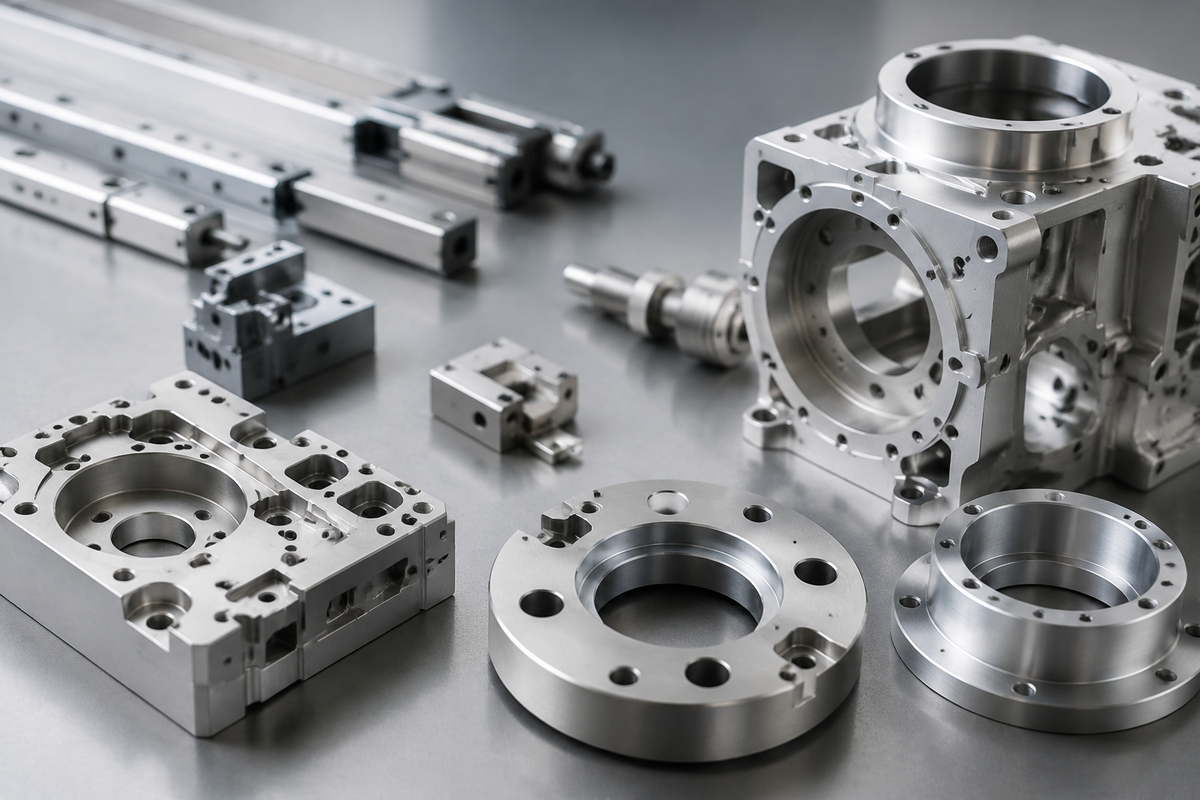
A CNC aluminum prototype is one of the most common choices because aluminum is relatively easy to machine and offers a good balance between strength, weight, cost, and finishing options.
Plastic CNC prototyping can be useful when the design requires better dimensional stability or more realistic mechanical behavior than some 3D printed materials can provide.
CNC Prototyping vs 3D Printing
CNC machining and 3D printing are both useful prototyping technologies, but they solve different problems.
Neither one is automatically better.
The right choice depends on what needs to be tested.
| Requirement | CNC Prototyping | 3D Printing |
| Production-grade material | Excellent | Depends on process |
| Tight dimensional tolerance | Excellent | Process dependent |
| Internal channels and complex cavities | Limited | Excellent |
| Functional mechanical testing | Excellent | Depends on material |
| Surface finish | Generally better as-machined | Often requires post-processing |
| Very fast visual models | Good | Excellent |
| Threads and mating features | Strong | May require finishing |
| Small design changes | Easy | Very easy |
If the goal is to quickly check shape or internal geometry, additive manufacturing may make more sense.
If material behavior, fit, precision, threads, strength, sealing, or surface condition are part of the test, CNC machining is often the stronger choice.
In many development programs, both processes are used.
Sometimes, a team may start with several 3D printed concepts, then move to CNC machined prototypes for functional testing once the design becomes more mature.
When Is CNC Prototyping the Right Choice?
CNC machining is especially suitable for rapid prototyping when the goal is to produce a part that behaves much like the final production component. Its main advantage is that engineers can test real materials, real dimensions, and real functional features before moving into larger production.
Fast Design Iteration Without Dedicated Tooling
One of the biggest advantages of rapid CNC prototyping is that it does not require dedicated molds or production tooling. Once the CAD model is ready, the part can move directly into programming and machining.
If the first prototype needs to be changed, the design and machining program can usually be updated quickly. This makes CNC well suited to repeated design-test-revision cycles and helps shorten product development time.
Production-Grade Materials for Functional Testing
CNC prototypes can be machined from many of the same metals and engineering plastics used in final production, including aluminum, stainless steel, alloy steel, copper, brass, POM, and PEEK.
This allows engineers to evaluate more than just appearance. Strength, stiffness, threads, sealing surfaces, wear, thermal behavior, and assembly performance can all be tested more realistically when the prototype uses the intended production material.
High Accuracy for Critical Features
Another major benefit of CNC prototype machining is dimensional control.
CNC machining is well suited to parts with precision holes, bores, threads, mating surfaces, locating features, and other dimensions that directly affect fit and function. This makes CNC machined prototypes particularly useful for functional validation and precision assemblies where a simple visual model is not enough.
A Better Starting Point for Production
CNC prototyping can also help identify manufacturing problems before the design reaches production.
Issues related to tool access, thin walls, difficult tolerances, workholding, machining sequence, and inspection can often be found during the prototype stage, when changes are still relatively easy to make.
This is especially useful for projects that may later move into small-batch or full production. The prototype becomes not only a test part, but also an early step in developing a more stable and repeatable manufacturing process.
For these reasons, rapid CNC prototyping is a strong choice for functional testing, engineering validation, precision assemblies, low-volume development parts, and bridge production before dedicated tooling is ready.
From CNC Prototype to Low-Volume and Production Machining
A successful prototype is not the end of the manufacturing process.
In many projects, it is the point where the real manufacturing questions begin.
Moving from one prototype to 100 or 1,000 parts is not simply a matter of running the same CNC program more times.
The priorities start to change.
| Prototype Stage | Production Stage |
| Flexible workholding | Stable and repeatable fixturing |
| Cycle time is less important | Cycle time becomes important |
| Tool wear may be limited | Tool life must be controlled |
| Full inspection may be practical | Inspection strategy must scale |
| Design may still change | Repeatability becomes the priority |
| Unit cost is secondary | Cost per part becomes critical |
During prototyping, a machinist may use a flexible setup that works well for one or two parts.
For production, the same project may need dedicated fixtures, optimized toolpaths, improved material utilization, more controlled tool life, and a faster inspection process.
This is one reason why the choice of CNC prototyping manufacturer matters.
A supplier that can produce one good prototype is not automatically the right partner for production. Choose one that can handle both to avoid some problems later.
How to Choose a CNC Prototyping Manufacturer
Choosing a prototype machine shop should not be based only on the lowest price or the shortest quoted lead time.
A good supplier should first be able to handle the actual technical requirements of the part.
That includes the material, part size, geometry, tolerance, surface finish, and inspection requirements.
Look Beyond Machine Capacity
A long equipment list is useful, but it does not tell the whole story.
The more important question is whether the manufacturer has the right machines, tooling, fixtures, engineering experience, and inspection capability for your specific component.
A precision turned shaft and a large 5-axis housing may both be CNC parts, but they require very different manufacturing resources.
Check the Level of Engineering Support
A reliable prototype machining service should do more than accept a drawing and send back a price.
Good DFM feedback may identify unnecessary tight tolerances, thin-wall risk, difficult tool access, small corner radii, or features that can be simplified without changing function.
That input can reduce both prototype cost and later production problems.
Ask How Parts Are Inspected
Inspection should match the function of the part.
Simple dimensions may be checked with micrometers, calipers, gauges, or optical systems.
More complex geometry may require CMM inspection or other precision measurement equipment.
For critical projects, ask whether inspection reports, FAI reports, or full dimensional records can be provided.
Consider What Happens After the Prototype
This is easy to overlook.
If the prototype passes testing, can the same supplier support 10 pieces? 100 pieces? 1,000 pieces?
Can they manage surface finishing, inspection, assembly, and production planning?
A capable CNC manufacturing partner should be able to support the project as requirements evolve rather than forcing the customer to rebuild the supply chain after every development stage.
What Affects CNC Prototype Cost?
CNC prototype cost mainly depends on the material, part geometry, tolerance requirements, quantity, surface finishing, and inspection needs.
Material: Material affects both raw stock price and machining behavior. For example, POM or aluminum 6061 is generally easier to machine than stainless steel, titanium, hardened steel, or some high-performance plastics.
Part Geometry: A small part with five setups, deep pockets, difficult tool access, and several tight-tolerance features such as deep cavitie, angled holes, or narrow slots may cost more than a much larger but simple plate.
Tolerance and Quantity: Tighter tolerances often require slower machining, additional finishing passes, more careful fixturing, and more detailed inspection. For a one-off prototype, programming and setup costs are carried by a single part, while a larger quantity allows those fixed costs to be spread across more pieces.
Surafce Finishing and Inspection: Anodizing, plating, heat treatment, polishing, CMM inspection, or full dimensional reports can all add both cost and lead time.
At XY-GLOBAL, we won't merely produce a CNC machined prototype; we also take these into consideration to save your money and time.
Design Guidelines for CNC Machined Prototypes
Good prototype design is not only about making the part machinable.
It is about getting useful test results without adding cost that does not improve the prototype.
Keep Internal Corners Machinable
CNC milling tools are round, so perfectly sharp internal corners cannot normally be produced directly with standard milling.
A small internal radius may look harmless in CAD, but if it requires a very small cutter, machining time can increase quickly.
Larger internal radii generally allow stronger tools, higher cutting speeds, and more stable machining.
If the corner is not functionally critical, increasing the radius is usually a simple way to reduce both machining time and cost.
Watch Deep Pockets and Thin Walls
Deep cavities can be difficult because long tools are more flexible and more likely to vibrate.
Thin walls create a different problem. They may deflect during cutting, especially in aluminum, plastics, and long slender parts.
Both situations can affect dimensional accuracy and surface finish.
When possible, avoid combining very deep features with extremely thin surrounding walls.
If the geometry is unavoidable, it should be discussed during DFM review so the machining sequence and support strategy can be planned properly.
Use Tight Tolerances Only Where They Matter
A prototype drawing filled with ±0.01 mm tolerances may look precise, but that does not mean every dimension needs that level of control.
Critical features should be identified based on function.
These may include:
-
bearing or shaft fits
-
mating holes
-
sealing surfaces
-
locating datums
-
sliding features
-
assembly interfaces
The remaining dimensions can often use broader tolerances without affecting performance.
This is one of the easiest ways to keep prototype machining cost under control.
Think About Tool Access and Workholding
A feature may look easy in CAD but still be difficult to machine if the cutter cannot reach it or if the part cannot be clamped securely.
Deep side features, angled holes, narrow slots, and delicate sections can all increase the number of setups or require special fixturing.
This becomes even more important when parts move from one-off prototypes into repeat production.
CNC Machining Prototyping at XY-GLOBAL: More Rapid and Reliable
Founded in 2010, XY-GLOBAL boasting ISO 9001 and ISO 13485 certifications has been a reliable and trustworthy one-stop manufacturer for custom and precision components through prototype validation, engineering changes, small-batch production, and ongoing manufacturing.
Our machining capabilities include CNC milling, CNC turning, multi-axis machining, and precision finishing for over 40 materials, including aluminum, stainless steel, carbon and alloy steel, copper alloys, and engineering plastics. Before production, our
We also support DFM support an engineering team can review drawings and provide DFM feedback on geometry, tolerance, material choice, machining access, and manufacturing feasibility.
For precision components, dimensional inspection can be carried out using CMM and other measuring equipment, with inspection reports available when required.
Besides, prototypes can get within a week or even faster if needed.
Conclusion
Rapid CNC prototyping gives engineers a practical way to move from CAD to a real, functional part before committing to larger production.
The value is not only speed.
A good CNC prototype can help verify material behavior, dimensions, assembly, fit, surface condition, and manufacturing feasibility while there is still time to change the design.
The best results come when prototyping is treated as part of the production path rather than a separate one-off step.
A capable CNC prototyping manufacturer should be able to support the first prototype, help resolve manufacturing risks, and continue with small-batch or production machining when the design is ready.
At XY-GLOBAL, we support that full path from prototype validation to production manufacturing.
If you have a new CNC prototype project, send us your 3D model, drawing, material, quantity, and tolerance requirements. Our engineering team can review the design and provide manufacturing feedback before production starts.
Frequently Asked Questions About CNC Machined Prototypes
1. What files should I send for a CNC prototype quote?
A 3D CAD file such as STEP, STP, X_T, or IGES is normally required. A 2D drawing should also be provided if the part has specific tolerances, GD&T, threads, surface finish, or inspection requirements.
2. Can I order only one CNC prototype?
Yes. One-off prototypes are common, although the unit price normally decreases when setup and programming costs are spread across a larger quantity.
3. Should the prototype use the final production material?
Not always. If the prototype is only for basic fit or geometry checks, a lower-cost material may be acceptable. For functional, thermal, structural, or durability testing, using the production material usually gives more meaningful results.
4. Does prototype lead time include finishing and shipping?
Not necessarily. Machining, surface finishing, inspection, and shipping may each require separate time. These should be confirmed when reviewing the quotation and delivery schedule.
5. Can the design be changed after the first prototype?
Yes. One of the advantages of CNC prototyping is that design revisions can usually be implemented without rebuilding dedicated tooling. Significant changes may still require new programming, setup review, or a revised quotation.
6. Can you handle both prototypes and production parts?
Yes, and this can reduce engineering transfer and revalidation work. A supplier that supports prototype machining, inspection, finishing, low-volume production, and larger manufacturing programs can often make the transition to production more efficient.
7. What is the typical lead time for CNC prototypes?
Lead time depends on material availability, part complexity, tolerance, quantity, finishing, and inspection requirements. Simple parts can usually be completed faster, while complex parts, special finishes, or detailed inspection may require additional time.
8. What tolerances can CNC prototypes achieve?
CNC machining can achieve tight tolerances, but the practical tolerance depends on the material, geometry, feature size, and inspection method. Critical dimensions should be clearly identified on the drawing, while non-critical features can usually use standard machining tolerances to control cost.

Share:
Ceramic CNC Machining: Materials, Processes, Tolerances and Design Guide