


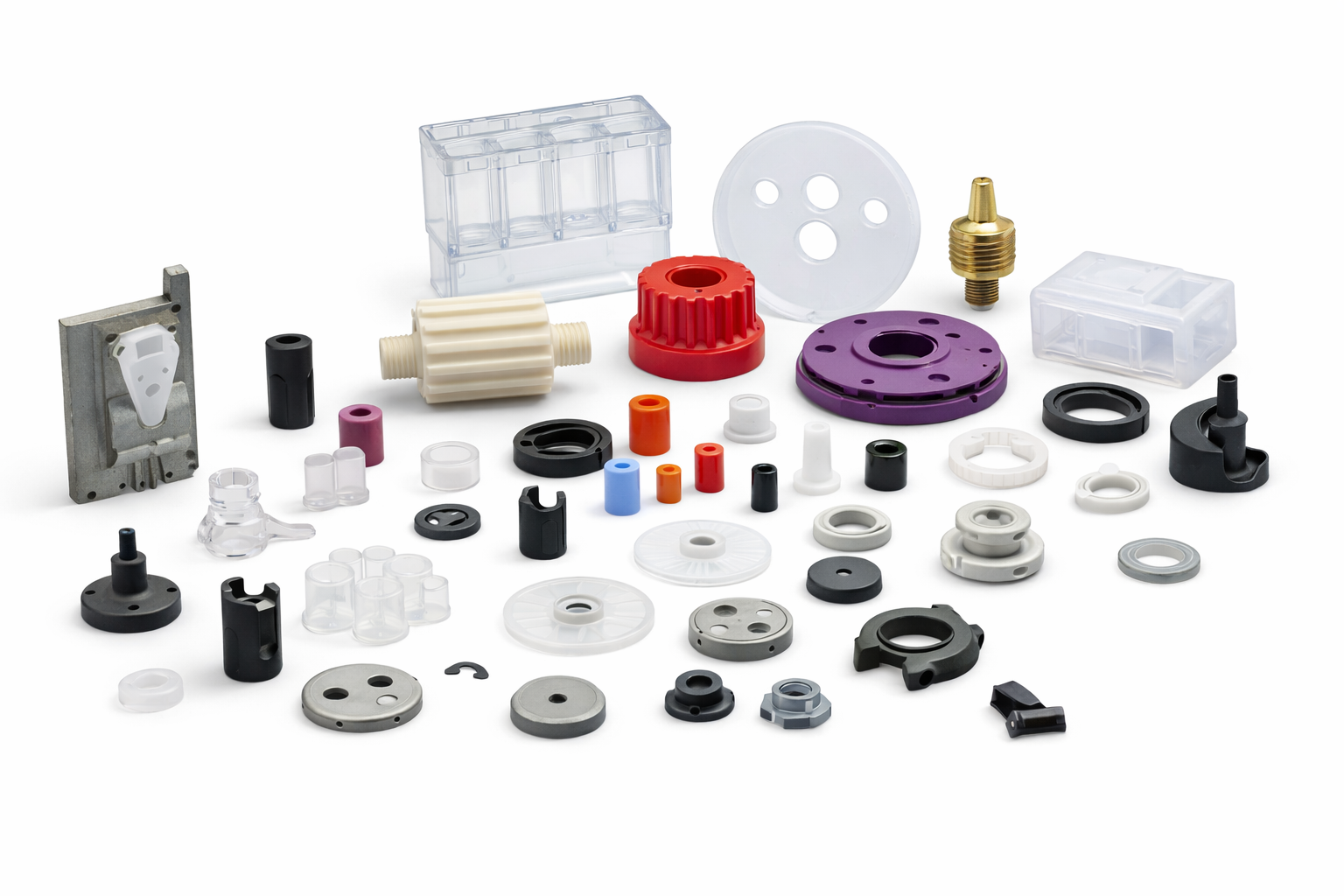
Custom Precison Injection Molding Services
Specialize in custom plastic injection molding— from prototypes to mass production. ±3µm precision, 7-day lead times, and zero MOQ. Turn your product design into reality with one‑stop injection molding services.
- ISO 9001: 2015 & ISO 13485 Certifications
- No MOQ Requirement
- Free DFM Analysis
Injection Molding at XY-GLOBAL
Injection molding turns your plastic part design into a repeatable, high‑quality production reality by injecting molten material into a precision metal mold and cooling it into a finished component. The process includes mold design and fabrication, plastic drying and melting, high‑pressure injection, controlled packing and cooling, and final part ejection and inspection, all executed in a tightly managed cycle to ensure consistency across thousands or millions of parts.
What makes injection molding powerful is its ability to combine low unit cost, tight tolerances, and a wide range of materials and surface finishes—everything from simple commodity plastics to high‑performance grades like PEEK and medical‑grade formulations, along with options such as high‑gloss, matte, and textured surfaces.
At XY‑GLOBAL, injection molding is built around speed, flexibility, and quality. We support zero MOQ, so you can start with prototypes or small batches and scale up to high‑volume production without redesigning your process. Our ISO 9001/13485‑certified workflows, stable yields above 95%, and 100% inspection for critical dimensions ensure that every part meets your dimensional and surface requirements. With deep experience in medical‑grade, industrial, and consumer applications, XY‑GLOBAL injection molding gives you a scalable, low‑cost, and highly reliable path from design to millions of finished plastic parts.
Injection Molding Capabilities at XY-GLOBAL
| Capability | Details |
|---|---|
| Machine & Process Range | Support for parts from ultra‑small features (as small as 0.1 mm wall thickness) to large structural components up to 1,000 mm × 1,000 mm × 400 mm, with part weights around 5–7 kg. |
| Materials & Colors | Wide range of injection‑moldable thermoplastics, including ABS, PP, PC, PS, PA (Nylon), PA+GF, POM, TPE, TPU, PVC, PBT, PEEK, and medical‑ or food‑grade grades, with options for custom colors and additives. |
| Surface Finishes & Post‑Processing | Molded surface options: high‑gloss polished, semi‑gloss, matte, and textured finishes; post‑processing including painting, pad‑printing, laser marking, ultrasonic welding, and basic assembly. |
| T1 Sample Lead Time | As fast as 3–5 business days for simple parts; 2–3 weeks typical for more complex molds, including first‑trial samples and minor adjustments. |
| Typical Lead Times | Mold development: 2–4 weeks for simple molds, 4–8 weeks for complex or multi‑cavity molds; sample delivery within 3–5 days after first trial; mass‑production shipment within 1–3 weeks after sample approval, depending on volume. |
| Quality System & Certifications | ISO 9001 & ISO 13485 certified processes. |
| Inspection & Test Capabilities | In‑line use of CMM, optical projectors, hardness testers, and color‑difference meters; incoming inspection, first‑article inspection (FAI), in‑process checks, and final‑batch inspection with defined AQL levels. |
| Part Repeatability, Yield & Key Dimension Control | Stable process control to keep part‑to‑part variation within tight limits, with typical production yield above 95% and 100% inspection for key dimensions on critical parts. |
Injection Molding Materials
We support a wide range of injection molding materials, including ABS, PP, PE, PC, PS, PMMA, Nylon (PA), POM, TPE, and TPU, with options for medical‑grade, food‑grade, flame‑retardant, and custom colors.
Acrylonitrile Butadiene Styrene (ABS)
A versatile engineering thermoplastic widely used in injection molding for consumer products and housings.
- Property: Good impact resistance, rigidity, and surface finish, with easy painting and post‑processing.
- Application: Electronic enclosures, consumer goods, automotive interior parts, and prototypes.
Polypropylene (PP)
A lightweight and cost‑effective thermoplastic suitable for large‑volume production.
- Property: Excellent chemical resistance, low density, and good fatigue resistance, with low moisture absorption.
- Application: Containers, caps, automotive trim, living hinges, and medical‑grade packaging.
Polyethylene (PE)
A highly flexible and chemically resistant plastic frequently used in molded thin‑wall and hollow parts.
- Property: High impact strength, low friction, and good low‑temperature performance, with good barrier properties.
- Application: Bottles, containers, caps, liners, and low‑cost packaging components.
Polycarbonate (PC)
A high‑performance clear thermoplastic valued for strength and transparency.
- Property: High impact resistance, good optical clarity, and moderate heat resistance.
- Application: Transparent covers, lenses, helmets, safety glasses, and electronic housings.
PMMA (Acrylic)
A rigid, transparent plastic often used when optical clarity and surface gloss are critical.
- Property: Excellent transparency, UV resistance, and high surface hardness, though more brittle than PC.
- Application: Light guides, lenses, displays, signage, and decorative panels.
Polystyrene (PS)
A low‑cost, easy‑to‑mold thermoplastic used for simple, high‑volume parts.
- Property: Good dimensional stability, low moisture absorption, and easy colorability, but limited toughness.
- Application: Disposable products, packaging trays, cosmetic containers, and low‑cost consumer parts.
PA (Nylon)
A family of engineering nylons known for durability and mechanical strength.
- Property: High wear resistance, good fatigue strength, and moderate heat resistance, with good chemical resistance.
- Application: Gears, connectors, automotive components, industrial fittings, and mechanical parts.
Polyoxymethylene (POM)
A rigid, low‑friction engineering plastic with excellent dimensional stability.
- Property: High stiffness, low creep, good fatigue resistance, and low moisture uptake.
- Application: Precision gears, bushings, clips, snap‑fit components, and mechanical hardware.
Thermoplastic Elastomer (TPE)
A soft, rubber‑like thermoplastic with good elasticity and comfort feel.
- Property: High flexibility, good grip, and excellent bonding to rigid plastics like PP or ABS.
- Application: Soft‑touch grips, seals, buttons, and ergonomic handles.
Thermoplastic Polyurethane (TPU)
A tougher, more durable elastomer than standard TPE, combining flexibility and abrasion resistance.
- Property: High abrasion resistance, good elasticity, and improved oil and chemical resistance.
- Application: Protective cases, phone covers, flexible tubing, and high‑wearing seals.
Polyether Ether Ketone (PEEK)
A premier high‑performance thermoplastic for extreme engineering applications.
- Property: Heat resistance exceeding 260°C and medical‑grade biocompatibility, with excellent chemical and wear resistance.
- Application: Implants, microfluidic chips, surgical tools, and high‑end aerospace components.
Polyethylene Terephthalate (PET)
A strong, clear thermoplastic commonly used for food‑contact and packaging applications.
- Property: High strength, good clarity, and excellent barrier to gases and moisture, with good chemical resistance.
- Application: Beverage bottles, food containers, caps, and thin‑wall packaging parts.
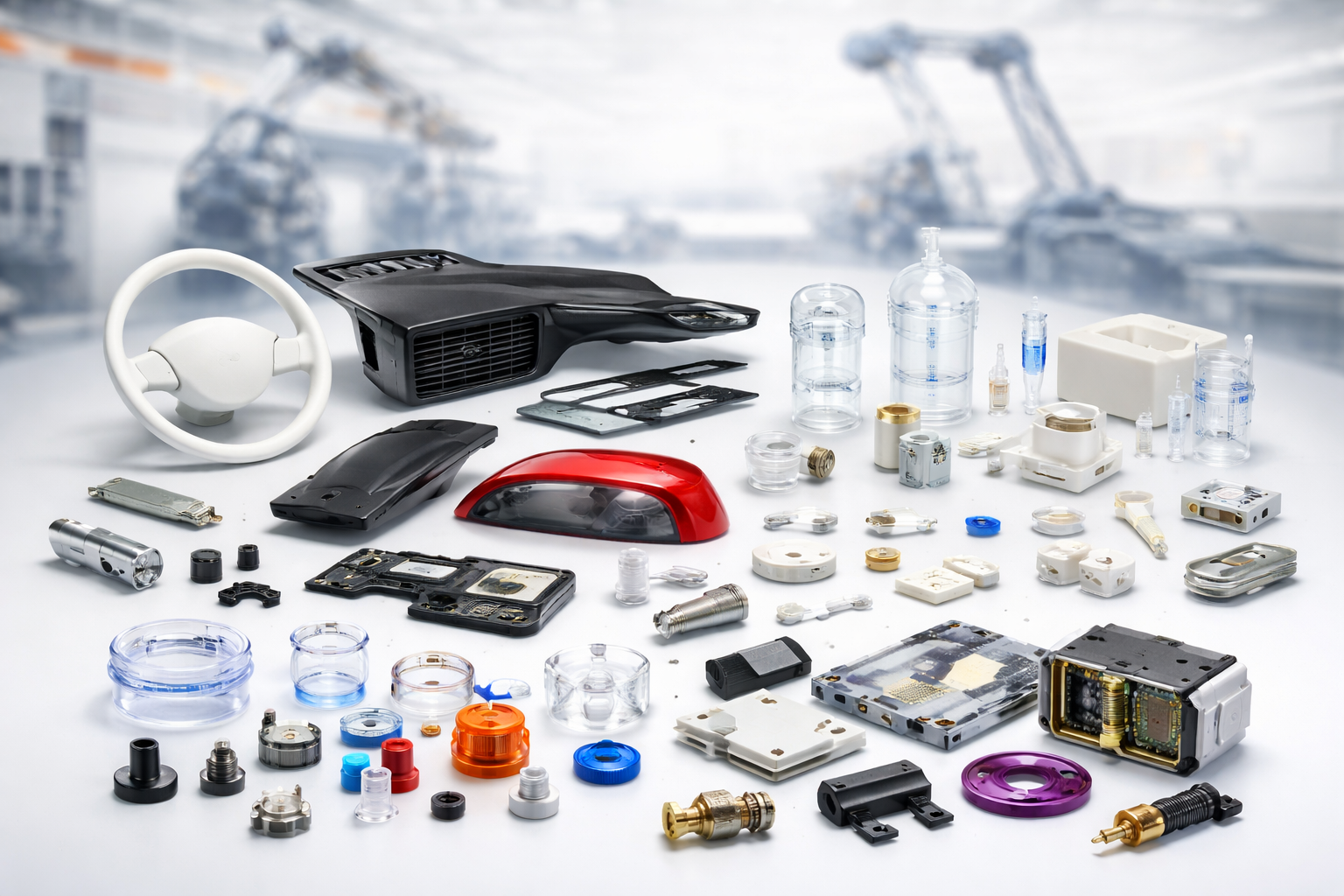
Injection Molding Application
Injection molding is widely used for high‑volume plastic part production in industries such as automotive, consumer electronics, and medical devices. At XY‑GLOBAL, we focus on applying this proven process to more specialized fields, including medical equipment, optics, semiconductor components, and communications devices, where precision, cleanliness, and reliability are critical.
- Medical Equipment Components
- Single‑Use Medical Parts
- Optical Housings & Lens Components
- Semiconductor & Electronics Enclosures
- Fiber‑optic & Communication Parts
- Sensors & Detection Modules
- General Industrial & Precision Parts
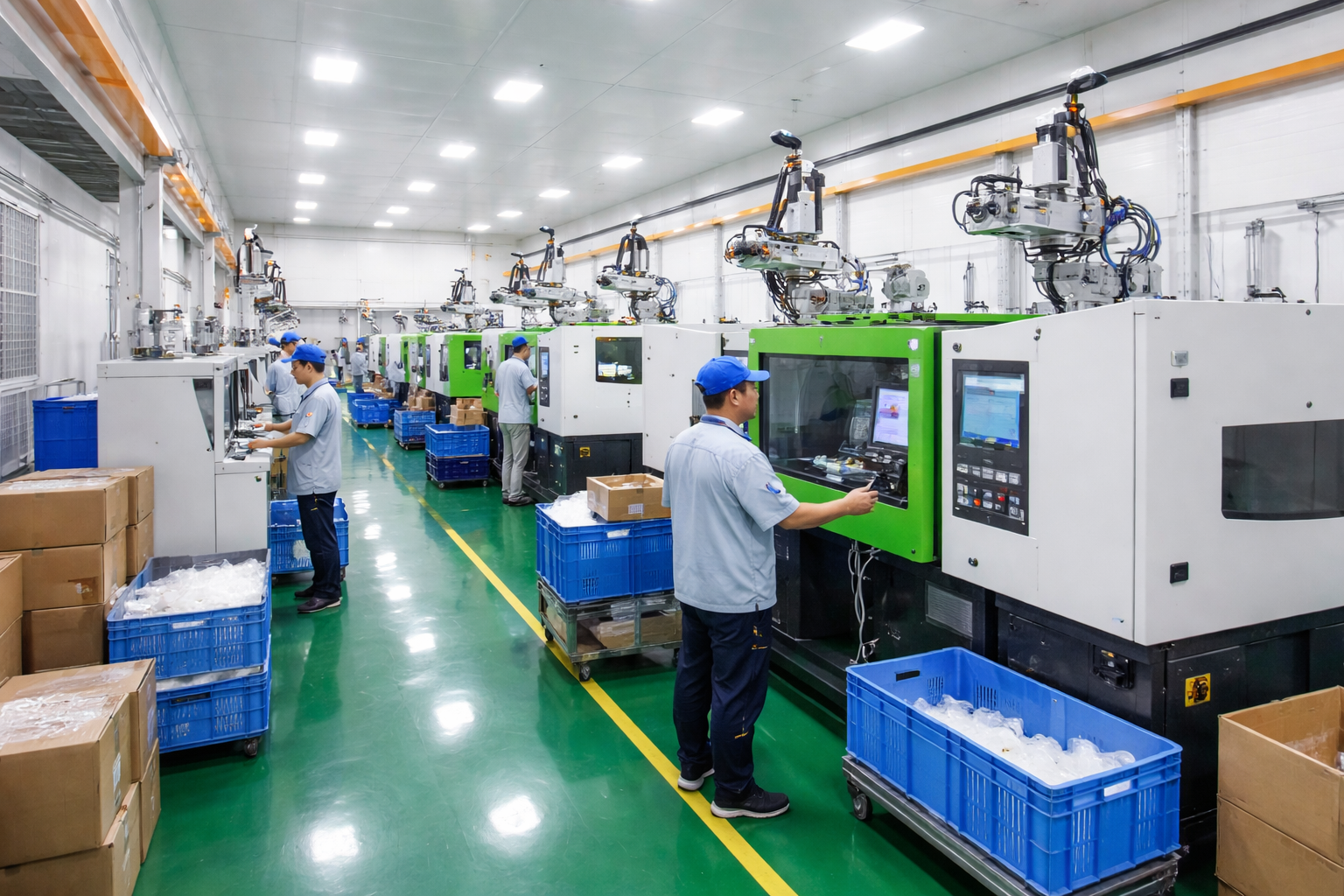
Why Choose XY-GLOBAL for Injection Molding Services?
We deliver production‑grade injection molding—zero MOQ, ISO 9001/13485‑certified—with capabilities from prototypes to mass production.
- End‑to‑End Support: Cover everything from design review and DFM feedback, through mold making and sampling, to mass production.
- Fast Lead Time & Flexible Quantities: Support prototypes, small batches, and high‑volume production, with fast mold lead times and short sample cycles.
- Wide Material Range & Precision Molds & Finishes: Support high‑precision molds with tight tolerances plus a variety of surface finishes following common SPI/VDI standards or your physical samples.
- Stable Output & Cost‑Effective Manufacturing: Fully controlled process to keep production yield above 95%. 100% inspection reports for critical dimensions for consistent and traceable parts.
Injection Molding FAQs
1. What is injection molding?
Injection molding is a manufacturing process that produces plastic parts by injecting molten material into a custom metal mold. Once cooled, the part is ejected and the cycle repeats, allowing fast, repeatable production of identical parts in medium to large volumes
2. What types of parts are suitable for injection molding?
Injection molding works best for solid or hollow plastic parts with consistent wall thickness, moderate to complex geometry, and the need for tight tolerances and good surface finish. Examples include enclosures, housings, buttons, connectors, and structural components.
3. What materials can you mold?
We commonly work with thermoplastics such as ABS, PC, PP, PE, PS, PA (nylon), and POM. Special grades with glass fiber, flame‑retardant, medical‑grade, or food‑safe properties are also available upon request.
4. What is the minimum order quantity (MOQ)?
We work with you at any scale—there is no minimum order quantity. You can start with a single prototype, a few test parts, or move directly into small‑batch or mass production, all using the same injection molding process and quality standards.
5. Can you handle color and surface finishes?
Yes. We support custom colors, textures (gloss, matte, grain), and post‑molding operations such as painting, pad printing, laser marking, and assembly, depending on your product requirements.
6. How is pricing determined for injection molding?
Pricing depends mainly on part geometry, material, tooling complexity (single vs. multi‑cavity), surface finish, and production volume. We provide a transparent quote that breaks down tooling, material, and per‑piece costs.
7. How long does it take from design to first parts?
Typical lead times are: design review in 1–2 working days, mold construction in 2–6 weeks (depending on complexity), and first sample parts within 3–5 days after mold completion. Mass‑production batches can often start within 1–3 weeks after sample approval.