


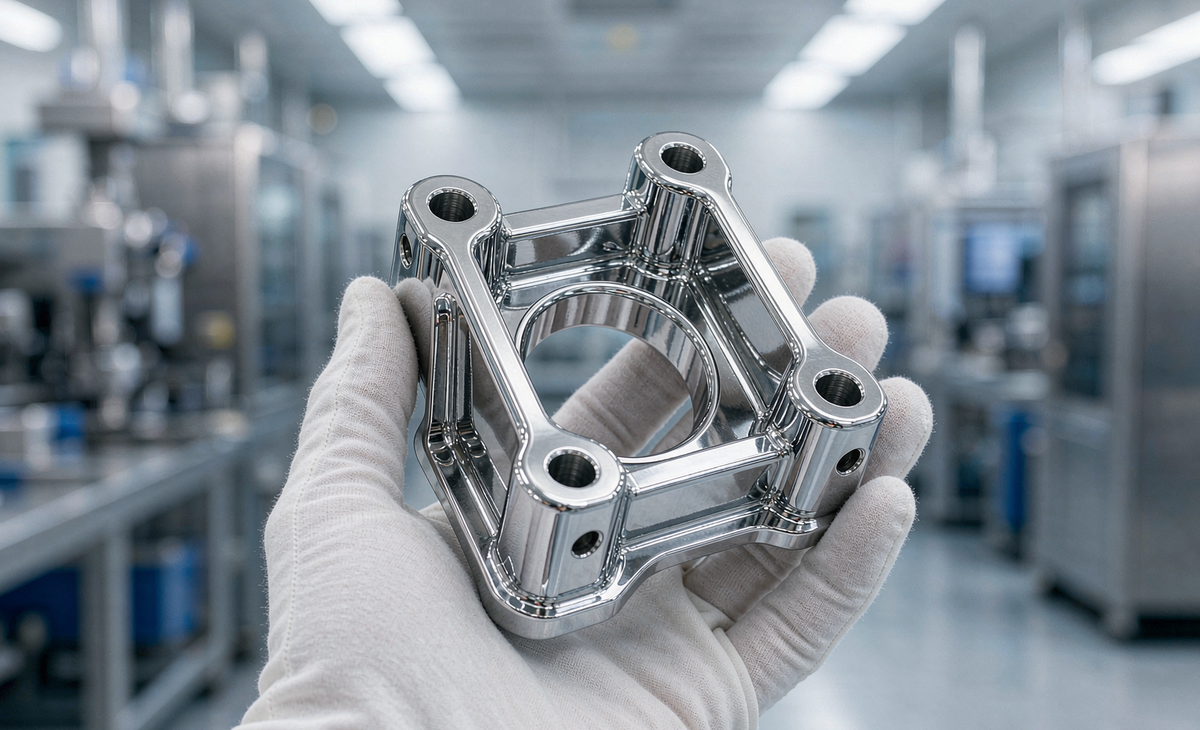
Most zinc projects don't fail at the casting machine. They fail at the plating rack. A part that looked perfect coming out of the die comes back from the plater with blisters along the ejector side, and suddenly a 12-week program is in a re-quote loop. The cause is almost never the finisher. It's a supplier who ran the die wet, vented it badly, or bought recycled ingot with lead in it — and nobody asked.
If you are shortlisting zinc casting suppliers for a thin-wall housing, a connector shell, a lock body, or a decorative component that has to take chrome, the questions below are the ones that separate a real hot-chamber operation from a trading company with a good website.
XY-GLOBAL casts zinc alongside aluminum and magnesium under ISO 9001:2015 and ISO 13485 systems, with integrated CNC post-machining and custom die casting services covering both hot-chamber and cold-chamber work. What follows is the sourcing framework we use with our own customers.
Question: What Are You Actually Buying From a Zinc Caster?
You are buying three things, and only one of them is a part:
- A die — with a specific steel, cavity count, cooling layout, and expected shot life
- A process window — shot profile, die temperature, venting, and a scrap rate the supplier has actually measured
- A finishing chain — trimming, machining, and plating, either under their roof or under their control
A supplier who can only describe the first one is a machine shop with a casting cell. A supplier who can describe all three in numbers is a manufacturing partner.
Why Zinc Is a Different Supply Base, Not a Cheaper Aluminum
Buyers often treat zinc as "aluminum for small parts." That assumption is where the trouble starts, because the two metals reward completely different process choices.
| Property | Zinc (Zamak 3) | Aluminum (A380) | What It Changes for You |
|---|---|---|---|
| Melt / pot temperature | ~385–420 °C | ~650–700 °C | Zinc runs in hot-chamber machines; aluminum cannot |
| Casting shrinkage | ~0.4–0.6% | ~0.6–0.8% | Zinc holds dimensions better across the tool |
| Minimum wall (practical) | 0.6–0.75 mm on small parts | 1.0–1.5 mm | Zinc gets you thinner sections without short shots |
| Typical die life | 500,000–1,000,000+ shots | 100,000–150,000 shots | Zinc tooling amortizes over far more parts |
| As-cast surface | Excellent — platability is its main selling point | Good, but porous skin shows under anodize | Zinc is chosen when the part must be plated |
| Size ceiling | Smaller parts, tighter detail | Large structural housings | Zinc is a detail metal, not a structural one |
The practical takeaway: zinc wins on detail density, thin walls, plating quality, and tool life. It loses on size, weight-sensitivity, and anything that needs to be anodized — zinc cannot be anodized in any useful sense, and a "zinc casting supplier" who offers anodizing on a zinc part has told you something important about how carefully they read your RFQ.

The Alloy Question That Exposes a Weak Supplier
Zinc die casting is a narrow alloy family. If a supplier quotes "zinc alloy" without a grade, the quote is not a quote.
| Grade | Composition Notes | Strength / Behavior | Where It Belongs |
|---|---|---|---|
| Zamak 3 | Zn–4% Al–0.04% Mg, Cu ≤0.25% | ~280–340 MPa; best castability and dimensional stability | Default choice: housings, brackets, general hardware |
| Zamak 5 | Zamak 3 + ~1% Cu | ~330–380 MPa; harder, stronger, slightly less ductile | Load-bearing fittings, lock parts, wear surfaces |
| ZA-8 | Zn–8% Al–1% Cu | ~370–400 MPa; better creep resistance, hot-chamber capable | Bearings, bushings, higher-temperature service |
| Zamak 2 | ~3% Cu | Highest strength, poorest ductility and castability | Rare; only when strength dominates |
Three follow-up questions matter more than the grade itself:
1. "Can you send the ingot certificate and a spectro report?" Recycled zinc carries lead and cadmium. ASTM B240 and EN 1774 cap lead in Zamak at roughly 0.003–0.004% for good reason: lead segregates to grain boundaries, causes intergranular corrosion, and destroys plating adhesion. A supplier who buys ingot from a certified smelter has paperwork. One who melts scrap does not.
2. "What's your cadmium and lead number, and does it meet RoHS/REACH?" If the part is going into consumer electronics or anything sold in the EU, this is not a formality — it is a shipment hold waiting to happen.
3. "What happens to your runners and overflows?" In-house remelt is normal and fine, but the ratio of virgin-to-remelt should be controlled, and the melt should be fluxed and sampled. Ask how often the pot is analyzed.
XY-GLOBAL casts Zamak 3, Zamak 5, and ZA-8, and lists verified grades on its materials page so you can match the alloy to the load case before tooling starts.
The Machine Test: Why Hot Chamber Is the Default for Zinc
In a hot-chamber machine, the injection system sits inside the molten metal pot. The gooseneck fills on each cycle and injects directly. That architecture is only possible because zinc melts at a temperature that does not destroy the injection components — and it produces three concrete advantages:
- Faster cycles — seconds, not minutes, which is why zinc unit cost stays low at volume
- Less oxide and dross — metal never travels through open air, so the shot is cleaner
- Better thin-wall fill — the melt stays at temperature right up to the gate
Cold-chamber machines feed a measured ladle of metal into a separate shot sleeve. They are the correct choice for high-aluminum zinc grades like ZA-12 and ZA-27 (the aluminum attacks hot-chamber hardware) and for the largest parts.
The red flag: a supplier who quotes Zamak 3 to be run on a cold-chamber machine. Either they do not have hot-chamber capacity and are hiding it, or they are brokering the job. Ask any three zinc casting suppliers for their machine list with tonnage, chamber type, and shot weight — two will send a PDF, and one will send a paragraph about "partnership."

What Tolerances Zinc Actually Holds
The most common fiction in zinc quotes is "±0.01 mm as cast." That number exists on zinc parts, but it belongs to machined features, not to the casting.
| Feature Type | Realistic Zinc Capability | Notes |
|---|---|---|
| As-cast dimension, < 25 mm | ±0.05 mm | Standard high-pressure die casting |
| As-cast dimension, 25–100 mm | ±0.08 mm | Add per additional 25 mm of length |
| As-cast dimension, 100–250 mm | ±0.13 mm | Confirm against NADCA product standards |
| Machined bores, seats, datums | ±0.01–0.025 mm | Requires casting + CNC in one supply chain |
| Draft angle, outside walls | 0.5–1° minimum | Zinc needs less draft than aluminum |
| Draft angle, inside cores | 1–2° | More if the surface is textured |
| Parting-line mismatch | 0.05–0.10 mm typical | Set the cosmetic spec before tooling |
| Flatness on a 100 mm face | 0.05–0.15 mm | Distortion shows up after ejection, not before |
Two sourcing implications follow. First, never specify a casting tolerance on a feature that will be machined anyway — you pay for the tightness twice. Second, if your drawing has a sealing face or a bearing bore, the drawing must say "as-cast" or "machined," feature by feature. Suppliers quote what the drawing says, not what you meant.
Get the finish callouts right at the same time; the difference between Ra 1.6 and Ra 0.8 changes both the process and the price. There is a usable reference in this surface finish callout guide.
Die Life Is Where the Money Is
A zinc die is not a fixed cost — it is a rate. Over a million shots, a die that lasts 300,000 cycles and one that lasts 900,000 produce wildly different unit economics, and the difference is decided before the first cut.
What actually buys die life in zinc:
- Hot-work die steel with proper heat treatment — H13 or equivalent, hardened and tempered to the right window, not to the cheapest window
- Nitriding or similar surface treatment on the cavity and core
- Cooling layout matched to the part — zinc's low melt temperature is an advantage only if heat leaves the die evenly
- Venting sized for the shot, not copied from the last job
- A maintenance schedule with records — polishing intervals, insert replacement, flash growth tracking
Ask this before you sign: "Who owns the die, what steel is it, how many shots do you expect, and what is the maintenance interval?" Then ask for the tool-transfer clause in writing. A supplier who will not let you move your own tool has effectively made the die a subscription.
For a deeper look at how tool design decisions drive life and part quality, see this guide to die casting mold design for longer tool life.

Plating: The Failure Mode Nobody Audits
Zinc's commercial reason to exist is that it takes a mirror chrome or nickel finish better than any other die-cast metal. It is also the reason zinc parts fail in the field.
The mechanism is simple. Subsurface porosity traps gas and plating solution. During plating, and especially during any downstream heat exposure, that gas expands and lifts the deposit. You see a blister. The customer sees a cosmetic reject — or worse, corrosion starting under a lifted layer.
The supplier-side controls that prevent it:
| Control | What It Looks Like in Practice |
|---|---|
| Die and gate design | Air is led to overflows, not trapped in the last-filled corner |
| Vacuum-assisted casting | Reduced gas entrapment when the part has deep ribs or bosses |
| Process discipline | Shot profile, die temperature, and spray pattern held in a window, not "adjusted by feel" |
| Porosity inspection | X-ray or sectioning on first articles and on any geometry change |
| Plating prep | Cleaning and activation per ASTM B252, not a generic dip line |
| Blister test | Heat the plated part (commonly ~200 °C for about an hour) and inspect — cheap, brutal, effective |
Ask whether plating is in-house or subcontracted, and who owns the reject if blisters appear. If the answer is "the plater," you have just found the gap in the chain where your schedule will go to die. The same defect classes show up across alloys; this catalogue of common die cast defects and their causes is a useful checklist to walk a sample part against.
Why Two Zinc Casting Suppliers Quote the Same Part 40% Apart
Neither quote is necessarily wrong. They are usually priced on different assumptions:
| Cost Element | What Varies | Question That Normalizes It |
|---|---|---|
| Metal | Alloy grade, virgin vs remelt ratio, runner recovery credit | "What ingot price basis, and what credit for returned runners?" |
| Tooling | Cavity count, steel grade, slides, expected life, amortization | "Is tooling one-time or amortized into piece price? Over what volume?" |
| Machine time | Tonnage class, cycle time, shifts, utilization | "What cycle time and what machine is this quoted on?" |
| Trimming | In-die trim vs trim press vs hand deflashing | "Is deflashing included or a separate line item?" |
| Secondary machining | Fixtures, datums, in-house vs outsourced | "Which features are machined, and on what fixture?" |
| Finishing | Plating stack (Cu/Ni/Cr), thickness, masking | "What plating thickness and which spec?" |
| Inspection | AQL sampling vs 100% CMM, documentation level | "What's the inspection plan and what reports ship with the lot?" |
| Volume assumption | Annual qty, lot size, EOQ | "What annual volume did you assume?" |
The single most useful habit in this comparison: send every supplier the same RFQ, including annual volume, target lot size, and the drawing's cosmetic section. Quotes built on different volume assumptions cannot be compared, and the cheapest one is usually the one that assumed the most generous volume.
A 12-Point Audit Script
Use these on a call or a plant visit. Most zinc casting suppliers answer the first three well and get vague around seven and nine, which is exactly where your project risk lives.
| # | Question | Answer That Should Worry You |
|---|---|---|
| 1 | Which zinc grades do you cast, and on which machines? | "Whatever you need" — no grade or machine specifics |
| 2 | Hot-chamber tonnage range and shot weight? | Numbers that don't cover your part's projected area |
| 3 | Can you send ingot certs and a spectro report? | "Not usually, but our metal is good" |
| 4 | Who designs the die, in-house or outsourced? | Fully outsourced tooling with no DFM review |
| 5 | What die steel, and what expected shot life? | "Standard steel, lasts forever" |
| 6 | Who owns the tool, and can it be transferred? | Ownership or transfer refused |
| 7 | Is CNC post-machining in-house? | Casting and machining across three vendors you must coordinate |
| 8 | How do you control porosity on sealing or cosmetic faces? | No vacuum, no X-ray, no first-article sectioning |
| 9 | Is plating in-house, and what's the blister test? | "Our plater handles it" with no test defined |
| 10 | What's your measured scrap rate on comparable parts? | No number at all |
| 11 | What inspection reports ship with each lot? | "We check as we go" |
| 12 | What's the tool trial and first-article process? | No PPAP/first-article step before volume |
For the general version of this evaluation — useful when you are buying aluminum and zinc from the same supplier base — this guide to choosing a precision manufacturing supplier walks the same ground at a higher level, and this broader look at die casting manufacturers for aluminum and zinc parts covers DFM and tooling basics.
What to Put in a Zinc Casting RFQ
- 3D CAD (STEP) plus 2D drawing with datums, tolerances, and GD&T
- Alloy grade, and whether remelt is permitted
- Critical features marked as-cast or machined — feature by feature
- Cosmetic spec: visible surfaces, parting-line allowance, ejector-mark allowance
- Porosity acceptance: where it is allowed, where it is not, and the test method
- Plating or coating spec with thickness and masking
- Annual volume, first-order quantity, and target lot size
- Inspection level and the documents that must ship (dimensional report, material cert, CMM)
- Target PPAP or first-article requirement
- Compliance: RoHS / REACH declarations required or not
If you cannot answer two or three of these, that is a normal starting point — a competent caster will run a DFM review, flag the risk, and quote against assumptions you can both see. XY-GLOBAL's engineering and DFM support exists for exactly this stage.
XY-GLOBAL as a Zinc Casting Supplier
| Capability | XY-GLOBAL |
|---|---|
| Zinc grades | Zamak 3, Zamak 5, ZA-8 |
| Process | Hot-chamber and cold-chamber die casting |
| Machine range | Up to 2,000 T cold chamber |
| Part size / weight | Up to 900 × 900 mm flat parts; under 10 kg |
| Minimum wall | 1.0 mm (geometry and flow dependent) |
| Tolerance | ±0.01 mm on machined features |
| Tooling | In-house design and fabrication, mold-flow simulation before steel is cut |
| Post-processing | CNC machining, trimming, deburring, plating coordination, anodizing, powder coating |
| Quality | ISO 9001:2015, ISO 13485:2016; CMM dimensional reports; X-ray on critical parts |
| Volume | No MOQ — prototype through production |
| Lead time | Samples in as little as 7 days, depending on complexity |
| Bases | Shenzhen, China + Malaysia |
The part that matters most for zinc: casting, machining, and finishing sit in one quality system, so a blister or a shifted datum is our problem to solve — not a dispute to referee between three suppliers. Inspection is documented with CMM reports rather than assurances.
If your project sits at low volume and you are still deciding whether tooling makes sense yet, this comparison of investment casting vs die casting will tell you honestly when a zinc die is premature.
FAQ: Zinc Casting Suppliers
Q: How do I find reliable zinc casting suppliers? Start with capability fit, not price. Confirm they run hot-chamber machines for the alloys you need, cast parts in your size and wall-thickness range, own their tooling design, machine critical features in-house, and can show a measured scrap rate plus first-article reports on a comparable part. Then compare quotes built on identical volume assumptions.
Q: What is the difference between zinc die casting and zinc casting generally? In commercial practice, "zinc casting" almost always means high-pressure zinc die casting with Zamak or ZA alloys. If a supplier offers zinc sand casting or zinc investment casting for the same part, they are either describing a prototype route or brokering the work — zinc's economics come from steel dies and fast cycles.
Q: What tolerance can zinc die casting hold without machining? Typically ±0.05 mm on dimensions under 25 mm, widening to roughly ±0.08 mm at 100 mm and ±0.13 mm at 250 mm. Tighter than that requires machining after casting, which is why the specification should separate as-cast from machined features.
Q: Why do plated zinc parts blister? Subsurface porosity traps gas and plating chemistry, which expands during plating or later heat exposure and lifts the deposit. It is controlled at the die (venting, overflow, gate design), at the machine (vacuum assist, stable shot profile), and at plating prep. A heat test on plated samples catches it before volume.
Q: How long does a zinc die last? Commonly 500,000 to 1,000,000+ shots — far longer than an aluminum die, because the lower melt temperature causes less thermal fatigue. Actual life depends on die steel, heat treatment, cooling design, maintenance discipline, and how abrasive the alloy and tolerances are.
Q: Is there a minimum order quantity for zinc castings? Not at XY-GLOBAL. Tooling is the real threshold, not piece count. Below a few thousand parts, the die amortization dominates unit cost, and a machined or investment-cast prototype route is often cheaper to validate the design first.
Q: Can one supplier handle casting, machining, and plating? The good ones coordinate all three under one quality system even when plating is subcontracted. What you want is single-point accountability: one supplier who owns the dimensional result and the cosmetic result, with documented inspection between stages.
Get a Zinc Casting Quote With the Assumptions Showing
Send a STEP file and a 2D drawing with your annual volume and cosmetic requirements. Our engineers will run a mold-flow and DFM review, tell you which features should be cast and which should be machined, and quote the tool with its expected life stated up front. If you are already comparing zinc casting suppliers, send us the same RFQ you sent them — the answers will line up line by line.
📧 market@xy-global.com | 🌐 www.xy-global.com
A zinc part is judged twice — once when it comes out of the die, and once when it comes back from the plater. We build for both.

分享:
Rapid Technical Ceramic Prototyping: CNC Machining, 3D Printing, and CIM Tooling Compared