


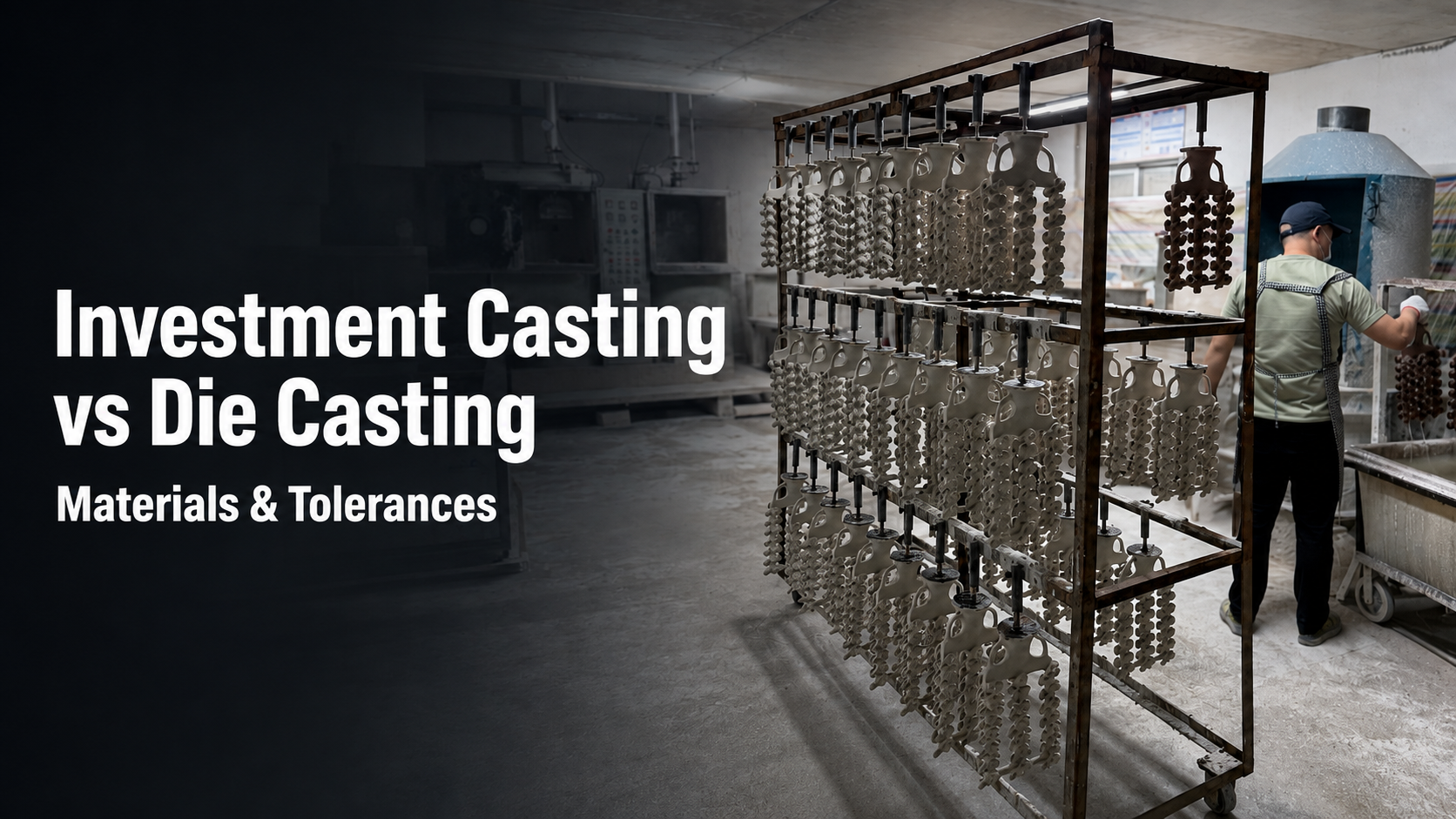
Investment casting and die casting are both used to produce complex, near-net-shape metal parts directly from a mold, but they solve different problems, and the difference isn't just a matter of preference — it's rooted in what each tool is physically capable of surviving. Choosing the wrong one for a given part usually shows up as a cost or lead-time surprise later: a die-cast tool ordered for a part that only needed 500 pieces, or a stainless steel part specified for die casting when the process can't cast that material at all.
The two processes differ in almost every practical dimension that matters for sourcing a part: which materials they can cast, what tolerances and surface finish they achieve as-cast, minimum wall thickness by material, how much tooling costs upfront, and at what production volume each becomes economical.
This article compares how investment casting and die casting work, explains the metallurgical reason die casting can't cast steel, and covers wall thickness, tooling cost, surface treatment compatibility, and common process selection mistakes to help you choose the right one.

What Is Investment Casting?
Investment casting, also called lost-wax casting, starts with a wax pattern of the part, made by injecting wax into a metal mold. The wax pattern is coated in ceramic shell, the wax is melted out, and the resulting hollow ceramic mold is filled with molten metal. Because a new ceramic shell is built for each casting cycle or batch, investment casting can produce complex geometries and cast high-melting-point alloys that would destroy die casting tooling.
What Is Die Casting?
Die casting injects molten metal under high pressure into a reusable steel mold (die), machined to the part's net shape and designed to survive tens of thousands of injection cycles. That reusability is die casting's main economic advantage — and also the source of its material limitation.
Why Die Casting Can't Cast Steel: The Metallurgical Reason
Die casting dies are typically machined from H13 tool steel, heat-treated and tempered to a working hardness around HRC 40–48. That tempering process is done at roughly 590–620°C (1100–1150°F) — and tool steel begins losing strength once it's exposed to temperatures approaching that same range in service.
Aluminum pours at roughly 660–750°C, close enough to the die's tempering temperature that a well-designed cooling cycle keeps the die within its working life. Steel and copper alloys, by contrast, pour at 1200–1600°C — far beyond what a tempered H13 die can survive without rapidly losing hardness and failing. This is the actual reason die casting is restricted to aluminum, zinc, and magnesium: it isn't a design convention, it's a hard limit set by what the tooling material itself can survive.

Tolerance and Surface Finish Compared
| Factor | Investment Casting | Die Casting |
|---|---|---|
| Typical tolerance | Approximately ±0.1–0.25 mm | Approximately ±0.05 mm at 25 mm, increasing with part size |
| As-cast surface finish | Typically Ra 3.2 μm or better | Good, but often requires additional machining for critical surfaces |
Minimum Wall Thickness by Material
| Process / Material | Typical Minimum Wall Thickness |
|---|---|
| Investment casting — general economic minimum | Approximately 0.75–1.5 mm |
| Investment casting — carbon and alloy steel | Approximately 2.5 mm minimum, 3.5–5 mm preferred |
| Die casting — aluminum/zinc/magnesium | Thin walls achievable, limited by fill dynamics of the specific alloy and part geometry |
The wall thickness gap between general investment casting guidance and steel-specific guidance is easy to miss on a drawing review — a part designed against generic investment casting rules of thumb can be significantly under-thickness once the material is locked in as steel.
Surface Treatment Compatibility
Post-casting surface treatment options track the material split between the two processes rather than the process itself. Aluminum die castings are compatible with anodizing for corrosion resistance and cosmetic finish, which isn't an option for steel or copper-based investment castings. Stainless steel investment castings are typically passivated rather than anodized, while carbon steel castings may require plating or coating for corrosion protection. Choosing a casting process without checking downstream surface treatment compatibility is a common source of late-stage design changes.

Tooling Cost, Cycle Time and Production Volume
Die casting dies are precision-machined, heat-treated steel tools designed to survive tens of thousands of cycles, which typically makes them 5–10 times more expensive than investment casting tooling. Investment casting tooling costs less upfront since the ceramic shell process doesn't require a hardened die, but each part's shell is effectively single-use, which affects per-part cost at high volume differently than die casting's reusable tool.
Well-designed investment casting shell clusters can achieve yield rates above 80%, but cycle times are generally longer than die casting's high-pressure injection cycle, since shell building, dewaxing, and firing all add time before metal is ever poured. This cost and cycle-time structure is what drives the volume threshold: investment casting is generally more cost-effective below roughly 10,000 pieces, while die casting's higher tooling investment is offset by lower per-part cost and faster cycle time once volume exceeds that range.
Common Process Selection Mistakes
A few patterns show up repeatedly when parts are specified for the wrong process:
Locking in a material before confirming the process. Specifying "cast stainless steel" without checking that this rules out die casting entirely, rather than starting from volume and tolerance requirements and letting material follow from there.
Applying generic wall thickness rules to steel parts. Using general investment casting minimums (0.75–1.5 mm) instead of the steel-specific minimum (2.5 mm+), which can result in a design that isn't castable as drawn.
Ordering die casting tooling before volume is confirmed. Committing to a 5–10x more expensive die before production volume clearly justifies it over investment casting's lower tooling cost.
Overlooking surface treatment requirements until late in the project. Discovering after tooling that the specified corrosion protection isn't compatible with the chosen casting material.

Which Should You Choose?
| Choose Investment Casting When | Choose Die Casting When |
|---|---|
| The part must be cast in steel, stainless steel, or another high-melting-point alloy | The part material is aluminum, zinc, or magnesium |
| Production volume is below approximately 10,000 pieces | Production volume exceeds approximately 10,000 pieces |
| Tight as-cast surface finish is critical and post-machining should be minimized | Lower per-part cost and faster cycle time at volume outweigh higher tooling investment |
XY-Global's Casting Capability: Die Casting and Investment Casting
At XY-Global, we offer both high-pressure die casting and investment casting, so the choice between processes can be based on your part's material, volume, and tolerance requirements rather than which process happens to be available to your supplier. Our die casting capability covers aluminum, zinc, and magnesium alloys for higher-volume non-ferrous parts, while our investment casting capability supports carbon and stainless steel, copper alloys, and other high-melting-point materials, with typical as-cast tolerances in the ±0.1–0.25 mm range.
For small, complex parts in stainless steel or similar alloys at moderate volume, metal injection molding (MIM) is also worth evaluating alongside investment casting, depending on part size and geometry. Our engineering team can review your material, volume, tolerance, and surface treatment requirements and recommend which process — die casting, investment casting, or MIM — fits your part best before tooling begins.
FAQ
Can die casting be used for steel or stainless steel parts?
No. Die casting dies are made from tempered tool steel that loses strength at the pouring temperatures steel and stainless steel require, so the die would fail rapidly rather than survive a production run.
Is investment casting always more expensive than die casting?
Not necessarily. Investment casting tooling costs less upfront than a die casting die, so at lower production volumes, investment casting is often the more cost-effective choice overall, even though its per-part cost at high volume is typically higher than die casting.
What's the minimum wall thickness for a steel investment casting?
Roughly 2.5 mm minimum, with 3.5–5 mm preferred for reliable filling and structural integrity, which is noticeably thicker than the general investment casting guideline of 0.75–1.5 mm used for other materials.
What information helps determine which process fits my part?
Material requirement, annual volume, critical tolerances, wall thickness, and surface treatment needs are the key inputs. A 2D or 3D drawing with these details allows an accurate recommendation between investment casting, die casting, or alternative processes like MIM.

Share:
Custom Brass CNC Machining Services | Precision Brass Parts
Precision Machined Metal Components: A Complete Manufacturing Guide