


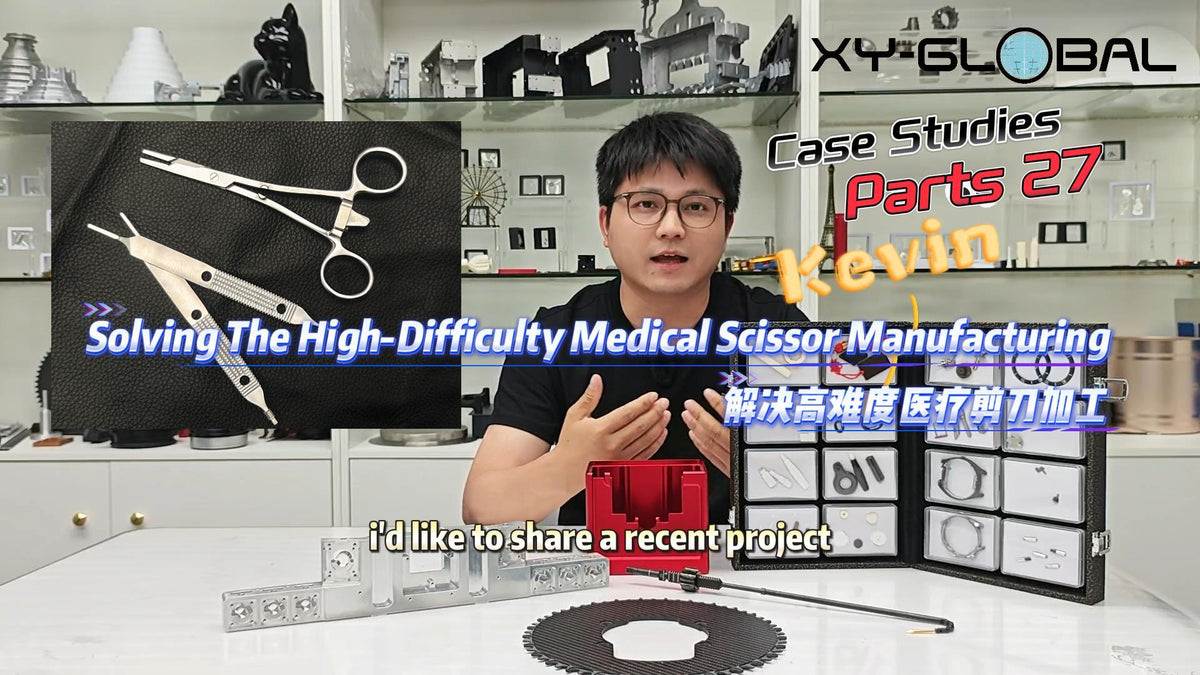
Project Overview
Our client, a medical instrument manufacturer, came to us with a unique scissor design. The shape and geometry posed significant challenges for precision machining and consistent assembly. The instruments also needed to meet strict requirements for sterilization and durability.
Manufacturing Challenges
During initial production, we encountered difficulties with geometry and assembly fit. Maintaining tight tolerances was critical to ensure both functional performance and repeatable quality.
Key challenges included:
- Achieving consistent dimensional accuracy across multiple parts
- Ensuring assembly fit for complex scissor geometry
- Maintaining surface quality compatible with sterilization requirements

Our Approach
Instead of rushing the process, our engineering team collaborated closely with the client to review the design. We optimized the machining process and tooling to overcome the issues. The steps included:
- Analyzing tolerance stack-up and critical dimensions
- Adjusting tool paths and machining sequences
- Iterating prototypes to validate assembly fit and function
Results
After several rounds of optimization:
- Dimensional accuracy was stabilized within required tolerances
- Assembly fit was consistent across multiple sets
- Functional performance met sterilization and durability standards
This project highlights our ability to solve complex precision machining challenges, not just produce parts.

Why It Matters
Precision in medical instrument manufacturing is crucial. Small deviations in geometry or assembly can impact usability, reliability, and safety. By integrating design review, process optimization, and quality control, we ensure the final product performs reliably in real-world use.


分享:
Case Study 26 : Custom Sealing Solution for Australia’s Oil Industry
STEP File Repair in Rhino and SolidWorks