


CNC machining removes material with a rotating cutting tool, which means it has physical limits: a tool can only cut what its geometry and rigidity allow. Hardened tool steel, sharp internal corners, and ultra-narrow slots often fall outside what a cutting tool can reach or survive without excessive wear.
Wire EDM removes material differently — through controlled electrical discharges rather than physical cutting force — which makes it possible to machine features and materials that would otherwise require expensive tooling, multiple setups, or wouldn't be achievable by CNC milling at all.
This article explains how wire EDM works, what tolerances and surface finishes it can achieve, which materials and features it suits best, and when it's the right process for a part that CNC machining alone can't complete.

What Is Wire EDM and Why Use It Instead of CNC?
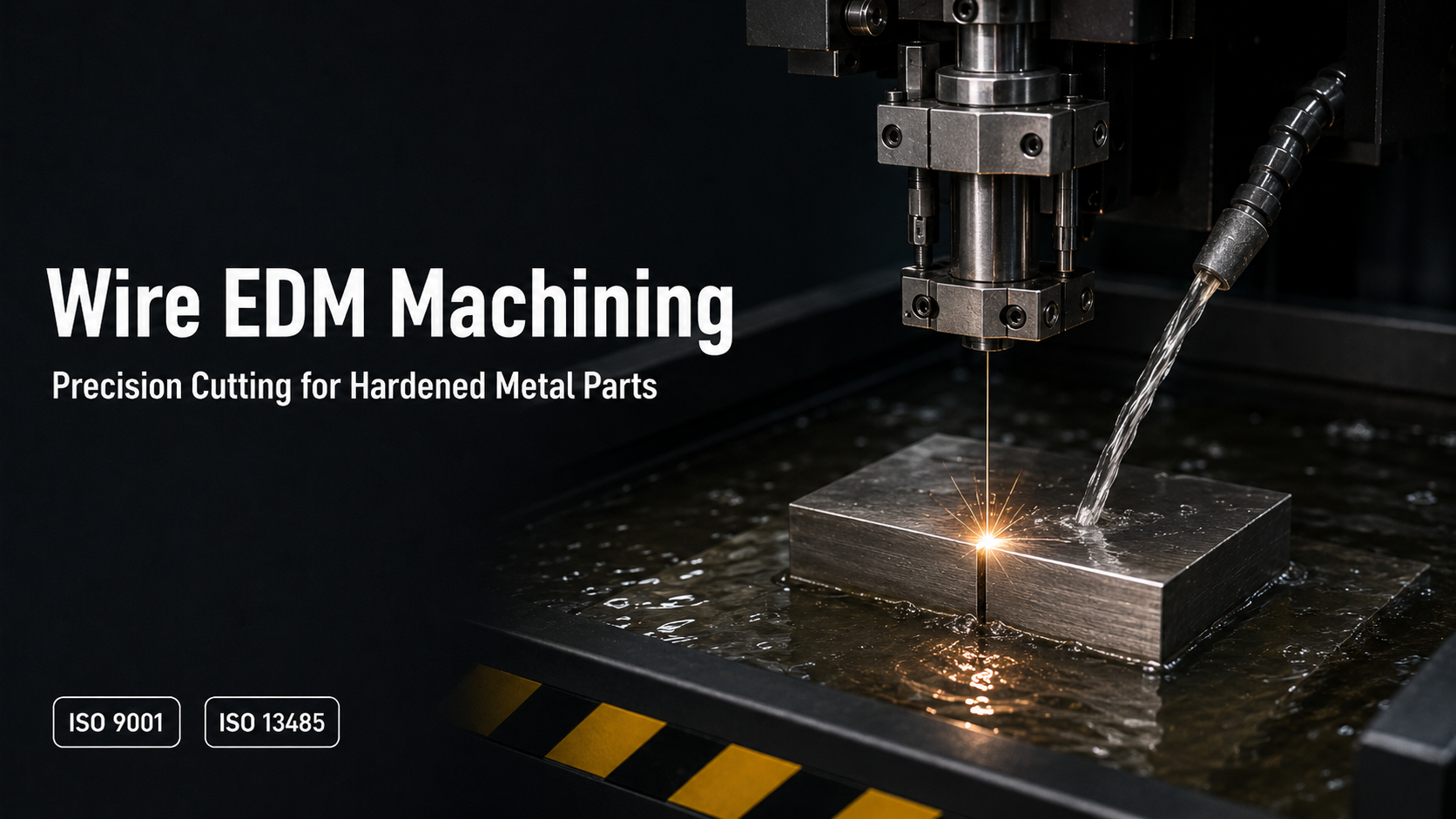
Wire EDM is a non-contact machining process. Instead of a cutting tool physically removing material, a thin, continuously fed metal wire acts as the electrode, and a series of controlled electrical discharges erode material from the workpiece as the wire travels along a programmed path. Because there is no cutting force involved, wire EDM can machine hardened materials that would be difficult or impossible to cut conventionally, and it can produce sharp internal corners and fine features that a rotating tool's radius simply cannot reach.
Wire EDM is typically used as a complementary process to CNC machining, not a replacement for it. Most parts are still roughed out or largely shaped by CNC, with wire EDM brought in for the specific through-features CNC can't finish.
How Wire EDM Works
The wire travels through the workpiece along a programmed path, eroding a narrow slot as it goes, similar in concept to a bandsaw but with no physical contact between the wire and the part. The workpiece is submerged in or flushed with a dielectric fluid, which helps control the discharge and flush away eroded material. Multiple passes along the same path — a rough cut followed by one or more finishing passes — are commonly used to improve dimensional accuracy and surface finish on critical features.
Because the wire is continuously fed from a spool, there is no electrode wear to compensate for during the cut, which keeps dimensional accuracy consistent across long or complex profiles.

Wire EDM Tolerances and Surface Finish
| Factor | Typical Capability |
|---|---|
| Achievable tolerance | Down to approximately ±0.005 mm |
| Surface finish | Smooth as-cut finish, further improved with additional finishing passes |
| Best-suited geometry | Through-holes, complex 2D profiles, narrow slots and small internal corners |
| Best-suited thickness | Thin to moderate section thickness |
Materials Suited for Wire EDM
Wire EDM works on any electrically conductive material regardless of hardness, which is its core advantage over cutting-based machining. Common materials include hardened tool steel, stainless steel, titanium, tungsten carbide, and other hard-to-cut alloys that would rapidly wear conventional cutting tools or require annealing before and hardening after CNC machining.

Typical Applications of Wire EDM
Wire EDM is used wherever CNC machining reaches a geometric or material limit: sharp internal corners on precision components, narrow slots and small holes with high aspect ratios, hardened tool steel components machined after heat treatment, and complex 2D profiles in mold and die components, precision instruments, and tooling where tight tolerances and fine features are required together.
We Also Offer Sinker EDM
For features wire EDM can't reach — blind cavities, 3D mold cores, and deep pockets — we also produce parts using sinker EDM, which presses a shaped graphite or copper electrode into the workpiece to erode a mirror-image cavity. If your part includes both through-features and blind cavities, both processes can be planned together as part of the same production sequence.
Quality Control and Inspection
Wire EDM'd features are inspected using the same dimensional standards applied to CNC machined parts. Critical dimensions, corner radii, and slot widths are verified by CMM, and surface finish is checked against drawing requirements, since as-cut surfaces can vary depending on the discharge parameters used and may need additional finishing passes for some applications.

XY-Global's EDM Capability
At XY-Global, wire EDM is available in-house alongside our CNC machining capability, so parts that combine both CNC-machined features and wire EDM-specific geometry — hardened components, sharp internal corners, narrow slots — can be produced under one production plan rather than shipped between separate subcontractors. This follows the same precision machining standards we apply across our CNC processes, backed by ISO 9001 and ISO 13485 certification.
If a feature on your drawing looks difficult to reach with a standard cutting tool — a sharp internal corner, a narrow slot, or a cavity in hardened steel — it's worth asking whether wire EDM is the right process before redesigning the part around CNC limitations. Our engineering team can review your drawing and recommend whether wire EDM, sinker EDM, or standard CNC machining fits each feature.
FAQ
Is wire EDM more expensive than CNC machining?
Generally yes, on a per-feature basis, since wire EDM is typically slower than CNC cutting. It's usually applied selectively to the specific features CNC can't produce, rather than used to machine an entire part.
Can wire EDM cut any metal?
Wire EDM works on any electrically conductive material, so it can machine hardened steel, titanium, and carbide, but it cannot be used on non-conductive materials like most plastics or ceramics.
Does wire EDM leave a different surface finish than CNC machining?
Yes. Wire EDM produces a distinct recast layer and surface texture different from a cut surface, which is sometimes addressed with additional finishing passes depending on the application's surface finish requirements.
What information is needed to quote a wire EDM feature?
A 2D drawing with the specific feature dimensions and tolerances, material and hardness, and material thickness are the key details needed to quote a wire EDM feature.

分享:
Brazed vs Friction Stir Welded Cold Plate: Which Sealing Method to Choose
CNC Aluminium Extrusion Guide For Custom Industrial Parts