


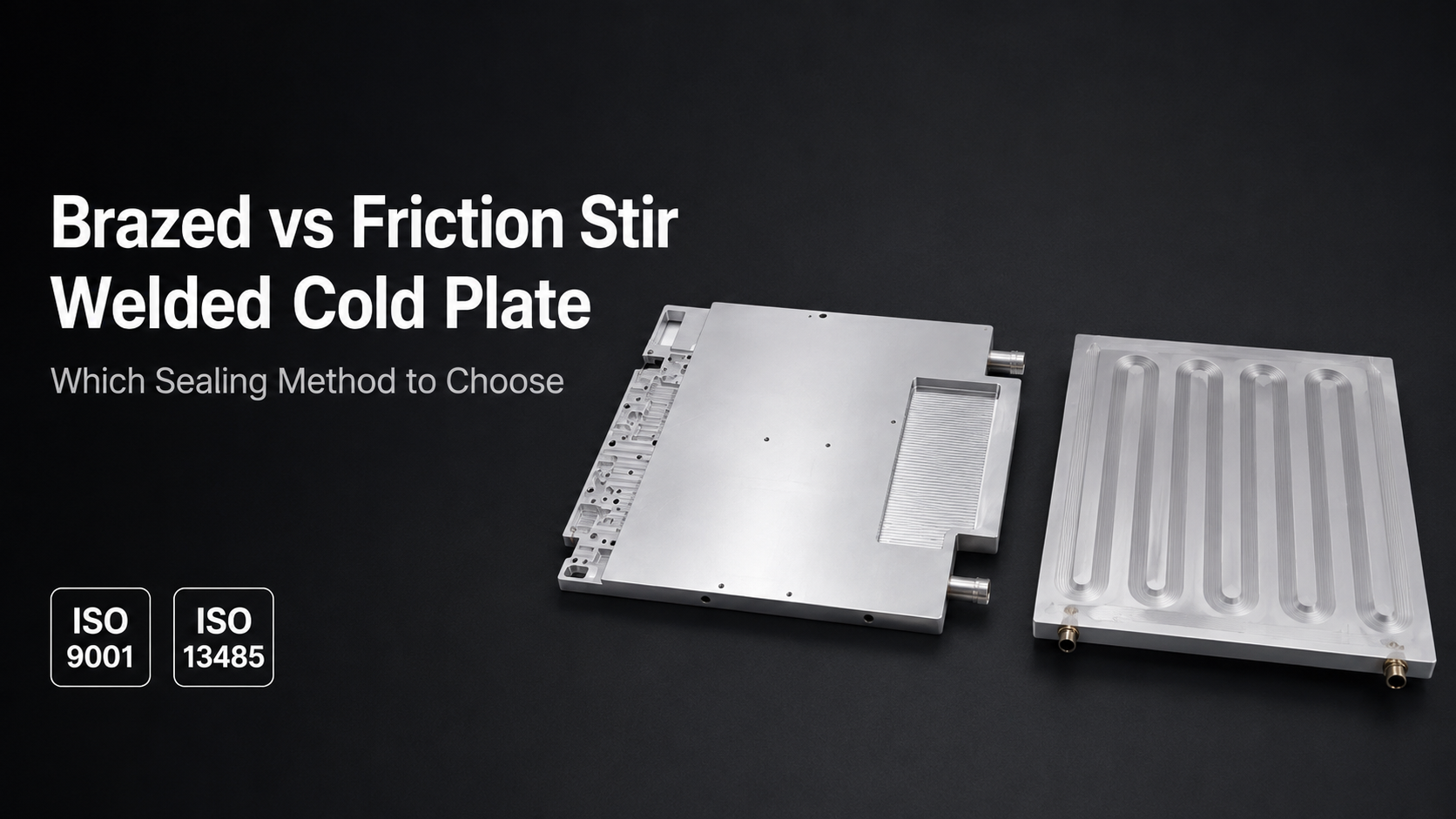
A liquid cold plate's cooling performance depends on its internal channel design, but its long-term reliability depends just as much on how the channel structure is sealed. Once a cover plate is joined to the base — whether by brazing or friction stir welding — that seam becomes the weak point the whole assembly is tested against: burst pressure, leak rate, and years of thermal cycling in service.
As cold plates move into higher-power applications — AI server direct-to-chip cooling, EV battery packs, and high-power industrial electronics — the cost of a joint failure has gone up. A leaking cold plate in a data center rack or a battery pack is not a minor defect; it is a system-level failure. That has pushed brazing and friction stir welding into direct comparison as manufacturers decide which sealing method fits a given design.
This article compares how brazed and friction stir welded (FSW) cold plates are made, how each performs under burst pressure and long-term thermal cycling, what channel geometries and sizes each method supports, and which applications tend to favor one method over the other.

What Brazed and FSW Cold Plates Have in Common
Both methods start from the same basic structure: cooling channels are machined or formed into a base plate, and a cover plate is joined over them to create a sealed, closed-loop flow path. The difference is entirely in how that cover-to-base joint is made and what it can withstand once sealed.
How Each Sealing Method Works
Brazing joins the cover and base plate using a filler metal that melts at a lower temperature than the base material, typically in a vacuum or controlled-atmosphere furnace. The filler flows into the joint gap and solidifies to form the seal. This is a well-established process capable of sealing complex internal fin structures and high-surface-area channel designs in a single furnace cycle.
Friction stir welding joins the cover and base plate in the solid state. A rotating tool traverses the joint line, generating frictional heat that softens the aluminum without melting it, then forges the material together as the tool moves along the seam. No filler metal is used, and the base material never reaches its melting point.
Burst Pressure and Leak-Tightness Compared
| Metric | Friction Stir Welded (FSW) | Brazed |
|---|---|---|
| Typical burst pressure | Around 20 bar | Around 10 bar |
| Joint structure | Solid-state, no filler, no porosity | Filler metal joint, can include micro-voids if furnace cycle is not well controlled |
| Leak-tightness | Helium leak rates below 1×10⁻⁷ mbar·L/s achievable | Leak-tight when properly executed, but more sensitive to furnace process control |
The higher burst pressure and lower porosity of FSW joints come directly from the solid-state nature of the process: without a filler metal or melting step, there is no solidification shrinkage or void formation along the seam.

Long-Term Reliability Under Thermal Cycling and Vibration
Cold plates in service are rarely subjected to a single pressure test — they see repeated thermal cycling as equipment powers on and off, and in mobile or vehicle applications, ongoing vibration. Brazed joints, because they rely on a filler metal with different mechanical properties than the base plate, are more prone to fatigue cracking over repeated thermal cycles. FSW joints have a continuous, forged grain structure through the weld zone, which generally holds up better under the same cyclic loading.
This is one reason FSW has become the preferred sealing method for high-power AI server cold plates and EV battery cooling plates, where the assembly may run through thousands of thermal cycles over its service life.
Design Flexibility: Channel Geometry and Size
Brazing still holds an advantage for certain designs. Complex internal fin structures and very high surface-area channel geometries — where many thin fins need to be joined across a large internal area — are often easier to produce reliably with a furnace brazing process than with a traversing weld tool.
FSW, on the other hand, is generally better suited to large-format or irregularly shaped cold plates, since the weld is produced by a moving tool rather than a furnace with a fixed chamber size. Machines with a working area of 1500 × 1300 mm or larger can seal large single-piece cold plates without the segmented joints or furnace size limits that brazing can run into.

Which Method Should You Choose?
| Choose Brazing When | Choose FSW When |
|---|---|
| Channel design includes complex, high-density internal fins | The application requires maximum burst pressure and leak reliability |
| Plate size fits within standard furnace dimensions | The plate is large or irregularly shaped |
| Thermal cycling and vibration exposure is limited | The plate will see extended thermal cycling or vibration in service (AI servers, EV battery packs) |
XY-Global's Capability for Both Sealing Methods
At XY-Global, both brazed and friction stir welded liquid cold plates are produced in-house, so the sealing method can be selected based on the application rather than which process a subcontractor happens to offer. Our friction stir welding capability includes a working area up to 1500 × 1300 mm for large or custom-shaped cold plates, with CNC machining accuracy up to 0.005 mm and CMM inspection accuracy up to 0.001 mm.
Every cold plate, regardless of sealing method, undergoes 100% pressure-hold and leak testing before shipment, and our engineering team can review your flow channel design, thermal load, and operating environment to recommend the sealing method suited to your application.
Choosing between brazing and friction stir welding ultimately comes down to how the cold plate will be used: complex fin geometries and moderate operating conditions can favor a well-controlled brazing process, while applications with high burst pressure requirements, large plate sizes, or extended thermal cycling — such as AI server and EV battery cooling — tend to favor friction stir welding.

FAQ
Is friction stir welding always better than brazing for cold plates?
Not always. FSW generally offers higher burst pressure and better long-term fatigue resistance, but brazing can be more practical for complex, high-density fin geometries where a furnace process handles the joint more reliably than a traversing weld tool.
Can a brazed cold plate be retrofitted to FSW?
Not directly. The two processes require different plate designs — FSW requires a joint line a tool can traverse, while brazing can seal more complex internal geometries. Switching methods usually means revisiting the channel design, not just the joining step.
Does FSW cost more than brazing?
It depends on plate size, channel complexity, and volume. Simple, moderate-size plates with complex fin structures can be cost-effective to braze, while large or high-reliability plates often justify FSW despite different tooling and cycle time considerations.
What information is needed to decide between brazing and FSW for a new design?
Operating pressure, expected thermal cycling and vibration exposure, plate size, channel geometry, and material are the key inputs. Our engineering team can review these against your application to recommend a sealing method before production begins.


分享:
CNC Machined Optical Sensor Housing: Design, Materials and Manufacturing
Wire EDM Machining: Precision Cutting for Hardened Metal Parts