Let’s face it. An aluminium extrusion rarely comes off the production line ready for assembly.
The profile may already have the right overall shape, but most industrial parts still need precisely located holes, threads, slots, mounting faces, connector openings or machined ends before they can fit and function as intended. This is where CNC machining becomes essential.
For custom industrial parts, the real question is not whether extrusion or CNC machining is the better process. It is how the two should be combined. Profile design, production volume, tolerances, fixturing and tooling cost all affect the final manufacturing route.
With over 15 years of manufacturing experience, XY-Global supports aluminium extrusion projects from profile review and machining planning through CNC machining, surface finishing and final inspection. Read this article for our hands-on guide to CNC aluminium extrusion, from process planning to design considerations.

Brief Introduction of CNC Aluminium Extrusion
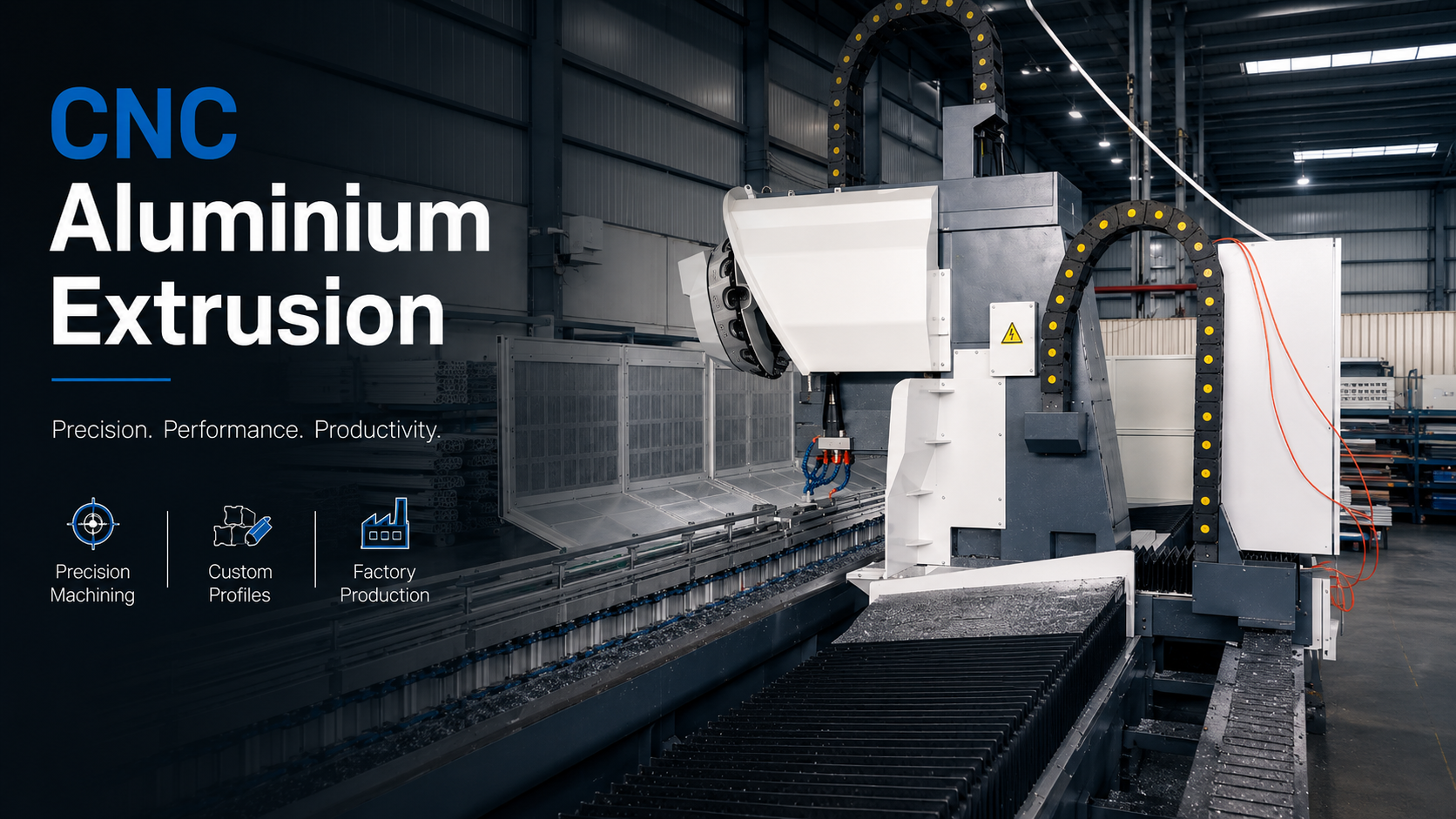
CNC aluminium extrusion normally describes a two-stage manufacturing route.
Extrusion is used for features that continue along the length of the part, such as channels, ribs, hollow sections, mounting grooves and heat-dissipation fins.
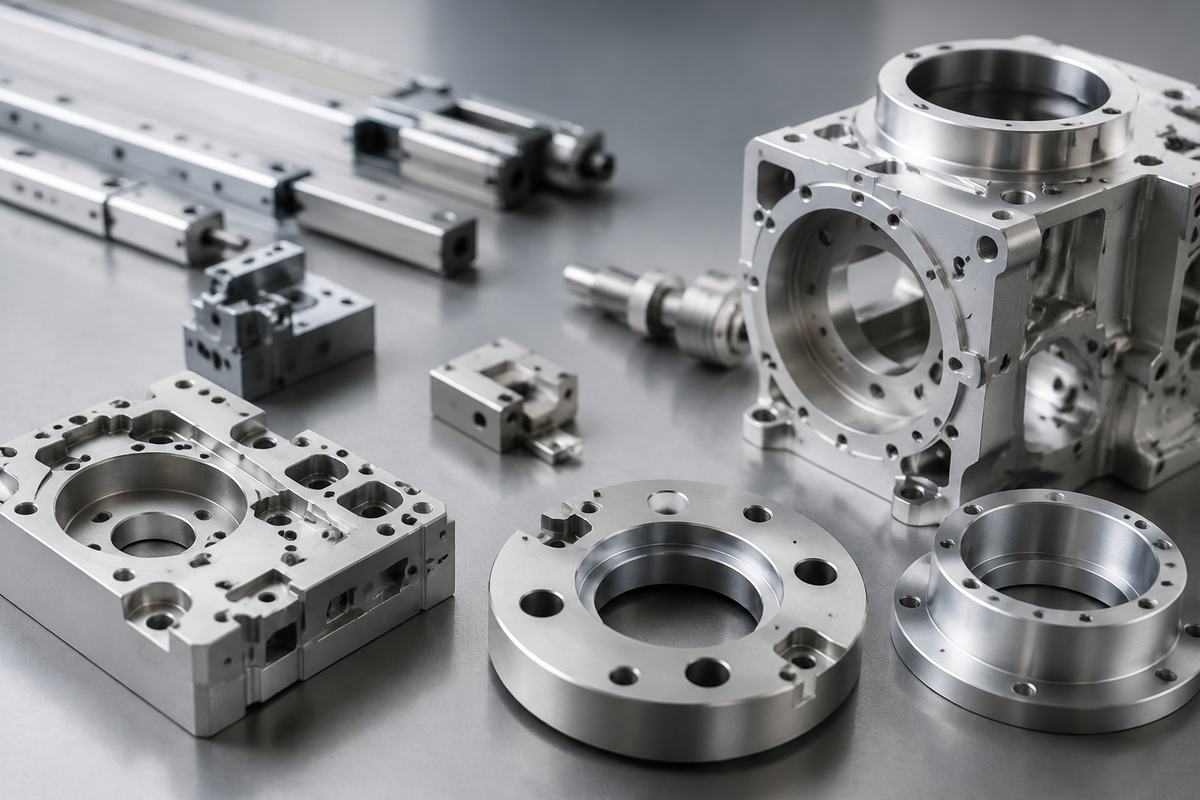
CNC machining is used for local features that cannot be produced by the extrusion die, including drilled and tapped holes, mounting slots, pockets and recesses, counterbores and countersinks, etc.
The two processes perform different jobs. Extrusion forms the basic profile efficiently, while CNC machining controls the details that affect assembly, alignment and function.
Why Combine Aluminium Extrusion With CNC Machining?
Reduced Material Removal
A custom extrusion can place material close to where it is needed in the finished part. CNC machining is then limited to the holes, surfaces and openings that require tighter control.
For example, a hollow housing produced from billet may require a large internal cavity to be milled out. An extruded hollow profile already contains that cavity, leaving only the ends, mounting holes and connector openings to be machined.
Shorter Machining Cycles
Less material removal normally means fewer machining passes and less tool engagement.
The saving is often more noticeable on long parts or profiles with complex internal sections. CNC machining still adds cost, but it is used only where it adds functional value.
Consistent Main Geometry
Once the extrusion process is stable, the same cross-section can be produced continuously. The profiles can then be cut into different lengths or machined into several part versions.
A single profile may support a product family with different hole patterns, end features or overall lengths.
More Options For Functional Design
Extrusion can incorporate features that would be costly to produce by machining alone, such as:
CNC machining then adds the features that require accurate location or do not continue along the full length of the part.
CNC Aluminium Extrusion Manufacturing Process
The exact manufacturing route depends on the profile, alloy, tolerances and surface finish. A typical project follows the steps below.
1. Profile Review And Die Design
The first stage is to review the proposed cross-section.
The supplier must consider wall thickness, hollow sections, ribs, screw ports, cosmetic surfaces and the size of the profile. The areas that will later be machined also need to be identified.
This stage should not focus only on whether the profile can be extruded. It should also consider how it will be held, machined and inspected. A profile that is easy to extrude may still be difficult to locate in a CNC fixture.
2. Extrusion And Heat Treatment
Aluminium billet is heated and pushed through the extrusion die. The continuous profile is cooled, stretched and cut into handling lengths.
Depending on the alloy and required temper, the material may then undergo artificial ageing or another heat-treatment process.
Heat treatment and straightening influence the final mechanical properties, straightness and dimensional stability of the profile.
3. Cutting To Length
The profile is cut into individual blanks. Cutting allowance may be needed if the ends will later be faced by CNC machining. The blank length must also suit the fixture, machine travel and final dimensional requirements.
For cosmetic profiles, handling and cutting methods should be controlled to reduce scratches and edge damage.
4. CNC Machining
The cut blanks are loaded into a machining fixture. Depending on the drawing, the profile may be milled, drilled, tapped, slotted or faced.
A simple part may be completed in one setup. Parts with features on several sides may require multiple setups, a rotary fixture or 4-axis and 5-axis machining.
The machining sequence should control both dimensions and deformation. Removing too much material from one side of a thin profile can release stress and affect straightness.
5. Deburring And Cleaning
Machined edges, holes and slots are deburred.
The parts are then cleaned to remove cutting fluid, aluminium chips and other contamination before surface finishing or inspection.
6. Surface Finishing
Common finishes for CNC machined aluminium extrusions include anodising, hard anodising, powder coating, wet painting, sandblasting, etc.
The surface finish should be considered before the CNC process is finalised. Threads, electrical contact points, bearing seats and tight-fitting areas may require masking or machining after finishing.
7. Inspection And Packaging
Inspection may include the extruded cross-section, overall length, hole diameter, thread condition, hole position, flatness, straightness and cosmetic appearance.
Packaging is especially important for anodised or painted profiles. Long parts can rub against each other during transport if they are not separated and supported correctly.

Common CNC Operations For Aluminium Extrusions
CNC machining can add a wide range of features to extruded profiles.
| CNC Operation |
Typical Use |
| Drilling |
Mounting holes, pin holes and access holes |
| Tapping |
Threaded connections and assembly points |
| Milling |
Flats, steps, pockets and local profile changes |
| Slotting |
Adjustment slots, guide features and cable openings |
| Counterboring |
Recessed screw and bolt installation |
| Countersinking |
Flush fastener installation |
| End Facing |
Final length and controlled end surfaces |
| Cut-Out Machining |
Windows, connector ports and access openings |
| Engraving |
Part numbers, orientation marks and traceability |
| Multi-Side Machining |
Features located on several faces of the profile |
The most suitable machining method depends on the profile length, feature location and required quantity.
For high-volume parts, dedicated fixtures may be used to shorten loading time and improve repeatability. Lower-volume projects may use modular fixtures that allow more flexibility.
Common Aluminium Alloys
6061
6061 offers a practical balance of strength, machinability and corrosion resistance. It is widely used for automation equipment, machine components, structural parts and industrial assemblies.
Its extrudability should still be reviewed for thin or highly complex sections.
6063
6063 is commonly used where profile complexity and surface appearance are important.
It is suitable for housings, frames, rails, covers and parts requiring a consistent anodised finish. Its mechanical properties are generally lower than those of 6061, so the strength requirement must be checked.
6082
6082 is widely used in European industrial applications where higher structural strength is required.
It can be suitable for machine frames, transport equipment and load-bearing components, subject to profile design and material availability.
The alloy should be selected for the complete manufacturing route. Extrudability, strength, machining performance, finishing requirements and regional supply all need to be considered.
Typical Industrial Applications
Automation Equipment
CNC machined extrusions are used for machine frames, mounting rails, actuator supports, guarding structures and linear-motion assemblies.
The extrusion creates the long structural section, while CNC machining adds the locating holes, mounting faces and end connections.
Robotics And AGV Systems
Typical parts include robot frames, sensor supports, battery enclosures, motor mounts and structural profiles for AGVs and AMRs.
One base extrusion can often be cut into different lengths and machined with different hole patterns for several vehicle models.
Electronics And Thermal Management
Extruded aluminium is commonly used for electronic housings, power enclosures and heat sink components.
The profile may include cooling fins, PCB rails or internal channels. CNC machining then adds connector openings, mounting holes and controlled contact surfaces.
Medical And Optical Equipment
Medical instruments, optical systems and sensor equipment often require clean surfaces, accurate hole patterns and stable mounting features.
These applications may also require material traceability, controlled surface treatment and dimensional inspection reports.
Industrial 3D Printers
Large industrial printers use aluminium extrusions for frames, gantries, back plates and guide structures.
CNC machining adds rail mounting faces, alignment holes, end connections and cable openings that cannot be formed directly during extrusion.
Design Considerations For CNC Machined Aluminium Extrusions
Provide Clear Datums
The drawing should identify the surfaces or features that control the location of the machined details.
Extruded surfaces have wider dimensional variation than CNC machined surfaces. If a hole position is measured from an uncontrolled outer wall, variation in the profile can affect the result.
For critical assemblies, the supplier may need to machine a reference surface first and use it as the datum for later operations.
Allow Space For Clamping
The profile must be held securely without damaging cosmetic surfaces or deforming thin walls.
A part may look simple in CAD but become difficult to machine if every external surface is curved, thin or functionally important.
Flat locating areas and suitable clamping zones should be included where possible. Temporary fixture features can also be added and removed after machining when necessary.
Avoid Unnecessarily Thin Walls
Thin walls can move during extrusion, cutting and CNC machining. They may also deform under clamping pressure.
There is no single minimum wall thickness that applies to every extrusion. The practical limit depends on:
A design review is normally required before the final wall thickness is confirmed.
Consider Tool Access
A feature must be reachable by the cutting tool.
Deep pockets, narrow internal slots and holes close to internal walls may require long tools or additional setups. These arrangements can increase cycle time and reduce machining stability.
Changing the feature location or opening the tool path slightly may simplify production without changing the function of the part.
Plan For Long-Part Support
Long aluminium profiles can bend under their own weight or vibrate during machining.
The fixture may require several support points along the length of the part. These supports should hold the profile without forcing it into an artificial position that changes after unclamping.
For very long profiles, machine travel and datum transfer between machining positions also need to be reviewed.
Review The Machining Sequence
The order in which material is removed can affect flatness and straightness.
Where possible, machining should be balanced across the part. Roughing and finishing may also be separated to allow stress to settle before critical surfaces are completed.
Thin structural profiles may require lighter cutting conditions than solid aluminium blocks.
Account For Surface Treatment
Anodising and powder coating change the condition of the finished surface.
Critical fits, threaded areas and electrical contact surfaces should be identified on the drawing. These areas may require masking, protective plugs or secondary machining.
The visual direction of brushed or sandblasted surfaces should also be agreed when appearance is important.
Be Clear About Critical Tolerances
Instead of applying tight tolerances across the entire part, identify the features that directly affect assembly and function. These requirements can then be reviewed against the profile design, machining process and inspection method.
Critical dimensions should be linked to clear functional datums. This is especially important for long or thin-walled profiles, where straightness, twist and clamping pressure can affect hole position and flatness.
Case Study: Aluminium Extrusion Frame For An Industrial 3D Printer
A long aluminium back plate was required for the main frame of an industrial 3D printer. Machining the complete part from thick plate would have removed a large amount of material, so a custom extrusion was used for the main structure, followed by CNC machining for the guide-rail mounting faces, hole pattern and end features.
The main challenge was straightness. The thin-walled profile could bend as residual stress was released during cooling and machining. To control this, the profiles were inspected before machining, supported along their length and clamped with limited pressure.
Critical mounting areas were checked again after CNC machining, with dimensional reports provided before shipment. This case shows that for long structural extrusions, wall thickness, straightness and the machining support method should be reviewed before the extrusion die is finalised.
CNC Aluminium Extrusion Services At XY-Global
XY-Global supports custom aluminium extrusion projects from profile review through CNC machining, surface finishing and final inspection.
Our machining services include drilling, tapping, milling, slotting, pocket machining, end facing and multi-side processing. We can also coordinate cutting, deburring, anodising, powder coating, part marking and assembly according to the drawing.
Before production, our engineering team reviews:
This review is particularly important for long, hollow or thin-walled profiles.
Inspection can include standard dimensional checks, CMM measurement and customised reports where required. Finished parts can also be packed individually to protect anodised, painted or other cosmetic surfaces during shipment.
Conclusion
CNC machining and aluminium extrusion are most effective when they are planned together from the beginning of the project.
A suitable profile can reduce material waste and shorten machining time. A clear datum, clamping and support strategy can then help maintain consistent dimensions when holes, slots, mounting faces and other local features are added.
The process is particularly suitable for long components, hollow profiles, repeated cross-sections and medium- to high-volume industrial parts. For early prototypes or parts with complex three-dimensional geometry, machining from billet may still be the more practical option.
For a manufacturability review or quotation, send XY-Global your 2D drawing, 3D model, alloy requirement, expected quantity, surface finish and critical tolerances.
CNC Aluminium Extrusion Frequently Asked Questions
Can A Standard Aluminium Extrusion Be CNC Machined?
Yes. Standard profiles can be cut, drilled, tapped and milled into custom components.
The profile size, alloy, straightness, available clamping surfaces and machining allowance should be checked before production.
Should CNC Machining Be Completed Before Or After Anodising?
Most machining is completed before anodising. However, grounding points, electrical contact areas, bearing fits and other functional surfaces may require masking or machining after finishing.
Can Long Aluminium Extrusions Be Machined Accurately?
Yes, provided the machine, fixture and support method are suitable for the part length.
Long profiles may require multiple supports, controlled clamping pressure and a clear datum strategy. Very long parts may also need to be repositioned during machining.
Is An Extruded Profile Always Cheaper Than Machining From Billet?
No. The extrusion die, minimum production quantity and profile development work must be included in the comparison. Extrusion is usually more economical when the same cross-section is repeated and the production volume can justify the tooling.
Can One Extrusion Profile Be Used For Several Parts?
Yes. One profile can often be cut into different lengths or machined with different holes, slots and end features. This can reduce the number of extrusion dies required for a product family, provided the main cross-section remains suitable for each component.





分享:
Wire EDM Machining: Precision Cutting for Hardened Metal Parts
Die Cast Aluminum Antenna Housing: Materials, EMI Shielding and Sealing