


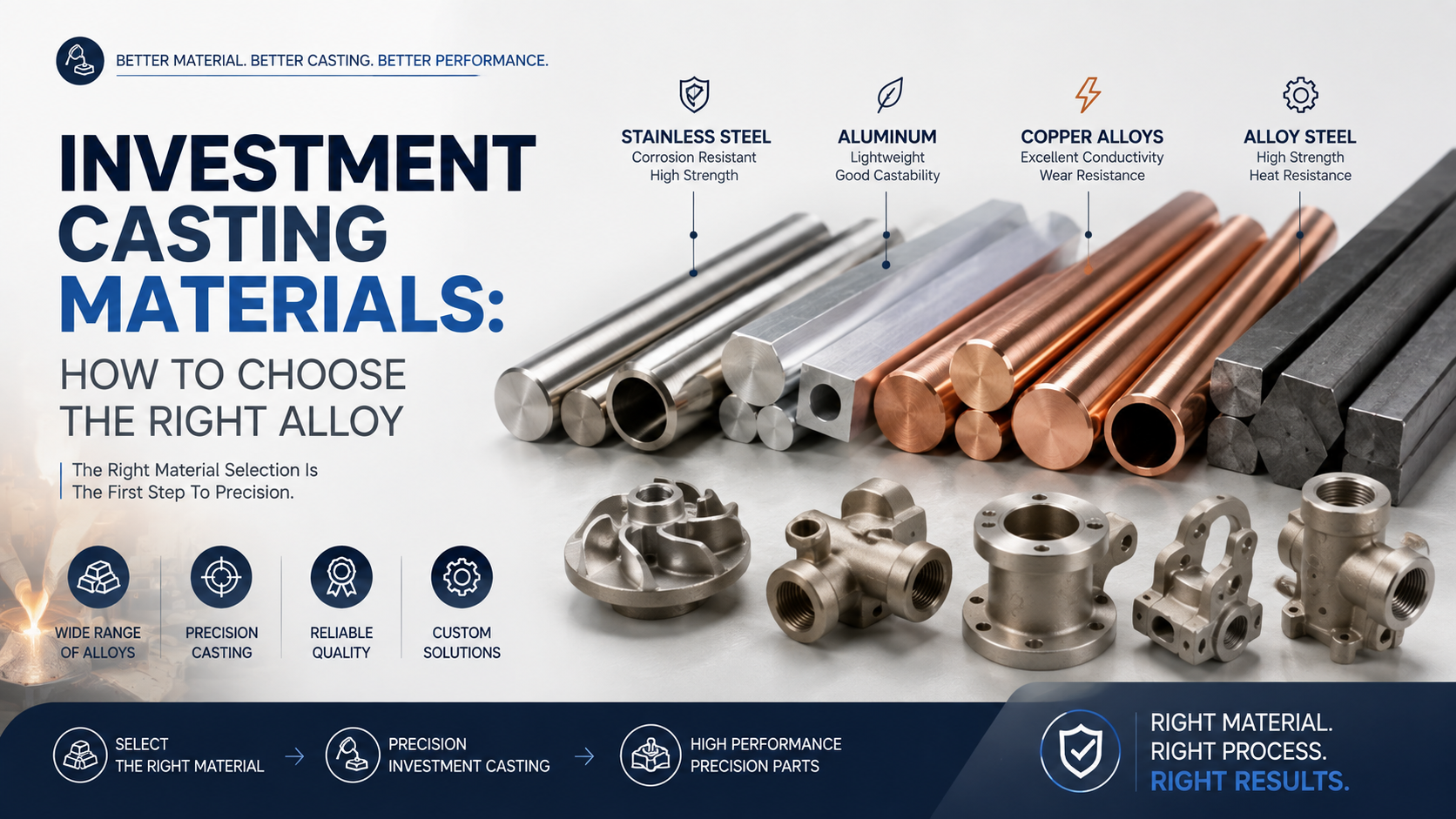
Material selection plays an important role in investment casting.
The alloy you choose affects not only the final strength of the part, but also corrosion resistance, wear performance, heat resistance, machining requirements and overall production cost.
Investment casting can be used with a wide range of ferrous and non-ferrous alloys. Common choices include stainless steel, aluminum alloys, copper alloys, carbon steel, alloy steel and high-performance alloys.
However, there is no single “best” investment casting material.
The right choice depends on where the part will be used, what environment it needs to handle and what performance requirements are critical.

Common Materials Used In Investment Casting
Investment casting supports many metal alloys. In industrial applications, materials are usually selected based on performance requirements rather than simply casting capability.
| Material Group | Common Materials | Main Advantages |
| Stainless Steel | 304, 316, 17-4PH | Corrosion resistance, strength, durability |
| Carbon Steel | Low carbon steel, medium carbon steel | Cost efficiency, machinability |
| Alloy Steel | 4140, 4340 | High strength, toughness, wear resistance |
| Aluminum Alloy | A356, A357 | Lightweight, corrosion resistance |
| Copper Alloy | Bronze, Brass | Conductivity, wear resistance |
| Cobalt Alloy | CoCr, Stellite | Heat and wear resistance |
| Nickel Alloy | Inconel, Hastelloy | High temperature and corrosion resistance |
| Titanium Alloy | Ti-6Al-4V | High strength-to-weight ratio |
Stainless Steel Investment Casting
Stainless steel is one of the most widely used materials in investment casting. It offers a strong combination of:
-
Corrosion resistance
-
Mechanical strength
-
Surface quality
-
Long-term durability
Because of these advantages, stainless steel investment casting is commonly used for industrial equipment, medical components, food processing equipment, valves and precision mechanical parts.
Different stainless steel grades provide different performance characteristics.

304 Stainless Steel Investment Casting
304 stainless steel investment casting is one of the most common choices for general industrial applications.
304 stainless steel provides:
-
Good corrosion resistance
-
Good weldability
-
Balanced mechanical properties
-
Good cost performance
It is often selected for:
-
Industrial brackets
-
Equipment components
-
Housings
-
General precision cast parts
For applications where extreme chemical exposure or high corrosion resistance is not required, 304 stainless steel is often an economical solution.
316 Stainless Steel Investment Casting
316 stainless steel investment casting is selected when better corrosion resistance is required.
Compared with 304 stainless steel, 316 contains molybdenum, which improves resistance against chloride environments and certain chemicals.(Investacast)
Typical applications include:
-
Medical equipment
-
Marine components
-
Chemical processing equipment
-
Food processing components
316 and 316L stainless steel are especially popular when cleanliness, corrosion resistance and reliability are important.
17-4PH Stainless Steel Investment Casting
17-4PH is a precipitation-hardening stainless steel.
Compared with common austenitic stainless steels such as 304 and 316, it provides higher strength and hardness.
Typical advantages:
-
High mechanical strength
-
Good dimensional stability
-
Good wear resistance
It is often used for:
-
Aerospace components
-
Industrial mechanisms
-
High-load precision parts
Aluminum Investment Casting
Aluminum investment casting is widely used when weight reduction is important.
Compared with steel materials, aluminum alloys provide:
-
Lightweight structure
-
Good corrosion resistance
-
Good machinability
-
Good strength-to-weight ratio
Common aluminum investment casting alloys include A356 and A357.(Investacast)
Typical applications:
-
Aerospace brackets
-
Automotive components
-
Lightweight housings
-
Industrial equipment parts
However, aluminum alloys are generally not suitable for extreme high-temperature environments. Material selection should consider operating temperature and mechanical requirements.
Copper Investment Casting
Copper-based alloys are widely used in investment casting when electrical conductivity, thermal performance or wear resistance are important.
Common copper investment casting materials include bronze and brass, but they provide different performance characteristics for different applications.
Choosing the right copper alloy depends on the required strength, corrosion resistance, wear performance and working environment.
Bronze Investment Casting
Bronze investment casting is commonly selected for components requiring good wear resistance, corrosion resistance and durability.
Compared with many other copper alloys, bronze provides excellent sliding performance and resistance to friction, making it suitable for mechanical components that experience continuous movement or contact.
Key advantages include:
-
Good wear resistance
-
Excellent corrosion resistance
-
Good strength and durability
-
Suitable for friction applications
Typical applications include:
-
Bearings
-
Valve components
-
Pump parts
-
Marine components
-
Industrial mechanical parts
Bronze investment casting is often used when long service life and reliable performance are more important than the lowest material cost.
Brass Investment Casting
Brass investment casting is widely used when good machinability, corrosion resistance and electrical conductivity are required.
Brass alloys typically contain copper and zinc, providing a good balance between strength, appearance and manufacturing performance.
Key advantages include:
-
Good machinability
-
Good corrosion resistance
-
Attractive surface appearance
-
Moderate electrical conductivity
Typical applications include:
-
Electrical components
-
Connectors
-
Fittings
-
Instrument components
-
Decorative mechanical parts
Brass investment casting is a practical choice for components that require both functional performance and a high-quality surface finish.
Alloy Steel Investment Casting
Alloy steel investment casting is commonly selected for demanding mechanical applications.
Compared with carbon steel, alloy steel contains additional alloying elements that improve:
-
Strength
-
Toughness
-
Fatigue resistance
-
Wear resistance
Common grades include 4140 and 4340. Typical applications:
-
Heavy equipment components
-
Industrial machinery parts
-
High-load structural components
Heat treatment is often an important part of alloy steel casting to achieve the required mechanical properties.

Carbon Steel Investment Casting
Carbon steel investment casting remains popular because it provides a practical balance between performance and cost.
Advantages include:
-
Good machinability
-
Good toughness
-
Cost efficiency
-
Wide material availability
Typical applications:
-
Industrial brackets
-
Machinery components
-
Structural parts
-
General engineering components
Carbon steel is often a good choice when high strength is needed but extreme corrosion resistance is not the primary requirement.
Cobalt Investment Casting
Cobalt investment casting is used for applications requiring excellent wear resistance and high-temperature performance.
Cobalt-based alloys, such as cobalt-chromium alloys and Stellite materials, are known for:
-
Wear resistance
-
Heat resistance
-
Corrosion resistance
Common applications:
-
Medical components
-
Aerospace parts
-
Wear-resistant components
Because of their performance characteristics, cobalt alloys are usually selected for more demanding applications.
Nickel Alloy And Titanium Investment Casting
Nickel Alloy Investment Casting
Nickel-based alloys such as Inconel are designed for harsh environments.
They provide:
-
High-temperature strength
-
Oxidation resistance
-
Corrosion resistance
Applications include:
-
Aerospace components
-
Energy equipment
-
Chemical processing parts
Titanium Investment Casting
Titanium investment casting is often selected when lightweight performance and corrosion resistance are required.
Advantages:
-
High strength-to-weight ratio
-
Excellent corrosion resistance
-
Biocompatibility
Applications:
-
Aerospace
-
Medical devices
-
High-performance components
How To Choose The Right Investment Casting Material
Material selection should always start from the actual working conditions of the part. The best investment casting material is not necessarily the strongest or most expensive option. It is the alloy that provides the right balance between performance, manufacturability and overall cost.
| Requirement | Recommended Materials |
| Corrosion Resistance | 316 Stainless Steel, Duplex Stainless Steel |
| General Industrial Applications | 304 Stainless Steel, Carbon Steel |
| Lightweight Design | Aluminum Alloy, Titanium |
| High Strength | Alloy Steel, 17-4PH Stainless Steel |
| Wear Resistance | Bronze, Cobalt Alloy |
| Electrical Conductivity | Copper Alloy, Brass |
| High Temperature Performance | Nickel Alloy, Cobalt Alloy |
When selecting an investment casting alloy, the operating environment should be considered first. Temperature exposure, chemical contact, moisture, wear conditions and expected service life all influence material selection. For example, 316 stainless steel may be preferred for corrosive environments, while nickel-based alloys are more suitable for high-temperature applications.
Mechanical requirements are also important. Factors such as strength, hardness, fatigue resistance and impact performance can determine whether a material is suitable for the application. A material that works well for a general industrial component may not provide enough performance for high-load or extreme-condition applications.
Machinability should also be considered, especially for precision investment casting parts that require secondary CNC machining. Some alloys provide excellent mechanical properties but are more difficult to machine, which may increase processing time and manufacturing cost.
The most suitable investment casting material is the one that meets the required performance while maintaining practical manufacturability and cost efficiency.
Choosing The Right Manufacturer For Custom Investment Casting Solutions
Material capability is important, but supplier experience is equally critical.
A reliable investment casting partner should understand:
-
Material selection
-
Casting design
-
Heat treatment
-
CNC machining
-
Surface finishing
-
Inspection requirements
The right supplier should not only provide castings, but also help evaluate the complete manufacturing route.
Investment Casting Materials And Manufacturing Support From XY-GLOBAL
At XY-GLOBAL, we help customers develop precision investment casting parts by considering the complete manufacturing requirement.
Our engineering team evaluates:
-
Material selection
-
Part geometry
-
Production volume
-
Machining requirements
-
Quality requirements
Beyond investment casting, we also support secondary CNC machining, surface finishing and inspection to help customers achieve finished precision components.
Whether you need stainless steel investment casting, aluminum investment casting, copper alloy parts or custom alloy components, XY-GLOBAL can help evaluate a practical manufacturing solution.
Investment Casting Material FAQs
1. Can investment casting materials meet the same requirements as wrought materials?
Investment casting materials can achieve excellent mechanical properties, but the final performance depends on the selected alloy, casting process and heat treatment condition. For applications with strict requirements, material grade, mechanical properties and inspection requirements should be evaluated together before production.
2. Do investment casting parts require heat treatment?
Many investment casting alloys require heat treatment to achieve the required mechanical properties, such as strength, hardness or toughness. The specific heat treatment process depends on the selected material and application requirements.
3. Can existing CNC machined parts be converted to investment casting?
Yes, many CNC machined parts can be evaluated for conversion to investment casting, especially when the part has complex geometry, high material waste or increasing production volume. However, the design may require adjustments for casting requirements and manufacturing efficiency.
4. What material certifications are available for investment casting parts?
Depending on customer requirements, investment casting suppliers can provide material documentation such as material certificates, chemical composition reports and mechanical property records. Additional inspection documentation can also be arranged for critical applications.
5. What is the best investment casting material for high-corrosion environments?
Stainless steel grades such as 316 stainless steel are commonly selected for applications requiring strong corrosion resistance. For more demanding environments, specialty alloys such as nickel-based alloys may be considered.
6. Can investment casting be used for low-volume production?
Yes. Investment casting is suitable for both prototype and production applications. The most suitable process depends on part geometry, material requirements, tooling investment and expected production volume.
7. How do I choose between stainless steel, aluminum and copper investment casting materials?
Stainless steel is usually selected for strength and corrosion resistance, aluminum for lightweight applications, and copper alloys for conductivity and wear resistance. The final choice depends on the operating environment, performance requirements and manufacturing considerations.

Share:
CNC Machining Vs Investment Casting: How To Choose For Complex Metal Parts