


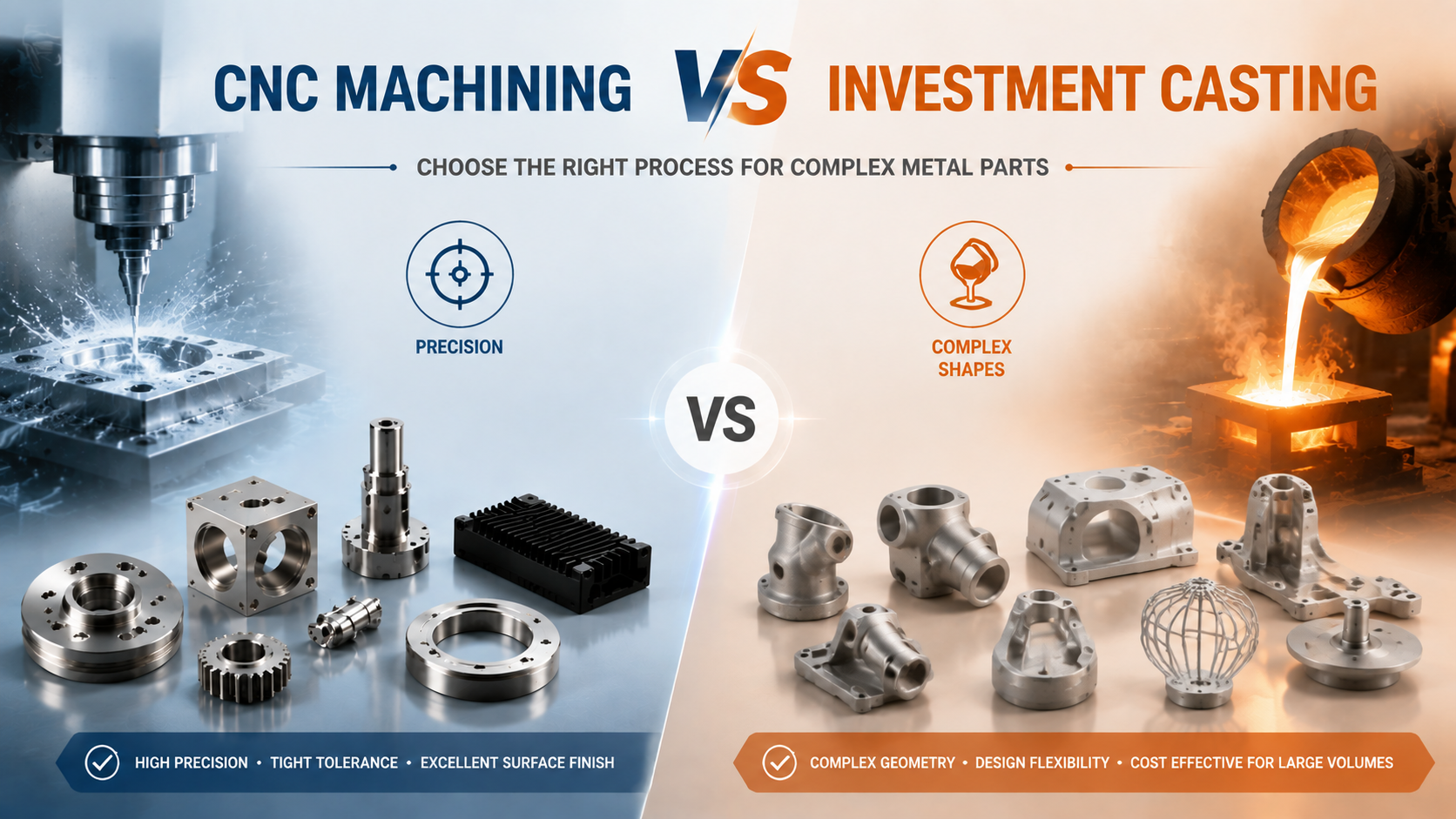
A complex metal part may make perfect sense to CNC machine when you need 20 pieces.
The same part can become expensive when annual demand grows to several thousand.
That does not mean CNC machining was the wrong choice at the beginning. It simply means the manufacturing decision has changed.
For many projects, the question is not simply which process is more accurate or which one has the lower piece price. You need to look at the part geometry, material, tolerance requirements, tooling, expected volume, and how much machining is actually needed.
And sometimes, the best answer is not CNC machining or investment casting. It is both.

CNC Machining Vs Investment Casting At A Glance
If you are already working on a drawing, the table below gives you a quick starting point.
| Decision Factor | CNC Machining | Investment Casting | What It Means For Your Part |
| Best Fit | Prototypes, low-volume parts, tight-tolerance components | Complex near-net shapes and repeat production | Start with the project stage and part geometry |
| Tooling | No casting mold required | Wax pattern tooling is normally required | CNC is more flexible while the design is changing |
| Design Changes | Easy to update | Changes may require tooling modification | Design maturity matters |
| Tight Tolerances | Strong choice for precision features | Critical features may still need CNC machining | Do not apply the same tolerance strategy to every surface |
| Complex Geometry | Depends on tool access, setups and machining time | Good for ribs, bosses, curves and difficult near-net shapes | Judge complexity by manufacturing effort, not appearance |
| Material Use | Can create significant chips when machining from large stock | Near-net shape can reduce material removal | More important with costly alloys |
| Initial Lead Time | Usually faster without casting tooling | Tooling and casting development add time | CNC often fits early NPI better |
| Repeat Production | Machining time remains part of every unit | Tooling cost can be spread across repeat orders | Stable demand can change the cost equation |
| Secondary Machining | Part is produced directly by machining | Often used for bores, threads, datums and mating surfaces | Hybrid manufacturing is common |
| Cost Strategy | Avoid tooling and stay flexible | Reduce repeated machining and material removal | Compare finished-part cost, not just the blank |
There is no universal rule that says “low volume means CNC” and “high volume means investment casting.”
A simple part may remain economical to machine even at a relatively high quantity. A complicated steel part with heavy material removal may become worth casting much earlier.
The drawing has to come first.
CNC Machining Vs Investment Casting: Key Differences
CNC machining is a subtractive manufacturing process.
The part usually starts as bar, plate, billet, forging or another form of solid stock. Computer-controlled cutting tools then remove material until the required geometry remains.
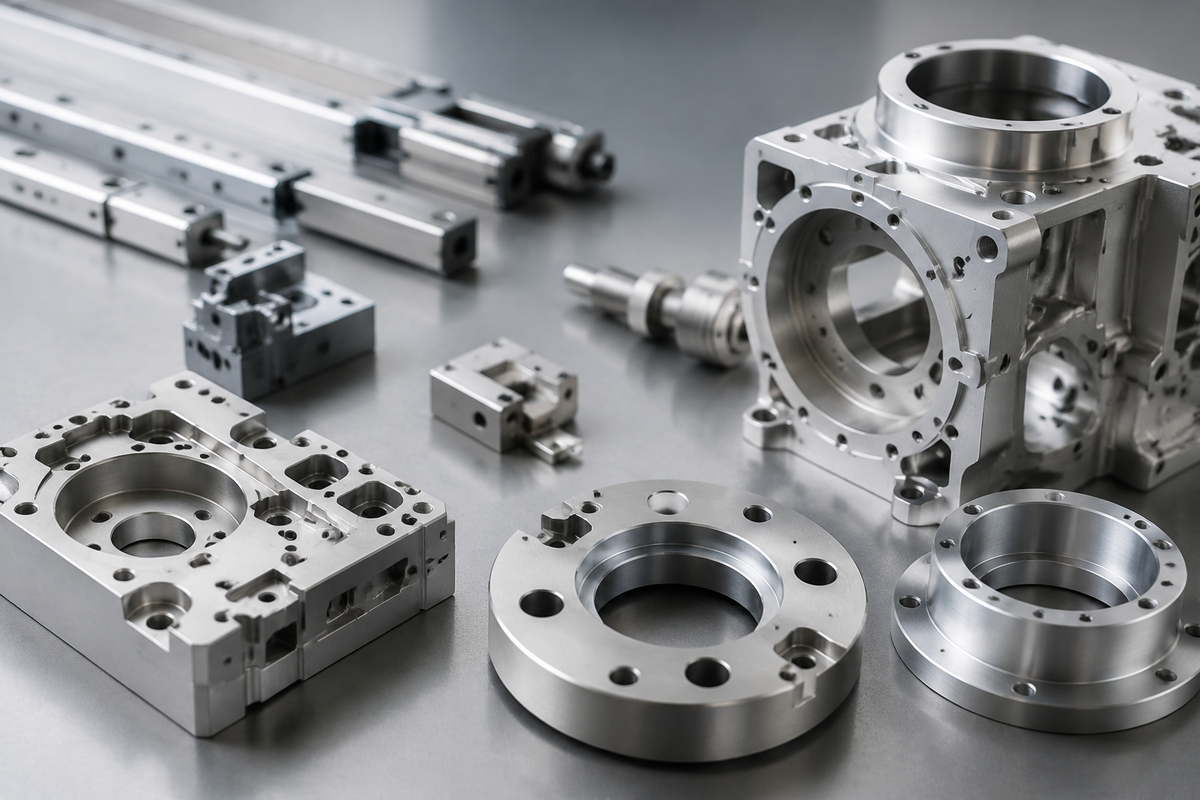
Typical operations include milling, turning, drilling, boring and threading. Modern 3-axis, 4-axis and 5-axis machines can produce complex parts with good dimensional control and repeatability.
Investment casting, also known as lost wax casting, can produce near-net shape castings. Instead of cutting the complete part from solid stock, the process creates the shape through a disposable wax pattern. Compared with cnc machining, tooling has to be made for investment casting.
In simple terms: CNC machining removes material to create the part while investment casting creates more of the shape before machining begins.

Key Differences Between CNC Machining And Investment Casting
For an actual manufacturing project, the better process depends on a combination of factors, including part geometry, tolerance requirements, surface finish, material selection, material usage, tooling investment, lead time and production volume.
Each of these factors can influence the overall manufacturing cost, production efficiency and long-term reliability of the final component.
Part Geometry And Design Complexity
Part geometry is usually one of the first factors considered when comparing CNC machining and investment casting.
A common assumption is that simple parts are machined while complex parts are cast. In reality, the decision is more about how difficult and expensive the geometry is to manufacture repeatedly.
A complex-looking component may still be suitable for CNC machining if tool access is good, the number of setups is limited and the raw material is close to the final shape.
However, parts with deep cavities, difficult tool access, large material removal or multiple machining directions can quickly become more expensive.
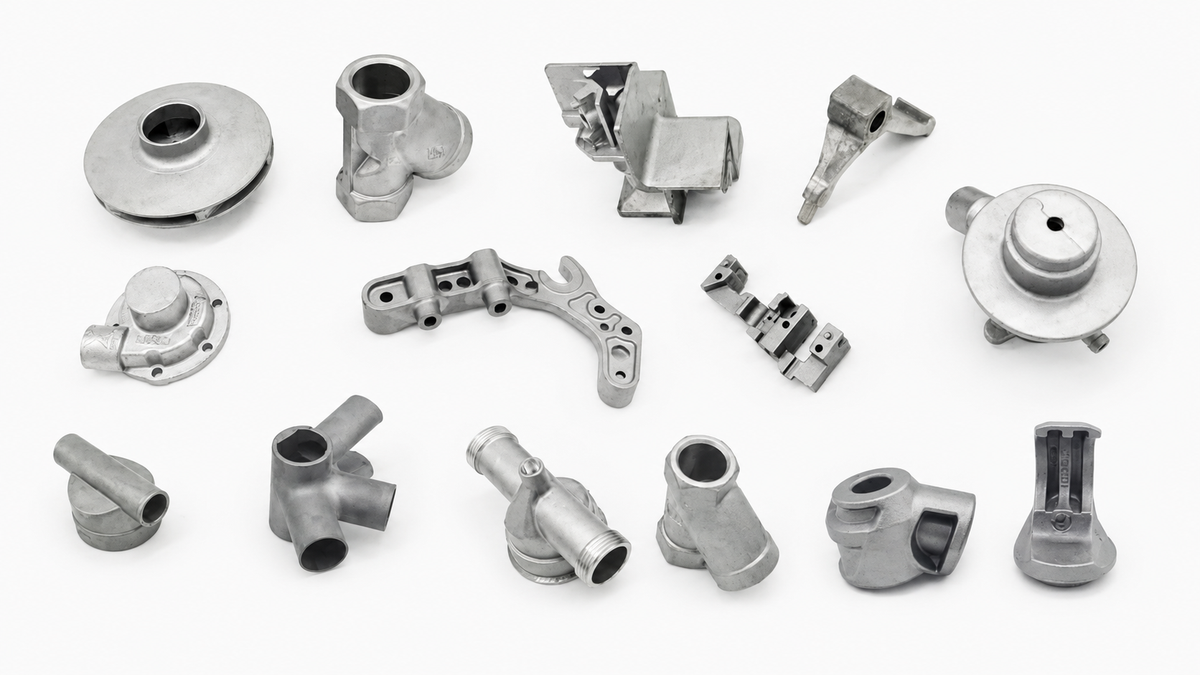
Investment casting can create many of these features closer to the final shape, including ribs, bosses, curved surfaces and irregular external profiles. CNC machining is usually reserved for features that require tighter control, such as precision holes, sealing surfaces and critical interfaces.
The real consideration is not whether a part looks complex, but whether the manufacturing effort matches the production requirement.
Dimensional Tolerance And Precision
CNC machining generally provides stronger control for tight dimensional requirements.
Features such as bearing bores, precision holes, datums, threads and mating surfaces are commonly finished through CNC machining because these areas directly affect assembly and function.
Investment casting can achieve good overall dimensional consistency, but not every surface needs to be produced at the same precision level.
Many complex components contain a combination of cast-friendly geometry and precision features. The external shape, ribs and bosses can be created through investment casting, while critical areas such as bearing seats or mounting datums are machined afterward.
This approach allows each process to handle the features where it creates the most value.
Surface Finish Requirements
Surface finish requirements depend mainly on how the part will be used.
CNC machining provides direct control over surface quality through tooling selection, cutting parameters and secondary finishing operations.
Investment casting can also achieve suitable surface finishes for many industrial applications. However, functional surfaces may still require additional machining or finishing.
For example, external non-critical surfaces may only need blasting or polishing, while sealing areas, bearing surfaces and precision interfaces may require CNC machining.
A well-designed manufacturing process does not apply the same surface requirement to every area of the component. It focuses finishing effort where it affects performance.
Material Selection
Both CNC machining and investment casting support a wide range of metals, but the material form and selection process are different.
CNC machining typically starts from bar, plate, billet or forged material, while investment casting uses alloys selected according to casting performance and final application requirements.
This becomes especially important when converting an existing CNC-machined part into an investment casting design.
The original material specification should be reviewed rather than transferred directly. Mechanical properties, heat treatment, corrosion resistance and industry standards all need to match the actual function of the component.
Changing the manufacturing process should not compromise the performance requirements of the part.
Material Waste And Machining Time
One major difference between CNC machining and investment casting is how the final shape is created.
CNC machining removes material from solid stock. For simple components, this may have little impact. But for large or complex parts made from expensive alloys, material removal can become a significant cost factor.
The total impact includes not only raw material usage, but also machining time, cutting tools and production capacity.
Investment casting creates a near-net-shape component first, reducing the amount of material that needs to be removed later.
This advantage becomes more noticeable when the part requires heavy rough machining, expensive materials or repeat production.
Tooling Cost
Tooling is one of the clearest differences between CNC machining and investment casting.
CNC machining usually requires less upfront investment. Once the design is ready, production can often begin without dedicated casting tooling.
Investment casting requires additional preparation, including wax pattern tooling, process development and sample validation.
This makes CNC machining attractive for prototypes and early-stage projects.
However, production economics should not be judged only by the first batch. Over time, the comparison becomes a balance between initial tooling investment and repeated machining cost.
The better choice depends on the complete production plan, not just the first order.
Lead Time And Design Flexibility
CNC machining is often preferred during product development because it allows faster design changes.
When a hole position, pocket dimension or interface changes, the machining program can usually be updated without creating new production tooling.
Investment casting requires more planning because tooling, wax patterns, shell preparation and sample approval are involved.
For prototypes, flexibility is often more important than production efficiency. For stable production, the balance may change.
A process that works well during development may not always be the most economical choice for long-term manufacturing.
Production Volume And Manufacturing Strategy
Production volume is an important factor, but it should not be considered alone.
There is no fixed point where CNC machining automatically becomes unsuitable and investment casting becomes the better choice.
The decision depends on the relationship between volume, geometry, material cost, machining time and tooling investment.
A simple aluminum component may remain economical to CNC machine at higher quantities.
A complex stainless steel component with long machining cycles may justify investment casting at a much earlier stage.
For repeat production, the key consideration is whether the same manufacturing cost is repeated on every additional part.
When machining time and material removal become major cost drivers, it is often worth reviewing alternative manufacturing routes.
Prototyping and Mass Production: When to Use CNC Machining vs Investment Casting
A manufacturing process that works well during product development may not always be the most efficient choice for repeat production.
During the prototype stage, design flexibility is usually the priority. CNC machining is often preferred because it allows faster modifications without additional tooling investment.
Once the product design becomes stable, factors such as repeatability, production capacity and finished-part cost become more important.
| Product Stage | Process To Evaluate First | Main Reason |
| Early Prototype | CNC Machining | Fast changes and no casting tooling |
| Functional Validation | CNC Machining | Verify fit, function and critical features |
| Pilot Production | CNC Or Process Review | Confirm design stability and production demand |
| Stable Production | Investment Casting + CNC May Be Worth Evaluating | Reduce repeated machining and material removal |
Consider an alloy-steel bracket with ribs, bosses, curved surfaces and several precision mounting features.
For the first 30 prototype parts, CNC machining is usually a practical choice because the design may still change.
After validation, the drawing becomes stable and annual demand increases. At this stage, machining the entire bracket from solid material means repeatedly removing material from features that do not require tight tolerances.
A combined process using investment casting for the overall geometry and CNC machining for critical features may provide a more efficient production route.
CNC Machining And Investment Casting Often Work Better Together
This is where the usual CNC machining vs investment casting discussion becomes too narrow.
Many production parts do not need to be 100% machined or 100% finished as cast.
The better route can be to divide the work. Investment casting handles the geometry. CNC machining handles the precision. For example, investment casting can create:
-
Ribs
-
Bosses
-
Curved surfaces
-
Complex outer profiles
-
Shape transitions
-
Near-net overall geometry
Then CNC machining can finish:
-
Bearing bores
-
Precision holes
-
Threads
-
Datums
-
Sealing faces
-
Mating surfaces
This is especially useful when only a small percentage of the part actually requires tight tolerance.
Instead of machining everything simply because a few features are critical, the manufacturing route can be built around the function of each feature.
XY-GLOBAL already uses this same logic in its investment-casting content: near-net geometry can be cast first, while bearing seats, threads, sealing surfaces, precision holes and mating faces are left for secondary machining.

Compare Finished-Part Cost, Not Just Process Price
Cost comparison between CNC machining and investment casting can be misleading if only the initial process price is considered.
A CNC-machined part may appear cheaper at the beginning because no casting tooling is required.
However, repeated machining time, material removal, cutting tools and production capacity can significantly affect the long-term cost.
Investment casting requires upfront tooling and process development, but it may reduce machining time and material waste when production volume increases.
The most meaningful comparison is always based on the finished component, including:
- Manufacturing operations
- Secondary machining
- Finishing
- Inspection
- Overall production efficiency
The best manufacturing route is the one that delivers the required component at the most efficient overall cost.
How XY-GLOBAL Helps Evaluate The Right Manufacturing Process
At XY-GLOBAL, we support both CNC machining and investment casting, allowing us to evaluate the complete manufacturing route instead of focusing on a single process.
Through DFM review, our engineering team evaluates key factors including part geometry, critical tolerances, material requirements, production volume and overall manufacturing cost. Based on these requirements, we can help determine whether full CNC machining, investment casting, or investment casting combined with selective CNC machining is the more suitable approach.
This approach helps customers select the right manufacturing method at different stages, from prototype development to stable production.
If you are evaluating a complex metal component, send us your 2D/3D drawing, material, quantity and critical requirements. XY-GLOBAL can help compare CNC machining and investment casting options and recommend the most practical approach for your application.
Conclusion
There is no single winner between CNC machining and investment casting.
CNC machining is usually easier to start with. It offers strong dimensional control, short development cycles and flexibility when a design is still changing.
Investment casting becomes more attractive when the part contains geometry that is expensive to machine repeatedly, material removal is high and production demand is stable enough to justify tooling.
For many complex metal parts, the best solution sits between the two.
Cast the geometry that does not need machining-level precision.
Machine the features that do.
And do not assume the manufacturing route chosen for the first prototype should remain unchanged for the life of the product.
The drawing may stay the same. The best way to manufacture it might not. The key is about selecting the right process for the right feature at the right stage of the product lifecycle.
Frequently Asked Questions(FAQs)
1. What files should I send for a cnc machining or investment casting evaluation?
A 3D model such as a STEP file is useful for reviewing the geometry.
A 2D drawing should also be provided when the part includes GD&T, critical tolerances, threads, surface-finish requirements or special inspection requirements.
Material, quantity and expected annual demand also help the supplier compare manufacturing routes more accurately.
2. Can a cnc-machined material grade be used directly for investment casting?
Not always.
A machined part may specify a wrought material grade or standard. If the manufacturing route changes to investment casting, the material specification should be reviewed for casting compatibility, mechanical properties, heat treatment and application requirements.
The goal is to maintain the required performance, not simply choose the closest material name.
3. Should threads be cast or cnc machined?
Critical threads are often machined after casting when dimensional accuracy, fit and repeatability are important.
The right approach depends on the thread size, function and part geometry.
Important threaded features should be identified before casting tooling is finalized.
4. Who owns the investment casting tooling?
Tooling ownership should be agreed before the order is placed.
The agreement should clearly cover who pays for the tool, who owns it, where it will be stored, how long it will be maintained and what happens if the customer later wants to move or modify the tooling.
This is especially important for long-term production programs.
5. What happens if the design changes after investment casting tooling is finished?
Small changes may sometimes be handled by modifying the existing tool.
Larger changes can require major tool rework or new tooling.
This is one reason investment casting is usually easier to justify after the design has reached a reasonably stable stage.
6. What inspection documents can be provided for cast and cnc-machined parts?
The exact documentation depends on the project.
Common requirements can include dimensional inspection reports, CMM results, material certificates, heat-treatment records, hardness results and FAI documentation.
Inspection requirements should be agreed before production, especially for critical features.

Share:
3D Printing in Medicine: Real Applications, Manufacturing Process and Future Trends
Investment Casting Materials: How To Choose The Right Alloy For Precision Metal Parts