


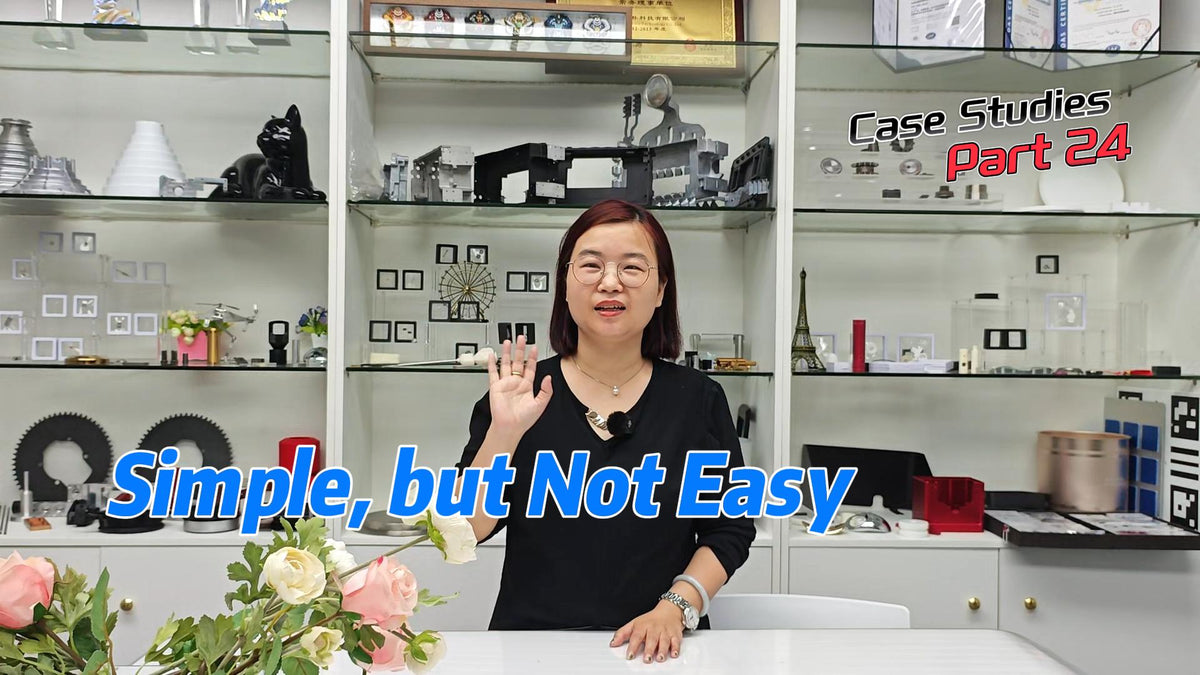
At first glance, this part did not look unusual.
It was a small fixture component for a long-term customer in the U.S. automation industry which seemed like it just a simple part as usual.
The outer geometry appeared straightforward, without the complex forms that usually suggest a difficult machining job. But once we moved from the 3D model to the detailed engineering drawing, the real challenge became clear.
Part Data Overview
Basic Information
-
Approximate size: 52 × 75 mm
-
Material: AISI 420 stainless steel
Precision Requirements
-
Critical dimensional tolerance: ±0.0002 inches
-
Heat treatment hardness: 38–42 HRC
This was a simple-looking part.
But it was not an easy one.
The Background Behind the Project
The customer had previously produced this part internally. As their business developed, they began evaluating whether an external manufacturing partner could reduce the cost without sacrificing quality. Their target price was around USD 40 per piece.
For many suppliers, this kind of RFQ may seem routine. A quick review of the model might suggest that the part is simple enough to quote immediately.
That is not how we approach precision machining projects at XY-Global.
For us, a drawing is not just a request for price. It is a technical document that reveals process difficulty, production risk, and manufacturability.
Especially in tight-tolerance machining, the key question is not whether a part can be made once, but whether it can be made consistently, economically, and in a production-ready way.
So instead of sending a quote right away, our engineering and production teams began with a deeper review.
Looking Beyond the Surface
After studying the drawing in detail, our engineers focused on three key areas:
-
Machining sequence
-
Grinding strategy
-
Inspection feasibility
The part had several surfaces and dimensions that were closely linked. That meant one machining step could influence the stability of the next.
If the process route was not planned correctly, even a small shift in flatness, stress, or positioning could affect the final grinding result.
This is often where “simple” parts become difficult.
A part may have a clean outer shape, but once it combines tight tolerances, hardened stainless steel, secondary finishing, and cost pressure, the manufacturing window becomes much narrower.
Success depends not only on machining capability, but also on whether the full route—from rough machining to finishing and final inspection—has been planned properly.
Solving the Problem Together
After the internal review, we arranged an online technical meeting with the customer.
Instead of discussing price alone, we walked through the actual machining risks together. We shared our views on process stability, grinding control, and the sequence required to protect the critical dimensions.
This kind of communication is important in precision manufacturing, because the best solution often comes from aligning design intent with manufacturing reality.
Through these discussions, we further refined the process plan.
By adjusting the machining sequence and carefully controlling the grinding process, our team was able to improve dimensional stability and make the part more suitable for repeatable production. The project then moved forward successfully.
What made the difference was not a shortcut or a single special technique. It was careful engineering review, practical process understanding, and the discipline to solve problems before production began.
Why XY-Global
This case is a good example of how we work.
We do not rush to quote before understanding the technical challenge. We review the drawing carefully, study the process route, and discuss manufacturability with the customer when necessary.
Our goal is not only to machine a part, but to help customers move from drawing to a production-ready solution with greater confidence.
That is why customers choose XY-Global for precision projects:
-
We take engineering review seriously
-
We focus on process stability, not only sample success
-
We communicate openly about machining risks and practical solutions
-
We help customers balance quality, manufacturability, and cost
In precision manufacturing, “simple” does not always mean easy.
But with the right engineering mindset, careful process planning, and a team that understands what is really behind the drawing, even the most deceptively simple parts can move forward successfully.
That is the value we aim to bring at XY-Global.


分享:
Case Study 23丨Precision Metal Components for Climbing Gear: A Manufacturing Optimization
Case Studies 25 丨Ten Years of Product Development Support for 3D Printing