


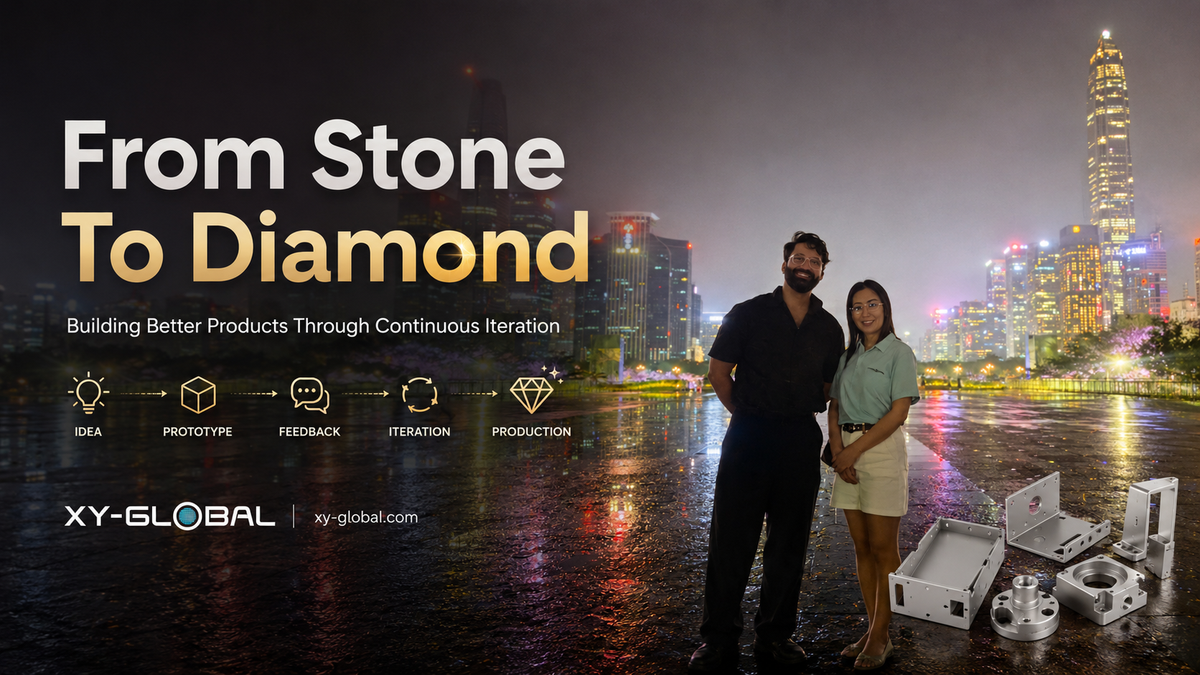
Great products are not simply made; they are refined through iteration.
They often start with an idea that still needs to be tested, a design that has not yet been fully validated, or a first prototype that looks very different from what will eventually go into production.
That does not mean the original idea was wrong. It simply means the product is still developing.
At XY-GLOBAL, this is the journey from stone to diamond.
A stone already has value and potential, but its final shape has not yet been revealed. It takes time, judgment and careful refinement to bring out what is inside.
Product development often works in much the same way.
Recently, we met with a client from Trackman at XY-GLOBAL to discuss the sheet metal tablet bracket project for golf data recording. During the visit, he was impressed by the warm and friendly atmosphere within our team, as well as the willingness of different team members to participate and contribute. Throughout the development of the project, our “from stone to diamond” approach also left a strong impression — both sides kept sharing feedback and refining the product together as it evolved.
A Product Does Not Always Start With A Complete Answer
For an established product, manufacturing is often straightforward—relying on a validated design, frozen drawings, and established parameters. New product development is different.
At an early stage, the customer may know exactly what problem the product needs to solve and how the user should interact with it, while some engineering details are still being explored.
A structure may still need validation. A dimension may change after the first assembly. A tolerance that looked necessary on the drawing may turn out to have little influence on the final function. In other cases, a feature that appeared simple at the design stage may create an unexpected manufacturing challenge.
This uncertainty is not unusual. It is part of developing something new.
A prototype gives the team information that a 3D model alone cannot always provide. Once the physical part is manufactured, assembled and tested, the next round of decisions becomes more informed.
This was also important in our discussions around the Trackman project. The purpose was not only to determine whether the sheet metal bracket could be manufactured. It was to better understand how the design, the manufacturing process and the actual application could work together.
Each new piece of information helped shape the next decision.
A drawing represents one stage of a product. Product development is the process of discovering what the next stage should be.

A Manufacturing Partner Should Be Able To Join The Journey
Some supplier relationships begin only after the customer has completed almost every part of the specification.
This model works well for established products. The supplier receives a complete drawing, quotes it, manufactures the parts, and delivers them.
But for a product that is still evolving, waiting for every detail to be finalized can also mean missing opportunities to improve the design earlier.
At XY-GLOBAL, many projects involve more than simply reproducing a finished drawing. We work across sheet metal, cnc machiningm, and other manufacturing processes, so our engineers naturally look at a product from the manufacturing side while offering DFM support.
For a sheet metal project, for example, we may consider bending behavior, material thickness, tolerance accumulation, assembly relationships, surface treatment, and production consistency.
The customer sees the same part from another angle.
They understand the application, the end user, the functional priorities, and the reasons behind the original design.
When these two perspectives are brought together early enough, the development process becomes more efficient.
The manufacturer may identify a production risk before it reaches tooling or volume production. The customer may explain an application requirement that changes the way that risk should be evaluated. One suggestion leads to another discussion, and that discussion may lead to a better version of the product.
This is where continuous iteration becomes valuable.

Iteration Is Not Failure or Rework, But a Step Forward
When a design moves from V1 to V2 and then to V3, it can be easy to view those changes as repeated corrections. But meaningful iteration is very different from uncontrolled rework. Each version should help answer a question.
The first prototype may confirm whether the overall concept works. Once the part is physically tested, the team may discover opportunities to improve assembly, manufacturability, stability or cost.
The next version then starts with more knowledge than the first.
As the project develops, the changes often become smaller because many of the major uncertainties have already been removed.
This is what makes iteration valuable. We saw this clearly in our discussions with Trackman.The customer brought valuable insight from the actual golf application, while our team evaluated the same product from a sheet metal manufacturing perspective.
That exchange helped guide the next decisions. A small change in bending geometry, tolerance, assembly detail, or process sequence may prevent a much larger issue later in production.
The goal is not to create more versions. It is to make each version more mature, more reliable, and closer to the final product.
From Prototype To Production
The need for iteration becomes even more important when a product begins moving toward volume production.
A prototype may only need to prove that an idea can work.
Production asks a different question: can that same product be made repeatedly, consistently and at a reasonable cost?
A process that is practical for five pieces may not be the right process for five hundred or five thousand. A manual adjustment that works during prototyping may need to be eliminated before production. Tolerances, inspection methods and manufacturing sequences may all need another review as quantities increase.
This is why we see product development as a continuous path rather than a single handover between customer and supplier.
DFM leads to prototyping. Prototyping creates feedback. Feedback drives improvement. Improvement needs validation. And validation eventually creates the confidence to move into production.
The stages are connected.
For XY-GLOBAL, supporting a customer through this process means understanding not only what the current drawing requires, but also where the product is trying to go.
From Stone To Diamond
The idea of going from stone to diamond is meaningful to us because product development often works in the same way.
At the beginning, there may already be value in the idea, but the final shape is still hidden.
The product gradually becomes clearer through engineering review, prototyping, testing, manufacturing feedback, and real-world use. Some features are kept. Some are adjusted. Others may disappear entirely because the team finds a better direction.
This is why we believe continuous iteration is not simply a manufacturing method. It is also a way of working together.
The customer does not need to arrive with every question already answered.
The manufacturer does not need to pretend it knows everything from the beginning.
What matters is that both sides are willing to share information, respond to new findings, and keep moving the project toward the same goal.
At XY-GLOBAL, we want to bring our manufacturing experience into that journey, especially when the product is still developing and there is still room to make it better.
A good product may begin with a rough idea.
It becomes stronger through testing, clearer through feedback, and more mature through every meaningful improvement.
The stone already contains possibility. Iteration reveals its shape. Collaboration gives it polish.
And over time, what began as an early idea can become something much closer to the diamond both teams were working toward.

分享:
The Empty Cup Mindset Behind Better Problem Solving: Listen, Learn, Improve
Turning Ideas Into Reality: Where Know-How Makes The Difference