


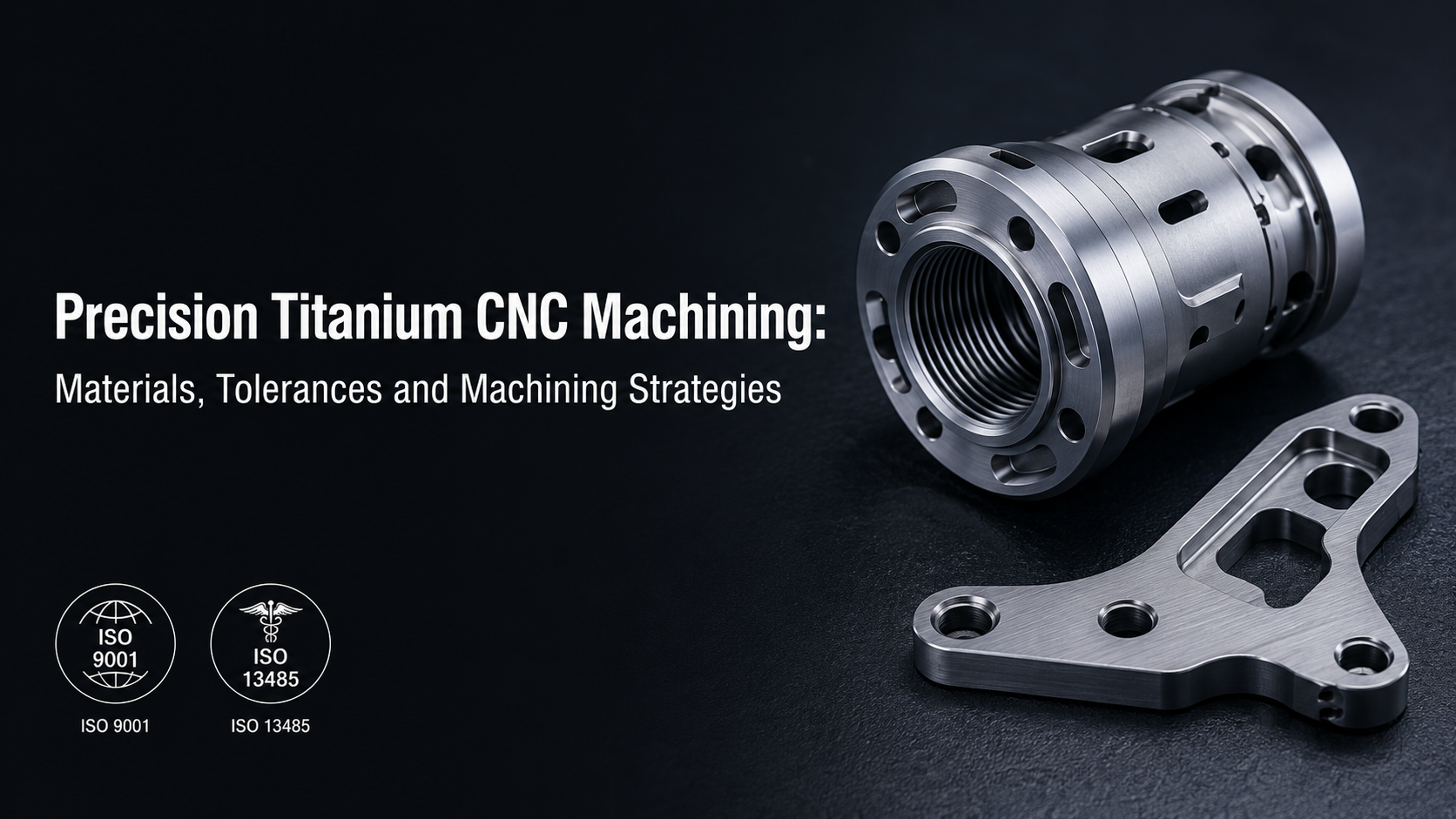
Titanium occupies a unique position in precision manufacturing. Its mechanical properties — roughly the same strength as many steels at less than half the density, excellent fatigue resistance, near-zero corrosion in most environments, and full biocompatibility — make it the material of choice for components where performance cannot be compromised. It is used in surgical implants, aircraft structural parts, optical instrument housings, semiconductor process equipment, and high-end industrial components where aluminum is too weak or steel is too heavy.
The difficulty is that titanium does not machine like either of those materials. Its low thermal conductivity concentrates cutting heat at the tool tip. Its tendency to spring back elastically under cutting forces makes dimensional control harder. Its chemical reactivity causes it to weld to cutting tool surfaces at elevated temperatures, accelerating tool wear. These characteristics mean that machining titanium to tight tolerances requires a fundamentally different process approach from machining aluminum or stainless steel parts to the same specifications.
This article covers the key aspects of precision titanium CNC machining — the alloys most commonly used, the process challenges involved, the tolerances achievable, surface finish and post-processing options, and the applications where CNC machined titanium parts are most widely specified.

Why Titanium Is Used for Precision CNC Components
The properties that drive titanium selection for precision CNC components are well understood and consistent across the industries that use it most heavily.
Strength-to-weight ratio. Titanium alloys — particularly Ti-6Al-4V, the most widely used grade — have tensile strength comparable to many alloy steels while being approximately 45% lighter. For applications where structural performance and low mass must coexist in the same part, titanium is often the only viable choice. Aerospace brackets, surgical instrument handles, and optical instrument structural members are all examples where this combination is decisive.
Corrosion resistance. Titanium forms a stable, self-healing oxide layer that provides excellent corrosion resistance in environments that would attack stainless steel or aluminum. This makes titanium the preferred material for components exposed to body fluids, seawater, aggressive industrial chemicals, or high-humidity environments where long-term dimensional stability under corrosion is required.
Biocompatibility. Titanium and its alloys are non-toxic and do not provoke adverse tissue reactions, making them the standard material for implantable medical devices and long-contact surgical instruments. ISO 10993 biocompatibility requirements are routinely met by titanium alloys used in medical device manufacturing.
Low thermal expansion. Titanium's coefficient of thermal expansion (CTE) is approximately 8.6 ppm/°C — significantly lower than aluminum (23 ppm/°C) and lower than most steels. For precision optical instruments, metrology components, and aerospace structural parts where dimensional stability across temperature ranges is critical, titanium's low CTE makes it a more stable material choice than aluminum despite the higher machining cost.
Fatigue resistance. Titanium alloys maintain good fatigue performance at high stress amplitudes, which is why they are used for components subject to cyclic loading — surgical tools, aerospace fasteners, and precision mechanical mechanisms that must survive many millions of load cycles without failure.
Titanium Alloys Used in Precision CNC Machining
Not all titanium alloys machine the same way or deliver the same performance. Understanding the most commonly used grades helps in specifying the right material for a precision CNC component.
Ti-6Al-4V (Grade 5) is the most widely used titanium alloy in precision CNC machining, accounting for the majority of aerospace, medical, and industrial titanium parts. It combines high strength (ultimate tensile strength typically 900–950 MPa), excellent fatigue resistance, good corrosion resistance, and established machining process data. Ti-6Al-4V is available in a wide range of bar, plate, and tube forms, has well-characterized properties, and is the default choice when titanium is specified without additional qualification.
Ti-6Al-4V ELI (Grade 23) is the extra-low interstitial variant of Ti-6Al-4V, with tighter limits on oxygen, nitrogen, carbon, and iron content. These tighter compositional controls improve ductility and fracture toughness at the cost of slightly lower strength. Grade 23 is the standard for implantable medical devices — surgical implants, bone screws, and long-term contact medical components — where the improved fracture toughness and biocompatibility consistency of ELI grade matter.
Commercially pure titanium (Grades 1–4) offers lower strength than Ti-6Al-4V but better formability, weldability, and in some cases improved corrosion resistance in specific environments. Grade 2 commercially pure titanium is commonly used for chemical processing components, heat exchanger parts, and some medical applications where the strength of an alloyed grade is not required. It is somewhat easier to machine than Ti-6Al-4V but still presents the same fundamental thermal and chemical machining challenges.
Ti-3Al-2.5V (Grade 9) is a medium-strength titanium alloy with better cold workability than Ti-6Al-4V, commonly used for hydraulic tubing, bicycle components, and some aerospace applications. It machines similarly to Grade 2 commercially pure titanium and is a useful intermediate option when the full strength of Ti-6Al-4V is not required but pure titanium is insufficient.

Why Precision Titanium CNC Machining Is Technically Challenging
Titanium's material properties that make it attractive for demanding applications are the same properties that make it difficult to machine consistently to tight tolerances. Understanding the specific challenges is useful for engineers selecting a machining supplier and for setting realistic expectations about process parameters and lead times.
Low thermal conductivity. Titanium's thermal conductivity (approximately 6.7 W/m·K for Ti-6Al-4V) is roughly one-sixth that of aluminum and about one-quarter that of carbon steel. This means that heat generated at the cutting zone cannot dissipate quickly into the workpiece — it concentrates at the tool-workpiece interface. Sustained high temperatures at the cutting edge accelerate tool wear, cause built-up edge formation, and can produce thermal damage to the workpiece surface. Controlling cutting heat through appropriate cutting speeds, feed rates, depth of cut, and coolant delivery is the central challenge of titanium machining.
Work hardening. Titanium work-hardens under machining — if the cutting tool dwells or rubs on the surface rather than cutting cleanly, the surface layer becomes harder and more resistant to subsequent cutting passes. This can quickly lead to accelerated tool wear and dimensional control problems. Maintaining consistent chip load and avoiding tool rubbing are more critical in titanium machining than in most other materials.
Chemical reactivity at temperature. At elevated temperatures, titanium reacts chemically with cutting tool materials — particularly carbide grades with high cobalt content — causing diffusion wear and built-up edge on the tool. Selecting appropriate tool grades and coatings, and maintaining cutting temperatures within acceptable limits through proper parameters and coolant, is essential for acceptable tool life in precision titanium CNC machining.
Elastic springback. Titanium has a relatively high elastic modulus ratio to yield strength, meaning it deflects more elastically under cutting forces than aluminum does and springs back more when the cutting force is released. This springback makes tight diameter tolerances harder to achieve on turning operations, and thin-walled titanium components can deflect under cutting loads in ways that require careful fixturing and machining sequence to control.
Thin-wall and small feature challenges. Titanium's combination of high strength and elastic springback means that thin-walled titanium components — common in aerospace and medical applications — are significantly harder to hold dimensionally than equivalent aluminum parts. Purpose-designed fixtures, reduced cutting forces, and appropriate machining sequences are required to maintain form accuracy on thin-section titanium parts.
Tolerances Achievable in Precision Titanium CNC Machining
Despite the machining challenges titanium presents, modern CNC turning and milling centers with appropriate process configuration can achieve tight tolerances on titanium components. The following table summarizes typical achievable tolerances for precision titanium CNC machining.
| Feature | Typical Achievable Tolerance | Notes |
|---|---|---|
| Diameter (turning) | ±1–5 μm | Requires stable thermal environment and appropriate tool selection |
| Bore diameter | ±2–5 μm | Springback requires final sizing pass with controlled parameters |
| Flatness / face runout | ≤ 3–5 μm | Dependent on part rigidity and fixture approach |
| Positional tolerance (holes) | ±5–10 μm | 5-axis machining improves consistency for complex geometry |
| Surface roughness (turned) | Ra ≤ 0.4–0.8 μm | Ra ≤ 0.1 μm achievable with finishing operations |
| Thread pitch accuracy | To standard specification | Single-point threading preferred for precision optical or medical threads |
Achieving the tighter end of these tolerance ranges on titanium requires machine tools with appropriate thermal stability, cutting tools selected for titanium, high-pressure coolant delivery, and in-process measurement to detect and correct dimensional drift before it affects a full batch of parts.

Tooling and Cutting Strategies for Titanium CNC Machining
Tooling selection and cutting strategy are more critical for titanium than for most other metals machined at comparable tolerances.
Cutting tool material and geometry. Uncoated or TiAlN-coated carbide is the standard for titanium CNC machining. Tool geometry matters significantly — high positive rake angles reduce cutting forces and heat generation. Carbide grades with lower cobalt content reduce diffusion wear at elevated temperatures. Cutting edge sharpness must be maintained; a worn tool allowed to rub rather than cut accelerates both tool failure and workpiece surface damage.
Cutting speed. Titanium must be machined at significantly lower cutting speeds than aluminum — typically 30–60 m/min for Ti-6Al-4V, compared to 200–600 m/min for 6061 aluminum. Higher speeds increase cutting temperature rapidly and cause tool wear to accelerate disproportionately. Titanium machining is inherently slower than aluminum machining; lead times and pricing for titanium components reflect this reality.
Coolant delivery. High-pressure coolant directed precisely at the cutting zone is important for titanium machining. Coolant serves two functions — removing heat from the tool-workpiece interface and flushing chips away from the cutting zone. Chip re-cutting (where chips are caught between tool and workpiece on subsequent passes) is a significant source of tool damage and surface finish degradation in titanium machining and is prevented by effective chip evacuation.
Chip management. Titanium produces long, stringy chips in turning operations that can wrap around the tool or workpiece if not managed. Chip-breaking geometries, appropriate feed rates, and good coolant flow all contribute to chip management. For deep bores, peck drilling strategies and appropriate chip evacuation are required to prevent chip packing and tool breakage.
Surface Finish and Post-Processing for Titanium CNC Parts
Surface finish requirements and post-processing options for precision titanium CNC machined parts differ from those for aluminum or steel components.
As-machined titanium surface roughness typically ranges from Ra 0.8–3.2 μm depending on cutting parameters and tool condition. For precision titanium parts requiring Ra ≤ 0.4 μm or better, finishing turning passes with appropriate cutting parameters, or secondary operations such as honing for bores, are used to achieve the required surface quality.
Passivation is commonly specified for titanium parts used in medical and chemical applications. Titanium naturally forms a passive oxide layer, but passivation treatment (typically nitric acid or citric acid per ASTM A967) removes surface contamination and ensures a clean, stable oxide layer. For implantable medical components, passivation is a standard finishing step.
Anodizing of titanium produces a hard, decorative oxide layer that can be produced in a range of colors by controlling the anodizing voltage. Type II titanium anodizing is commonly used for surgical instruments and medical components to provide color coding for instrument identification. Unlike aluminum anodizing, titanium anodizing does not significantly change part dimensions and does not require dimensional allowance in machining.
Electropolishing is used for titanium medical components and food-contact parts where an exceptionally smooth, clean surface is required. It removes surface material uniformly, improving Ra values and eliminating micro-crevices that could harbor contamination.
Bead blasting produces a uniform matte finish on titanium parts and is commonly used for aerospace and industrial components. It does not significantly change dimensions and improves surface appearance uniformity.

Applications for Precision Titanium CNC Machined Parts
Medical devices and surgical instruments are the most demanding application area for precision titanium CNC machining. Orthopedic implant components, spinal fixation hardware, surgical instrument handles and shafts, endoscopic instrument bodies, and dental implant components are all produced from titanium — primarily Ti-6Al-4V ELI (Grade 23) for implantable components and Grade 5 for non-implantable instruments. Tolerances, surface finish, material traceability, and quality documentation requirements for medical titanium CNC machining are among the most stringent in precision manufacturing.
Aerospace and defense structural components, brackets, housings, and fasteners make extensive use of titanium alloys for their combination of high strength and low weight. Aerospace titanium components typically require extensive process documentation, material certification to aerospace material specifications (AMS), and first article inspection reports.
Optical and scientific instruments use titanium for housings, structural members, and optomechanical components where low thermal expansion and low mass are simultaneously required. Telescope tube structures, precision instrument frames, and space-qualified optical bench components are examples where titanium's dimensional stability across temperature cycles makes it preferable to aluminum despite the higher cost.
Semiconductor equipment uses titanium components in process chambers, wafer handling structures, and precision motion components where corrosion resistance, low outgassing, and dimensional stability in vacuum or aggressive chemical environments are required.
High-performance consumer and industrial products including premium sporting equipment, industrial valve components, marine hardware, and chemical processing equipment use titanium CNC machined parts where the performance-to-weight ratio or corrosion resistance justifies the material cost premium over stainless steel or aluminum.
What to Look for in a Precision Titanium CNC Machining Supplier
Selecting a machining supplier for precision titanium components requires more evaluation than for standard aluminum or steel work. The following criteria distinguish suppliers with genuine titanium CNC machining capability from general machine shops that will attempt titanium work without appropriate process knowledge.
Demonstrated titanium experience. A supplier who regularly machines titanium will have established cutting parameters for the specific alloys they work with, appropriate tooling inventory, and experience with the process behaviors — tool wear rates, surface finish achievability, dimensional control challenges — that titanium presents. Ask for reference parts or past project examples in titanium at comparable tolerances to your requirement.
High-pressure coolant capability. High-pressure coolant is important for titanium machining, particularly for bore work and deep features. Confirm that the supplier's machines have high-pressure through-spindle or directed coolant systems, not just flood cooling.
Appropriate metrology for tight tolerances. Verifying ±2–5 μm diameter tolerances on titanium parts requires CMM or air gauging, not bench micrometers. Confirm that the supplier has measurement infrastructure matched to your tolerance requirements and that they measure critical features in their standard inspection process.
Quality system certification. For medical titanium components, ISO 13485 certification is a baseline requirement. For aerospace titanium parts, AS9100 certification or demonstrated aerospace supply chain experience is expected. ISO 9001 certification is the minimum for industrial titanium precision parts.
Material traceability. For medical and aerospace titanium components, material traceability — from certified bar stock through to finished parts — is a standard requirement. The supplier should provide material certificates with shipments and maintain lot traceability records. Confirm this capability before placing a first order for regulated applications.

Why XY-GLOBAL for Precision Titanium CNC Machining
XY-GLOBAL provides precision titanium CNC machining services for medical, aerospace, optical, and industrial applications. Our CNC turning, milling, and 5-axis machining capabilities support titanium parts to dimensional tolerances of ±1 μm, surface roughness to Ra ≤ 0.1 μm on finished surfaces, and complex geometries in Ti-6Al-4V, Ti-6Al-4V ELI, commercially pure titanium, and other titanium alloys.
Our process approach for titanium includes high-pressure coolant delivery, carbide tooling selected for titanium alloys, thermal stabilization of the machining environment for tight-tolerance work, and in-process inspection at critical dimensions to detect and correct dimensional drift before it affects a production batch. Surface finishing options including passivation, anodizing, electropolishing, and bead blasting are available for titanium components with appropriate process documentation.
XY-GLOBAL holds ISO 9001 and ISO 13485 certifications, supporting precision titanium CNC machining for medical device programs with full material traceability, first article inspection reports, and quality documentation structured for medical device quality system requirements. Production start is within one day of drawing confirmation, and free prototype support is available for new titanium component programs.
Contact XY-GLOBAL to discuss your precision titanium CNC machining requirement — from a first prototype to an ongoing production program.
FAQ
What is the most commonly used titanium alloy for precision CNC machined parts?
Ti-6Al-4V (Grade 5) is the most widely used titanium alloy for precision CNC machining, accounting for the majority of aerospace, industrial, and non-implantable medical titanium components. Ti-6Al-4V ELI (Grade 23) is the standard for implantable medical devices due to its improved fracture toughness and biocompatibility consistency. For applications where the full strength of Ti-6Al-4V is not required, Grade 2 commercially pure titanium is a common alternative with somewhat better machinability.
How tight a tolerance can be held on CNC machined titanium parts?
With appropriate process configuration, precision titanium CNC machining can achieve diameter tolerances to ±1–3 μm on turned features, bore diameter tolerances to ±2–5 μm, and surface finishes to Ra ≤ 0.1 μm on finished surfaces. Achieving these values requires machine thermal stability, appropriate titanium-specific tooling, high-pressure coolant, and in-process inspection. Achievable tolerances depend on part geometry, feature size, and wall section.
Why does precision titanium CNC machining cost more than aluminum?
Precision titanium CNC machining is more expensive than equivalent aluminum work for several reasons: significantly lower cutting speeds (increasing machine time per part), faster tool wear (increasing tooling cost per part), greater process care required to manage heat and springback (increasing process overhead), and higher raw material cost. Titanium is typically selected when its performance advantages justify this cost premium.
What surface treatments are available for CNC machined titanium parts?
Common surface treatments for precision CNC machined titanium parts include passivation (for medical and chemical applications), anodizing (for medical instrument identification and corrosion protection), electropolishing (for medical and food-contact applications), and bead blasting (for uniform matte finish on aerospace and industrial parts). Unlike aluminum anodizing, titanium anodizing does not require dimensional allowance in pre-treatment machining.
Does XY-GLOBAL provide material traceability for titanium CNC parts?
Yes. XY-GLOBAL provides material certificates with titanium CNC machined parts as standard, with lot traceability from certified bar stock through to finished components. For medical device programs under ISO 13485, full material and process traceability documentation is included as a standard quality deliverable.
Conclusion
Precision titanium CNC machining requires a fundamentally different process approach from standard aluminum or steel machining — in tooling selection, cutting parameters, coolant management, and tolerance control strategy. For engineers and procurement teams sourcing titanium components for medical, aerospace, optical, or industrial applications, understanding these differences helps in selecting a capable supplier and setting realistic expectations about lead time and cost.
The performance advantages titanium offers — strength-to-weight ratio, corrosion resistance, biocompatibility, and dimensional stability — justify the additional manufacturing complexity for a wide range of demanding applications. Working with a supplier who has genuine precision titanium CNC machining experience, appropriate machine and tooling capability, and an established quality system reduces prototype risk and supports more reliable production transitions for titanium component programs.
XY-GLOBAL provides precision titanium CNC machining from prototype to production, with the dimensional accuracy, surface finish capability, and quality documentation that demanding titanium applications require. Contact us with your drawing or design requirements to begin.

分享:
Medical Die Casting for Custom Medical Equipment Components
Friction Stir Welding: CNC Machined Aluminum Enclosures and Housings