


When a pacemaker electrode or a spinal implant fails, it isn't just a product recall—it’s a human life in the balance. That’s why the medical device machining process is one of the most tightly controlled and technically demanding disciplines in modern manufacturing.
It combines advanced multi-axis CNC technology with biocompatible materials, rigorous quality standards, and zero-margin-for-error documentation.
In this guide, I’ll walk you through the exact processes, material considerations, and regulatory realities I’ve encountered in over a decade of medical machining—so you can make informed decisions whether you’re a design engineer, a procurement manager, or an entrepreneur launching a new Class II device.
What Is Medical Device Machining?
At its core, medical device machining is the subtractive manufacturing of components intended for clinical use—ranging from handheld surgical instruments to implantable orthopedic joints.
Unlike general machining, this niche operates under ISO 13485 quality management and frequently within FDA QSR (21 CFR Part 820) guidelines. Every chip removed from a titanium workpiece must be traceable to a material heat lot, every tool change logged, and every surface finish validated for biocompatibility.
Typical medical components produced via machining include:
- Orthopedic implants (hip stems, knee trays, spinal cages)
- Cardiovascular device components (stent housings, pacemaker enclosures)
- Endoscopic and robotic surgery end-effectors
- Dental abutments and custom abutment bases
- Drug-delivery system parts (inhaler components, auto-injector housings)

Key Machining Processes for Medical Devices
Medical parts are rarely simple prisms. They frequently combine tight radii, micro-scale features, and freeform surfaces. Here are the processes that make them possible.
CNC Swiss Machining for Small, Complex Parts
When I need to produce 10,000 bone screws or neurovascular clip filaments, I reach for a CNC Swiss-type lathe. This technology excels at long, slender parts with diameters down to 0.5 mm. The guide bushing supports the bar stock inches from the cutting tool, enabling tolerances of ±0.005 mm even on tiny features.
Swiss machining also allows simultaneous turning and milling, often eliminating secondary operations. For implantable devices, coolant selection and filtration are critical to avoid sub-surface contamination.
5-Axis Milling for Freeform Implants
Anatomical implants like acetabular cups or custom cranial plates have organic, compound-curved surfaces. Only simultaneous 5-axis machining can achieve a smooth, ready-to-polish finish without repositioning the workpiece.
By tilting the cutting tool relative to the surface, we maintain ideal cutter engagement, extend tool life, and hit surface finishes below Ra 0.4 µm directly off the machine. This capability also reduces the need for hand polishing, which can introduce inconsistencies in the final product.
Wire EDM for Intricate Profiles and Sharp Corners
Wire Electrical Discharge Machining (EDM) is a go-to when designs demand sharp internal corners, fine slots, or ultra-hard materials like cobalt-chrome. Material is removed by a precisely controlled electrical spark, leaving zero burrs and no mechanical stress.
I’ve seen wire EDM used to produce heart valve frames and instrument linkage slots where a rotating cutter simply cannot reach. The process is slower and costlier, but for the right applications, it’s irreplaceable.
Laser Cutting and Micro-Machining
Laser technology shines in processing stents, vascular filters, and micro-scale fluidic plates. Femtosecond lasers can cut through nitinol without creating heat-affected zones, preserving the material’s superelastic properties. This cold ablation process is essential for implantable scaffolds that will expand inside a patient’s artery.
Materials Matter: Biocompatible Alloys and Polymers
Selecting the right material is a dual decision between mechanical performance and biological compatibility. Here’s what occupies most of my spindle time:
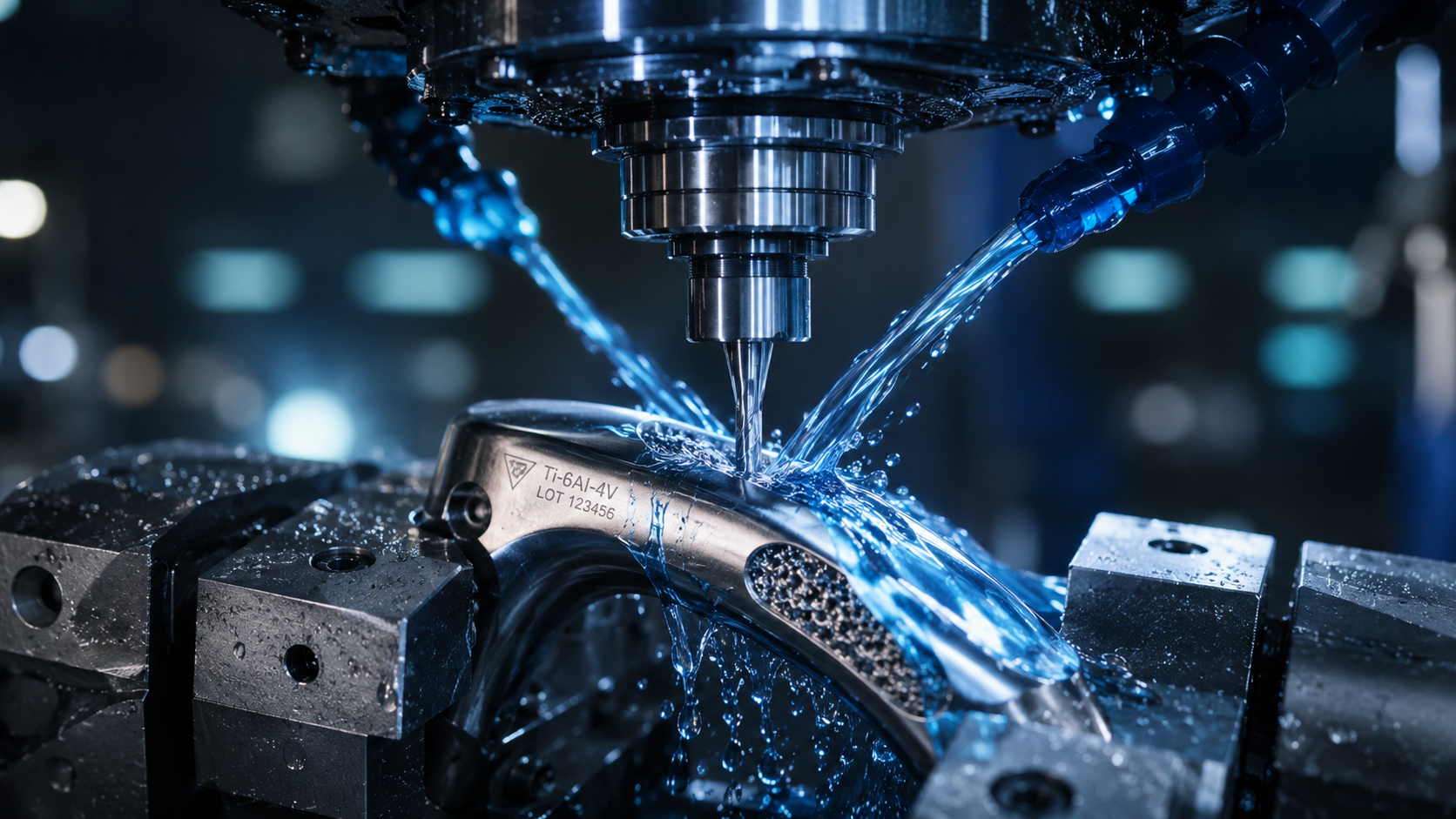
- Titanium Grade 5 (Ti-6Al-4V) — The workhorse of orthopedics. Its poor thermal conductivity means we must use aggressive high-pressure coolant and slow speeds to prevent work-hardening. Tool wear prediction is vital here.
- Cobalt-Chromium (CoCr) — Chosen for its extreme wear resistance in knee implants. It’s unforgiving to cut, demanding rigid setups and carbide tools with advanced coatings like AlTiN.
- 316L Stainless Steel — Still common for surgical instruments and temporary implants. Its machinability is decent, but passivation post-processing is mandatory to restore corrosion resistance.
- PEEK (Polyether Ether Ketone) — A high-performance polymer increasingly used for spinal interbody fusion cages. It absorbs moisture, so we store it in heated cabinets and machine it with sharp, polished tools to avoid delamination.
Every material we machine is supplied with full material certifications and undergoes incoming inspection using XRF analyzers to confirm chemistry before a single chip is made.
Quality & Regulatory: Beyond ISO 13485
Having an ISO 13485 certificate on the wall is just the starting point. Real-world medical machining means living inside a process validation universe. For a recent Class III implant project, our team executed IQ/OQ/PQ (Installation, Operational, Performance Qualification) on every CNC machine cell.
We documented everything: coolant concentration checks every two hours, tool wear graphs plotted against surface finish data, and full dimensional layouts on CMMs at defined intervals.
Non-negotiable practices in medical machining:
- Batch traceability: A permanent laser marking on each part links back to material heat, machine, operator, and inspection date.
- Cleanliness: Parts are cleaned in ultrasonic baths and, where needed, processed in ISO Class 7 cleanrooms before packaging.
- Documentation: A Device History Record (DHR) is compiled for each batch, proving every production step met the approved Device Master Record (DMR).

Why Choose XY-Global as Your Medical Machining Partner?
Medical components require more than standard machining capability. They demand stable processes, strict inspection, material traceability, and a supplier who understands the risks behind every critical dimension.
At XY-Global, we support medical device projects with ISO 13485:2016 and ISO 9001:2015 certified quality management, precision CNC machining experience, and a strong focus on manufacturability from the early design stage. Before production, our engineering team can review drawings, tolerances, materials, surface requirements, and inspection points to help reduce machining risk and avoid unnecessary cost.
For medical parts, inspection is not only a final step — it is part of the whole manufacturing process. XY-Global can provide dimensional inspection, CMM reports, first article inspection support, and quality documentation according to project requirements. For critical features such as tight diameters, alignment surfaces, threads, and mating areas, we focus on process stability rather than simply producing parts that “look correct.”
We also understand that medical customers need clear communication and reliable project control. From prototype to small-batch and production runs, XY-Global helps manage material selection, DFM review, machining, finishing, inspection, and delivery with a practical, engineering-driven approach.
A good medical machining partner should not only make the part. It should help reduce the technical, quality, and supply risks behind the part. That is where XY-Global aims to provide long-term value for medical device manufacturers.
Conclusion
The medical device machining process is where manufacturing meets medicine. It’s about building a chain of trust from raw material to sterile delivery. By understanding the interplay between advanced machining technologies, validated processes, and unwavering quality culture, you empower your devices to perform flawlessly when they are needed most.
FAQ
What tolerances are achievable in medical machining?
Typically, ±0.01 mm on CNC turning and milling, with ±0.005 mm on Swiss machines. Some micro-features are held even tighter, but you must correlate tolerance with measurable capability studies.
How do you ensure biocompatibility after machining?
It starts with non-toxic cutting fluids. After machining, parts undergo passivation (for stainless steel), anodizing (for titanium), or simply extensive cleaning and passivation cycles. Final validation is through cytotoxicity, sensitization, and irritation testing per ISO 10993.
What is the typical lead time for custom medical implants?
Patient-specific implants can be machined from a CT-derived CAD model in 24–48 hours using digital manufacturing workflows. Production runs of standard implants typically run 6–12 weeks, largely driven by raw material procurement and finishing steps like hydroxyapatite coating.
Can PEEK be machined on standard CNC equipment?
Yes, but you must control humidity, use exceptionally sharp tools, and avoid excessive heat. Internal stresses can warp thin sections, so stress-relieving and gentle clamping are essential.

分享:
CNC Optical Part Prototype for Precision Optical Device Development
Optical Precision Machined Components for High-Accuracy Optical Systems