


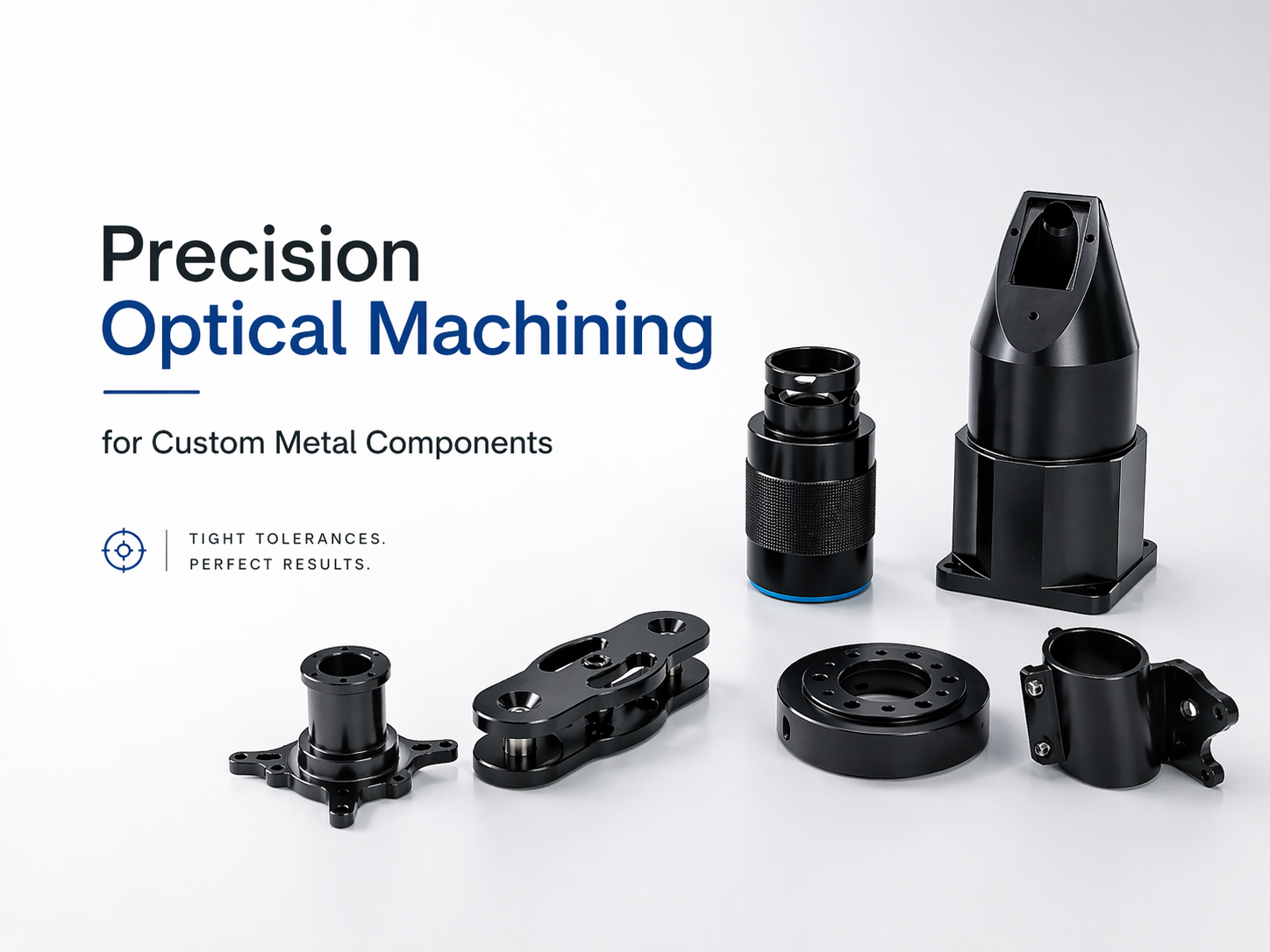
In many high-performance optical systems, precision is not only about the lens itself. The metal components around the optical path also play a critical role in alignment, stability, and assembly consistency. This is where precision optical machining becomes important.
In this context, precision optical machining does not refer to glass lens production or optical coating. Instead, it refers to the precision machining of custom metal components used in optical systems, such as lens barrels, optical housings, mounts, retainers, spacers, and alignment parts.
These parts may look like structural components, but their machining quality can directly affect how well the full optical system performs.
For manufacturers working on imaging devices, medical optics, analytical equipment, or industrial optical assemblies, choosing the right machining approach for these metal parts is essential.
What Is Precision Optical Machining?
Precision optical machining refers to the manufacturing of metal components that support, position, protect, or align optical elements inside a system.
Unlike standard industrial machining, this type of work usually involves tighter tolerances, more complex fit requirements, and stricter control of coaxial features, threads, and mating surfaces.
Many optical assemblies rely on custom metal parts to hold lenses in place, maintain optical spacing, and ensure stable assembly during operation. If these parts are not machined accurately, even a well-designed optical system may face problems during assembly or performance verification.
That is why precision optical machining is often associated with optical mechanical components rather than simple machined hardware. The goal is not only to make the part to print, but also to make sure the part supports optical alignment, assembly repeatability, and long-term structural stability.
Common Custom Metal Components Used in Optical Systems
Many optical devices depend on machined metal parts to create a stable and accurate mechanical platform for internal optical elements. These components are often custom-designed based on the structure of the product and the performance requirements of the system.
Lens Barrels
Lens barrels are among the most common parts in precision optical machining. They are used to hold optical elements in position and maintain the relationship between inner bores, shoulders, threads, and outer reference surfaces.
In many cases, the machining quality of the lens barrel directly affects concentricity, assembly smoothness, and optical axis consistency.
Optical Housings
Optical housings are used to support and protect internal assemblies while providing mounting interfaces to the rest of the device. These parts may include internal cavities, threaded features, mounting holes, and critical reference surfaces.
Their role is not only structural. They also contribute to alignment stability and assembly precision.
Mounts and Retainers
Mounts and retainers are typically used to fix or position lenses, filters, mirrors, or other sensitive internal components. These parts are often small, but their dimensional consistency is important. Poor machining can lead to uneven holding force, unstable fit, or alignment shift during assembly.
Spacers, Rings, and Sleeves
Spacers, rings, and sleeves are frequently used to control axial distance, locate components, or create repeatable stacking relationships inside the assembly. Even though these parts may seem simple, they often require accurate thickness, clean contact surfaces, and reliable dimensional control.
Why Precision Matters in Optical Metal Component Machining
In optical assemblies, metal parts are not passive support pieces. They influence how optical elements are positioned and how consistently the system can be assembled. This is why precision optical machining is critical for custom metal components.
For example, small variations in concentricity may affect the relationship between the lens and the housing. Inaccurate threads may change assembly feel or introduce tilt. Poor control of mating surfaces may reduce repeatability during installation.
These issues are not always visible at first glance, but they can create serious downstream problems when the full product enters testing or production.
Compared with ordinary machined parts, optical metal components often require closer attention to:
- concentricity between inner and outer features
- coaxial alignment of stepped bores and threaded sections
- stable assembly fit
- fine thread quality
- tight tolerance control
- repeatability from prototype to production
This is why precision optical machining requires more than general machining experience. It requires an understanding of how machined metal parts interact with optical assemblies in real applications.
How CNC Machining Supports Precision Optical Components
CNC machining plays a central role in producing custom parts for optical systems. Different machining methods are suitable for different component types, and the process strategy must match the structure and function of the part.
For rotational parts such as lens barrels, sleeves, and threaded rings, CNC turning is often the most effective process. It helps achieve good control over diameters, bores, shoulders, and thread features. When properly planned, turning can also support better concentricity between internal and external geometries.
For more complex structural parts such as optical housings or custom mounts, CNC milling is commonly used. It allows greater flexibility for machining pockets, mounting surfaces, side holes, reference planes, and irregular geometries.
In some cases, multi-axis machining may be preferred to reduce repositioning and improve feature accuracy.
In precision optical machining, process control matters as much as equipment. A well-designed fixture, reasonable machining sequence, and stable inspection plan all contribute to better consistency.
This is especially important when moving from prototype quantities to small-batch or production runs.

What to Consider When Designing Custom Optical Metal Components
A good optical metal part is not defined only by its shape. It also needs to be manufacturable, inspectable, and stable during assembly. That is why design decisions have a strong impact on the success of precision optical machining.
One important point is tolerance allocation. Not every feature needs the tightest tolerance. Critical dimensions should be based on actual function, such as alignment, spacing, or fit. Over-constraining the drawing can increase cost and machining difficulty without adding real value.
Another important factor is geometry. Thin walls, fine grooves, deep bores, narrow slots, and small threads may all increase machining risk if they are not designed with manufacturability in mind.
In custom optical parts, these features are common, so early DFM review is especially helpful.
Surface treatment must also be considered from the beginning. In optical assemblies, finishes such as black anodizing or other surface treatments may be needed for appearance, protection, or light control.
However, finishing should not interfere with critical dimensions, threaded areas, or key contact surfaces.
For this reason, the best results usually come from collaboration between design and manufacturing early in the project. When the machining supplier understands the functional goal of the part, it becomes easier to recommend workable solutions before issues appear in production.
How to Choose a Precision Optical Machining Supplier
Not every machining supplier is suitable for optical metal components. A supplier may be able to machine standard industrial parts well, but that does not automatically mean they understand the special needs of precision optical machining.
When evaluating a supplier, it is helpful to consider whether they have experience with parts such as lens barrels, optical housings, retainers, and custom mounts.
These parts often require tighter control of fit, geometry, and surface condition than ordinary components.
It is also important to check whether the supplier can support different project stages. In many optical projects, the work begins with prototypes, then moves into small-batch validation, and later into repeat production. A capable supplier should be able to maintain consistency across these stages rather than treating each order as a completely separate job.
Other useful considerations include:
- ability to review drawings and provide DFM feedback
- understanding of optical mechanical tolerances
- control of both dimensions and surface quality
- inspection capability for critical features
- process stability for repeat production
A strong machining partner does more than simply produce parts. They help reduce risk, improve manufacturability, and support the project from development to delivery.
From Prototype to Production for Custom Optical Metal Components
The path from prototype to production is especially important in optical projects. A part that works in one prototype build may still face problems when moved into repeated assembly or larger quantities. That is why precision optical machining must be considered across the full project cycle.
In the prototype stage, the main goal is usually to verify design intent, fit, and assembly logic. This is the stage where issues related to thread engagement, spacing, shoulder position, or housing interface are often discovered. Fast feedback and design adjustment are valuable here.
In the small-batch stage, the focus usually shifts to consistency. The question is no longer only whether the part can be made, but whether it can be made repeatedly with the same quality.
This is where machining strategy, fixture control, and inspection planning become more important.
In production, stability becomes the priority. Repeatability, delivery control, and quality consistency all matter. For optical mechanical parts, even small variation between batches can affect downstream assembly or product performance. That is why the supplier’s process discipline is just as important as the original machining capability.
A supplier experienced in precision optical machining can help bridge these stages more smoothly. By reviewing manufacturability early and controlling the process carefully, they can reduce rework, improve predictability, and support a more efficient transition into production.

Why Custom Precision Optical Machining Supports Better System Performance
Optical system performance depends on more than the quality of the lens. The surrounding metal structure also affects how reliably that lens is positioned, secured, and integrated into the assembly. This is why custom precision optical machining is so important.
A well-machined lens barrel can improve alignment stability. A consistent housing can reduce assembly variation. A properly designed retainer or spacer can support more reliable positioning of sensitive elements.
These mechanical details may seem secondary, but they often have a direct effect on final product quality.
For companies developing precision optical devices, custom metal components are not just supporting hardware. They are part of the performance chain. When machining quality is high, the full system is more likely to achieve better repeatability, smoother assembly, and more stable long-term use.
Conclusion
Precision optical machining is a key part of manufacturing custom metal components for modern optical systems. From lens barrels and optical housings to mounts, retainers, and spacers, these parts must do more than match a drawing. They must also support alignment, assembly consistency, and system stability.
For this reason, choosing the right machining supplier matters. A supplier that understands optical mechanical components, tight tolerance control, and the transition from prototype to production can provide more than parts alone. They can help improve manufacturability, reduce risk, and support better results across the whole project.
If your project involves custom metal components for optical assemblies, working with a team experienced in precision optical machining can make the process more efficient and the final product more reliable.
FAQ
What should be considered when designing optical metal components?
Key considerations include tolerance allocation, concentricity requirements, thread quality, wall thickness, surface treatment, and assembly function. Early DFM review can help improve manufacturability and reduce project risk.
What is the difference between optical lens manufacturing and precision optical machining?
Optical lens manufacturing usually refers to the production of glass or plastic lenses. Precision optical machining, in this context, focuses on custom metal components that hold, position, and support those optical elements within the system.
How do I choose a supplier for precision optical machining?
A good supplier should understand optical mechanical components, tight tolerance control, and the needs of both prototyping and production. Experience with lens barrels, housings, mounts, and related metal parts is also important. At XY-GLOBAL, we provide custom precision machining services for optical metal components, including lens barrels, optical housings, mounts, retainers, and other structural parts, with support from DFM review and prototyping to small-batch and production manufacturing.

分享:
What Are the Differences Between Low-Pressure and High-Pressure Die Casting?
Top Die Casting Companies for Precision Aluminum and Zinc Parts