


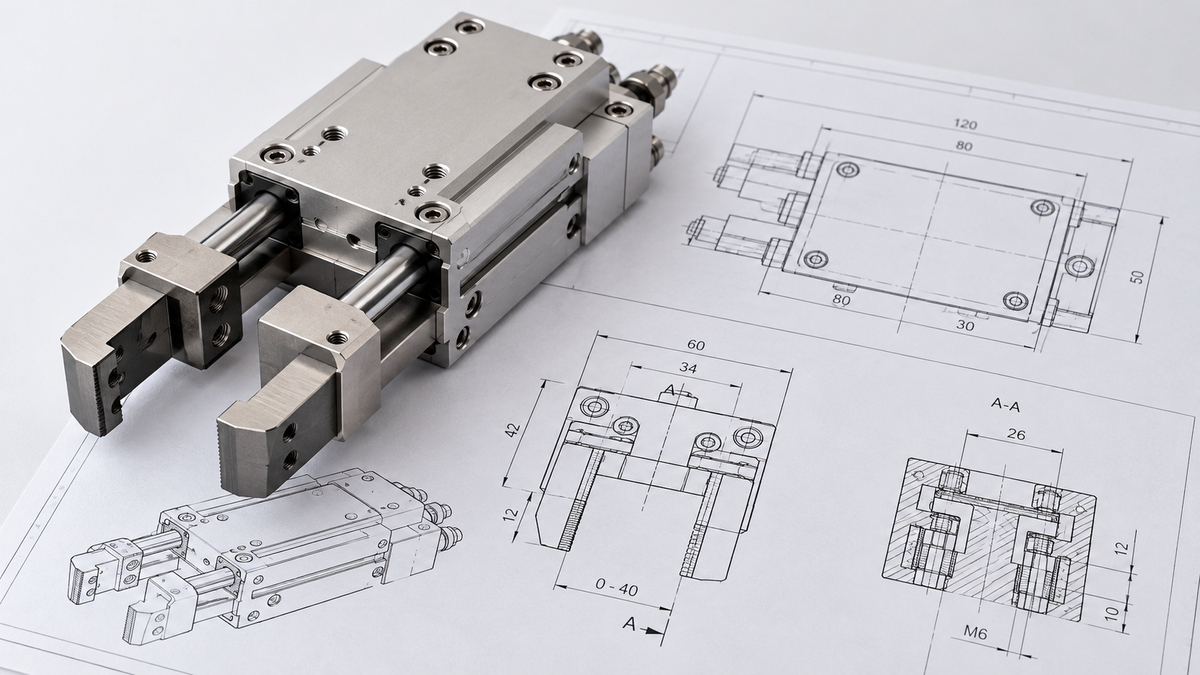
A robotic gripper may look perfect in CAD, but even small manufacturing errors can affect its performance. Misaligned jaws, inaccurate mounting holes, or excessive clearance can lead to unstable gripping and premature wear.
That's why precision manufacturing for robotic grippers isn't just about tight tolerances. It's about controlling the features that directly affect movement, alignment, and reliability.

Which Robotic Gripper Components Need Precision Manufacturing?
Not every component requires the same level of accuracy. The focus should be on parts that influence gripping performance and assembly.
Gripper bodies and housings need accurate guide surfaces, mounting holes, and bearing seats to keep moving components properly aligned.
Gripper jaws and fingers require controlled geometry and surface finishes to grip workpieces securely without causing damage.
Mounting plates and flanges must maintain accurate positioning between the gripper and robot arm.
Pins, shafts, and linkages require suitable fits to minimize friction, unwanted movement, and wear.
The key is identifying critical features rather than applying unnecessarily tight tolerances to every dimension.
Choosing the Right Manufacturing Process for Robotic Grippers
CNC machining is widely used for robotic grippers, but MIM, die casting, and injection molding can also be suitable depending on part complexity and production volume.
CNC Machining for Custom Gripper Parts
CNC machining is ideal for custom gripper bodies, jaws, and mounting components, especially when tight tolerances or frequent design changes are involved.
It allows manufacturers to produce prototypes directly from CAD models without dedicated tooling. For complex parts, 5-axis machining can reduce setups and improve the consistency of critical features.
However, machining costs can increase for intricate components produced in large quantities.

Metal Injection Molding for Small Components
MIM is worth considering for small, complex components such as miniature linkages and locking mechanisms, particularly in higher-volume production.
It can produce intricate geometries with less material removal than conventional machining. However, tooling costs, sintering shrinkage, and secondary machining requirements must be considered.
For low-volume or frequently modified designs, CNC machining is often the more practical option.
Die Casting and Plastic Injection Molding
For higher-volume production, aluminum or zinc die casting may be suitable for gripper housings and structural bodies.
Casting can reduce material removal compared with machining an entire housing from solid stock. Critical bearing seats, mounting surfaces, or locating holes may still require CNC finishing.
Plastic injection molding is another option for protective covers, non-load-bearing components, and suitable replaceable contact elements.
The following comparison provides a practical starting point.
| Process | Suitable Components | Main Consideration |
|---|---|---|
| CNC Machining | Bodies, jaws, plates, shafts | Flexible for prototypes and tight-tolerance features |
| MIM | Small linkages, locking parts | Tooling and sintering control |
| Die Casting | Housings, structural bodies | Volume and secondary machining |
| Plastic Injection Molding | Covers, contact elements | Tooling, material behavior, production quantity |
The final manufacturing process should be selected according to geometry, functional requirements, quantity, and total production cost.
Material Selection for Robotic Gripper Components
Material selection affects gripper weight, stiffness, wear resistance, and operating life.
Aluminum 6061-T6 is commonly used for gripper bodies, mounting plates, and structural components. It offers good machinability, relatively low weight, and compatibility with anodizing.
Aluminum 7075-T6 may be considered when higher strength is needed without substantially increasing component weight. However, its environmental suitability and surface treatment requirements should be evaluated.
Stainless steels such as 304, 316L, and 17-4PH are options for components requiring corrosion resistance, higher strength, or specific mechanical properties.

For replaceable contact elements, engineering plastics such as POM can be useful where low friction, dimensional stability, or reduced risk of scratching the workpiece is important.
No single material is ideal for every gripper.
A gripper handling polished electronic components has different surface-contact requirements from one handling heavy metal workpieces. Material selection should therefore begin with the gripping task rather than a preferred manufacturing method.
Critical Tolerances That Affect Gripper Performance
In precision manufacturing for robotic grippers, not every dimension requires an extremely tight tolerance.
The important question is which dimensions directly affect motion, alignment, and gripping consistency.
Jaw Alignment and Parallelism
For parallel-jaw grippers, the relationship between guiding surfaces and jaw mounting interfaces is particularly important.
Excessive misalignment may cause uneven contact, increased friction, or unreliable jaw movement.
Parallelism, flatness, and positional tolerances should be defined according to the mechanical design.
Bearing Fits and Locating Features
Bearing seats, dowel holes, and locating bores often require more attention than external dimensions.
For suitable CNC-machined features, tolerances around ±0.005 mm may be evaluated when required. Actual feasibility depends on part geometry, material, measurement method, and manufacturing conditions.
Applying the same tolerance across an entire component can unnecessarily increase cost.
Weight and Structural Stability
Removing material can reduce gripper weight and robot payload demand, but excessive material removal may reduce stiffness.
Thin walls, deep pockets, and long fingers can also introduce manufacturing distortion or deflection under load.
Engineers should balance weight reduction with structural rigidity and dimensional stability.
Surface Finishing and Quality Inspection
Surface finishing can influence gripper performance as well as appearance.
Anodizing is frequently used on aluminum bodies to improve corrosion resistance and surface durability. However, coating thickness must be considered around tight-fitting holes, mating surfaces, and threaded features.
For steel components, passivation, plating, hardening, or other treatments may be appropriate depending on the material and operating environment.
Inspection should focus on functional dimensions rather than visual appearance alone.
Typical quality checks include:
-
CMM inspection for hole positions and geometric tolerances
-
Bore gauges and pin gauges for critical fits
-
Surface roughness measurement on specified interfaces
-
Visual inspection for burrs, damage, and coating defects
-
Assembly-fit verification where required

For components produced in repeated batches, first article inspection and appropriate in-process checks help identify dimensional variation before it affects assembly.
A precision-machined component should not only pass inspection individually. It should also fit its mating components under the intended assembly conditions.
Moving from Prototype Manufacturing to Production
A successful gripper prototype does not automatically mean the design is ready for economical volume production.
Early prototypes often use CNC machining because it allows rapid modifications to jaw geometry, mounting interfaces, and overall structure.
Once the design is validated, manufacturers can review opportunities to reduce production cost.
These may include simplifying machining features, combining components, improving fixturing, or changing suitable parts to MIM, die casting, or injection molding.
However, a process change can affect dimensions, mechanical properties, surface finish, and assembly behavior.
Critical interfaces should therefore be revalidated before approving a new manufacturing method for production.
For procurement teams, comparing only the unit price can be misleading. Tooling costs, inspection requirements, production volume, and possible design changes should all be included in the decision.
Custom Robotic Gripper Manufacturing with XY-GLOBAL
XY-GLOBAL supports precision manufacturing for robotic grippers and other custom mechanical components used in robotics and industrial automation.
Our manufacturing capabilities include 3-axis and 5-axis CNC machining, CNC turning, MIM, die casting, surface finishing, dimensional inspection, and precision assembly support.
We work with customers from prototype development through repeat production, including DFM review and manufacturing-process evaluation.
Operating under ISO 9001 and ISO 13485 quality management systems, we can also support project-specific inspection and documentation requirements.
If you are developing custom robotic grippers, end effectors, or automation components, send us your 2D drawings, 3D CAD files, material specifications, and estimated quantities.
Our engineering team can review the design and recommend a practical manufacturing approach.
Contact XY-GLOBAL to discuss your custom precision manufacturing project.
FAQ
What files are needed to quote custom robotic gripper parts?
A STEP or IGES 3D model and a 2D engineering drawing are recommended. Include material, quantity, critical tolerances, surface treatments, and any assembly or inspection requirements.
Can different materials be combined in one robotic gripper assembly?
Yes. Aluminum bodies, stainless steel mechanical parts, and engineering plastic contact elements can be combined when the design supports their different mechanical and thermal properties.
How should replaceable gripper fingers be designed?
Replaceable fingers should have clearly defined mounting interfaces, repeatable locating features, and accessible fasteners. This allows worn fingers to be exchanged without unnecessarily replacing the complete gripper.
Can a gripper be manufactured from an existing physical sample?
Reverse engineering may be possible when sufficient dimensional and functional information is available and the customer has the appropriate design rights. Critical fits and performance requirements should be confirmed before manufacturing replacement parts.

分享:
Electronics CNC Machining for Precision Electronic Parts
CNC Machining Services for Hydraulic Manifolds: Why Internal Burrs Matter