


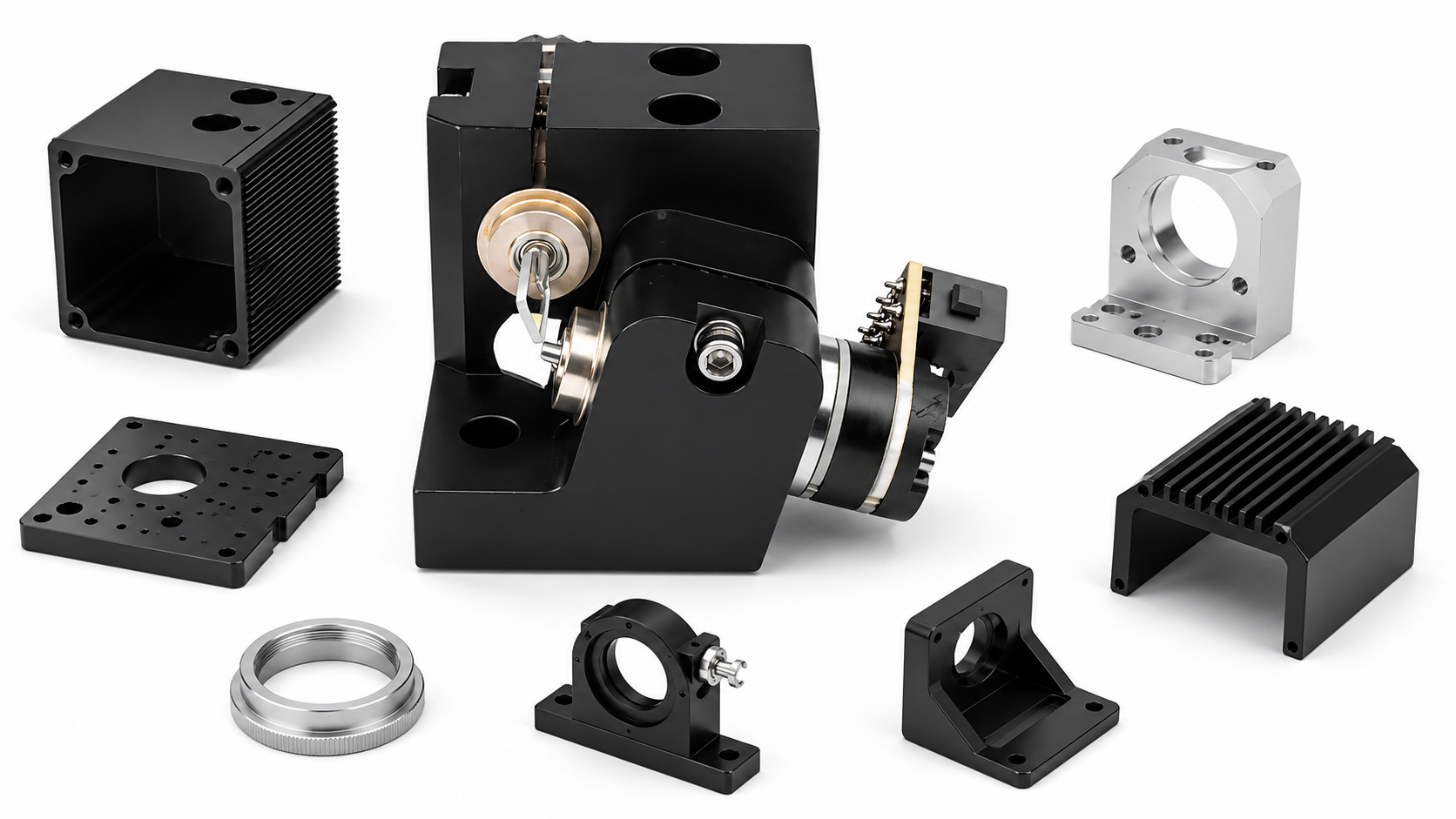
In optical equipment, the mechanical parts around lenses, mirrors, sensors, and laser modules are just as important as the optical elements themselves. A small error in a lens barrel, mirror holder, spacer, or mounting bracket can affect alignment, focus stability, and final assembly performance.
XY-GLOBAL provides optical precision manufacturing services for custom optomechanical components used in imaging systems, laser equipment, inspection devices, medical-related optical instruments, and precision industrial assemblies.
Our focus is not optical glass, lens grinding, or coating. We manufacture the precision mechanical components that hold, position, protect, and support optical elements.

What We Manufacture for Optical Systems
Optical precision manufacturing is different from general CNC machining. These parts often require tighter dimensional control, cleaner edges, stable surface treatment, and careful inspection of assembly-related features.
Typical parts we support include lens barrels, optical housings, mirror mounts, holders, spacers, rings, adapters, brackets, positioning blocks, and small high-precision structural parts.
| Custom Optical Component | Common Material | Key Manufacturing Focus |
|---|---|---|
| Lens Barrels | Aluminum, stainless steel, brass | Inner diameter, thread fit, coaxiality, black anodizing |
| Optical Mirror Mounts | Aluminum, stainless steel | Flatness, hole position, mounting surface stability |
| Precision Spacers and Rings | Aluminum, stainless steel, ceramic | Thickness, parallelism, burr control |
| Optical Brackets and Holders | Aluminum, titanium, stainless steel | Positioning accuracy, rigidity, assembly fit |
| Laser Module Housings | Aluminum, copper alloy | Heat dissipation, surface finish, dimensional stability |
| Camera and Imaging Parts | Aluminum, stainless steel | Lightweight structure, clean edges, repeatable assembly |
| Ceramic Insulating Parts | Alumina, zirconia | Insulation, wear resistance, dimensional stability |
Most of these parts are made according to customer drawings and 3D models. Before production, we review which features directly affect optical alignment and which areas can follow standard tolerance to avoid unnecessary cost.
Reference Manufacturing Capabilities
Different optical parts require different control points. A lens barrel may need accurate inner diameter and coaxiality, while a mirror holder may require flatness and hole position accuracy. For small spacers, thickness and parallelism may be more important than external shape.
The following values are reference ranges for common precision optomechanical parts. Final capability depends on part size, material, geometry, surface treatment, and inspection method.
| Manufacturing Item | Reference Capability |
| Process Options | CNC milling, CNC turning, 5-axis machining, grinding, polishing, surface finishing |
| Common Tolerance Range | ±0.01 mm to ±0.02 mm for many precision machined features |
| Critical Local Features | ±0.005 mm can be evaluated after drawing review |
| High-Precision Grinding Features | ±0.001 mm to ±0.003 mm may be possible on selected features |
| Surface Roughness | Ra 1.6 μm typical machined finish; Ra 0.8 μm / Ra 0.4 μm or better can be discussed |
| Materials | Aluminum 6061 / 7075, stainless steel 304 / 316L / 17-4PH, titanium, brass, copper alloy, PEEK, POM, ceramic |
| Surface Treatment | Black anodizing, hard anodizing, passivation, plating, polishing, sandblasting |
| Inspection Options | CMM inspection, height gauge, micrometer, thread gauge, surface roughness inspection, visual inspection |
For optical precision parts, we do not suggest applying the tightest tolerance to every dimension. A better approach is to identify the critical optical or assembly features first, then control those areas carefully.

Material Selection for Optical Mechanical Parts
Aluminum is one of the most common materials for optomechanical components. It is lightweight, easy to machine, and suitable for black anodizing. For many lens barrels, optical housings, and brackets, aluminum 6061 or 7075 is a practical choice.
Stainless steel is used when higher strength, wear resistance, or better long-term assembly stability is required. For compact parts that need strength and low weight, titanium may also be considered.
Copper alloys can be used when thermal conductivity is important, such as in some laser or heat-sensitive optical modules. Engineering plastics and ceramics may be selected for insulation, low weight, or special application requirements.
The material should be selected based on the actual function of the part, not only the drawing shape.
Application Example: Custom Aluminum Lens Barrel
One customer needed a small aluminum lens barrel for an imaging device. The part included an inner bore, external thread, positioning shoulder, and several small mounting holes. The main requirement was stable lens positioning during assembly.
After reviewing the drawing, we identified four key control points: inner diameter, thread fit, shoulder height, and coaxiality. The non-critical outer surfaces followed standard machining tolerance, while the optical assembly areas were inspected more carefully.
The part was CNC turned and milled, then finished with black anodizing. Before shipment, we checked the thread, inner diameter, and main assembly dimensions to confirm consistency.
This type of part looks simple, but small errors in the bore, thread, or positioning shoulder can affect optical alignment. That is why drawing review and inspection planning are important before production.

Why XY-GLOBAL for Optical Precision Manufacturing Services
XY-GLOBAL supports custom optical precision parts from prototype to small batch and repeat production. Our strength is not only machining parts according to drawings, but also helping customers review manufacturability before production.
We can support:
- Custom optomechanical parts based on 2D drawings and 3D models
- CNC milling, turning, 5-axis machining, grinding, and finishing
- Black anodized aluminum parts for optical assemblies
- Stainless steel, titanium, copper alloy, plastic, and ceramic precision parts
- Prototype samples, small batches, and repeat production
- Inspection reports for critical dimensions when required
For optical projects, we pay special attention to burr control, surface finish, hole position, thread quality, flatness, coaxiality, and assembly-related dimensions. These details often decide whether the final optical system can be assembled smoothly.
What We Need for a Quotation
To quote optical precision manufacturing services accurately, please provide a 2D drawing with tolerances and a 3D model if available. STEP, STP, X_T, IGS, and PDF files are commonly used.
It is also helpful to share the material, quantity, surface treatment, critical dimensions, inspection requirements, and the function of the part in the optical assembly.
If you are not sure which dimensions are critical, you can tell us how the part is used. We can help review the drawing and suggest which areas need tighter control.
FAQ
What are optical precision manufacturing services?
Optical precision manufacturing services refer to the production of precision mechanical parts used in optical systems, such as lens barrels, mirror mounts, spacers, housings, brackets, and holders.
Do you manufacture optical lenses?
No. We mainly manufacture optomechanical components used around lenses, mirrors, sensors, and laser modules. We do not focus on optical glass grinding or lens coating.
Can you make black anodized optical parts?
Yes. Aluminum optical components can be black anodized when required. This is common for lens barrels, housings, mounts, and other parts where reflection control or surface protection is needed.
Can you support tight tolerance optical parts?
Yes, depending on the material, size, geometry, and inspection method. Critical local features such as holes, bores, mounting faces, or ground surfaces can be reviewed separately.
What files are needed for quotation?
A 2D drawing with tolerances is recommended, and a 3D model is helpful for complex parts. Please also provide material, quantity, surface treatment, and critical dimensions.

分享:
Custom Sheet Metal Parts For Liquid Cooling Systems In AI Servers And Data Centers
CNC Machined LiDAR Components: Precision Manufacturing for Optical Sensing Systems