


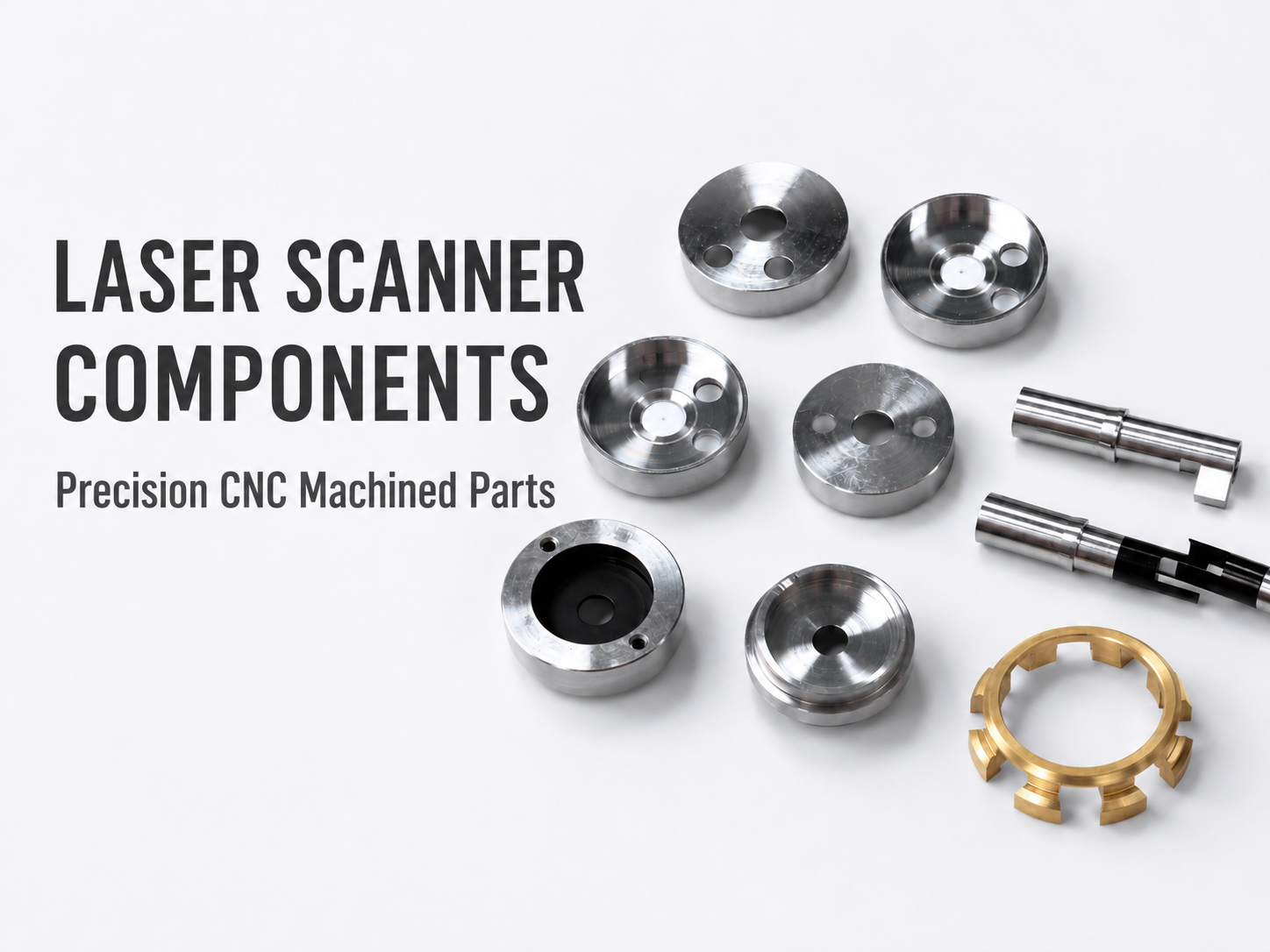
Laser scanner components are precision mechanical parts used inside laser scanning modules, optical inspection systems, measuring devices, and other laser-based equipment.
Although these parts may look like simple metal rings, sleeves, shafts, or small housings, they play an important role in positioning the laser beam, holding optical elements, controlling stray light, and keeping the scanning system stable during operation.
In many laser scanner assemblies, the performance of the optical system depends not only on the laser source or sensor, but also on the accuracy of the mechanical parts around them. A small deviation in the center hole, mounting surface, or optical channel can affect beam alignment, signal stability, and measurement accuracy.

Where Are Laser Scanner Components Used?
Laser scanner components are used in many industries where laser beams are used for scanning, measuring, positioning, or inspection.
1. Industrial Laser Scanning Systems
In industrial automation, laser scanners are often used for distance measurement, profile scanning, object detection, and surface inspection. The metal components inside these systems must hold the optical path accurately and maintain stable alignment during long-term operation.
Used for 3D measurement, defect inspection, dimension control, robotic positioning, and inline QC.
For these systems, the mechanical parts must be stable, repeatable, and resistant to vibration or assembly stress.
2. 3D Scanners and Measurement Equipment
Laser-based 3D scanners use optical modules to project and receive laser signals. The accuracy of the scan depends heavily on the relationship between the laser source, lens, mirror, sensor, and housing.
CNC machined laser scanner components help maintain:
- Correct optical centerline
- Stable lens position
- Accurate beam direction
- Consistent sensor alignment
- Reduced assembly deviation
Even small errors in the mechanical structure may cause scanning distortion or unstable measurement results.
3. LiDAR and Optical Sensing Modules
Laser scanner components can also be found in LiDAR systems and optical sensing modules. These systems are used in robotics, automation, mapping, smart equipment, and navigation-related applications.
In this type of product, machined parts may be used to:
- Hold laser emitters
- Position receiving optics
- Support rotating or scanning structures
- Protect internal optical elements
- Control unwanted light reflection
The parts are often compact, thin-walled, and highly integrated, which makes CNC machining quality especially important.
Why Precision CNC Machining Matters for Laser Scanner Parts
Laser scanner parts are usually small, but their function is highly sensitive. A part may appear simple from the outside, but it may contain several critical features inside, such as center holes, stepped bores, mounting grooves, thin walls, side holes, and anti-reflection surfaces.
The main machining requirements usually include:
High Coaxiality
Many laser scanner components have a center hole, outer diameter, and internal step structure. If these features are not coaxial, the laser beam may not pass through the correct optical path.
Accurate Hole Position
Side holes are often used for screws, pins, light channels, or assembly positioning. Poor hole position can cause assembly problems or optical misalignment.
Burr-Free Edges
Burrs around small holes, grooves, and internal edges can affect assembly and may also create contamination inside the optical system.
Stable Surface Finish
Some surfaces need to be smooth for accurate positioning, while other areas may require matte or black treatment to reduce reflection.
Controlled Surface Treatment Thickness
Black anodizing, chemical blackening, plating, or coating may change the final dimensions of the part. For optical assemblies, coating thickness must be considered during machining and inspection.
Common Materials Used for Laser Scanner Components
Laser scanner components can be made from different materials depending on the design and working environment.
Common materials include:
| Material | Typical Use |
|---|---|
| Aluminum | Lightweight optical housings, lens holders, scanner covers |
| Stainless steel | Shafts, sleeves, high-strength mounting parts |
| Brass / Copper alloy | Retaining rings, conductive parts, precision support parts |
| Titanium | Lightweight and corrosion-resistant precision structures |
| Engineering plastics | Insulation, light shielding, or non-metallic internal parts |
Aluminum is often selected for optical housings because it is lightweight and easy to machine. Stainless steel is used when strength, wear resistance, or dimensional stability is required. Brass or copper alloy parts may be used for retaining, positioning, or electrical/thermal considerations.

Surface Treatment Considerations
Surface treatment is especially important for laser scanner and optical parts. Unlike general mechanical components, optical parts may need to control light reflection, glare, and internal scattering.
Common surface treatments include:
- Black anodizing
- Chemical blackening
- Nickel plating
- Passivation
- Polishing
- Fine turning surface
- Matte surface treatment
- Anti-reflective surface treatment
For parts inside the optical path, black treatment is often used to reduce stray light. However, not every black surface is suitable for optical use. The surface must be evaluated based on reflectivity, thickness, adhesion, and dimensional impact.
Key Manufacturing Challenges
Laser scanner components can be challenging to machine because they often combine small size, complex geometry, and high precision requirements.
Typical challenges include:
1. Thin-Wall Deformation
Some optical housings and sleeves have thin walls or large internal cavities. Improper clamping or machining sequence may cause deformation.
2. Internal Burrs
Small internal holes and deep grooves are difficult to deburr. Burrs inside the optical path may affect light transmission or assembly.
3. Concentricity Control
Round parts often require the center hole, outer diameter, and mounting step to remain aligned. This requires careful turning, milling, and inspection control.
4. Surface Reflection
A shiny machined surface may not always be suitable for optical use. Internal reflective surfaces may need blackening or matte treatment.
5. Assembly Fit After Coating
Surface treatment may add thickness or slightly change the final fit. For tight assemblies, this must be considered before production.
How XY-GLOBAL Supports Laser Scanner Component Manufacturing
XY-GLOBAL provides precision CNC machining support for optical and laser-related metal parts, including laser scanner components, optical housings, lens holders, aperture parts, shaft sleeves, and custom mounting structures.
We support customers from prototype to low-volume and production manufacturing. For laser scanner and optical module parts, our engineering team focuses not only on machining the shape, but also on the key functional details that affect assembly and optical performance.
Our support includes:
- CNC turning and milling for small precision parts
- Custom optical housing and sleeve machining
- Tight control of holes, grooves, steps, and datum surfaces
- Burr control for small holes and internal edges
- Surface finish and black treatment support
- DFM review before production
- Dimensional inspection based on drawing requirements
- Prototype and low-volume production support
For laser scanner components, small details can make a major difference. A center hole, side hole, groove, or blackened surface may directly affect alignment, light control, and final assembly reliability.
Conclusion
Laser scanner components are not just simple metal parts. They are precision mechanical elements that help control the position, direction, stability, and quality of the optical path inside laser scanning systems.
These parts are widely used in industrial inspection, 3D scanning, LiDAR, barcode readers, optical sensors, medical instruments, and laboratory equipment. Because laser scanner modules often require accurate alignment and stable optical performance.
The CNC machined parts inside them must be produced with careful attention to coaxiality, hole position, surface finish, burr control, and surface treatment thickness.
For customers developing laser scanner modules or optical scanning systems, working with an experienced precision CNC machining supplier can help reduce assembly risk and improve product reliability.
FAQ
Are laser scanner components the same as laser parts?
Not exactly. Laser parts may refer to the laser source or electronic parts, while laser scanner components often refer to the mechanical structures around the optical path, such as housings, holders, sleeves, rings, and mounting parts.
Why do laser scanner parts need high precision?
Laser scanning systems depend on accurate optical alignment. If a hole, lens seat, or mounting surface is slightly off-center, the laser beam may shift, which can affect scanning accuracy and signal stability.
What materials are used for laser scanner components?
Common materials include aluminum, stainless steel, brass, copper alloys, and sometimes titanium or engineering plastics, depending on strength, weight, thermal stability, and surface treatment requirements.


分享:
Custom Aluminum Die Casting Parts for Industrial Applications
Custom Optical Design: Why Precision Opto-Mechanical Parts Matter