


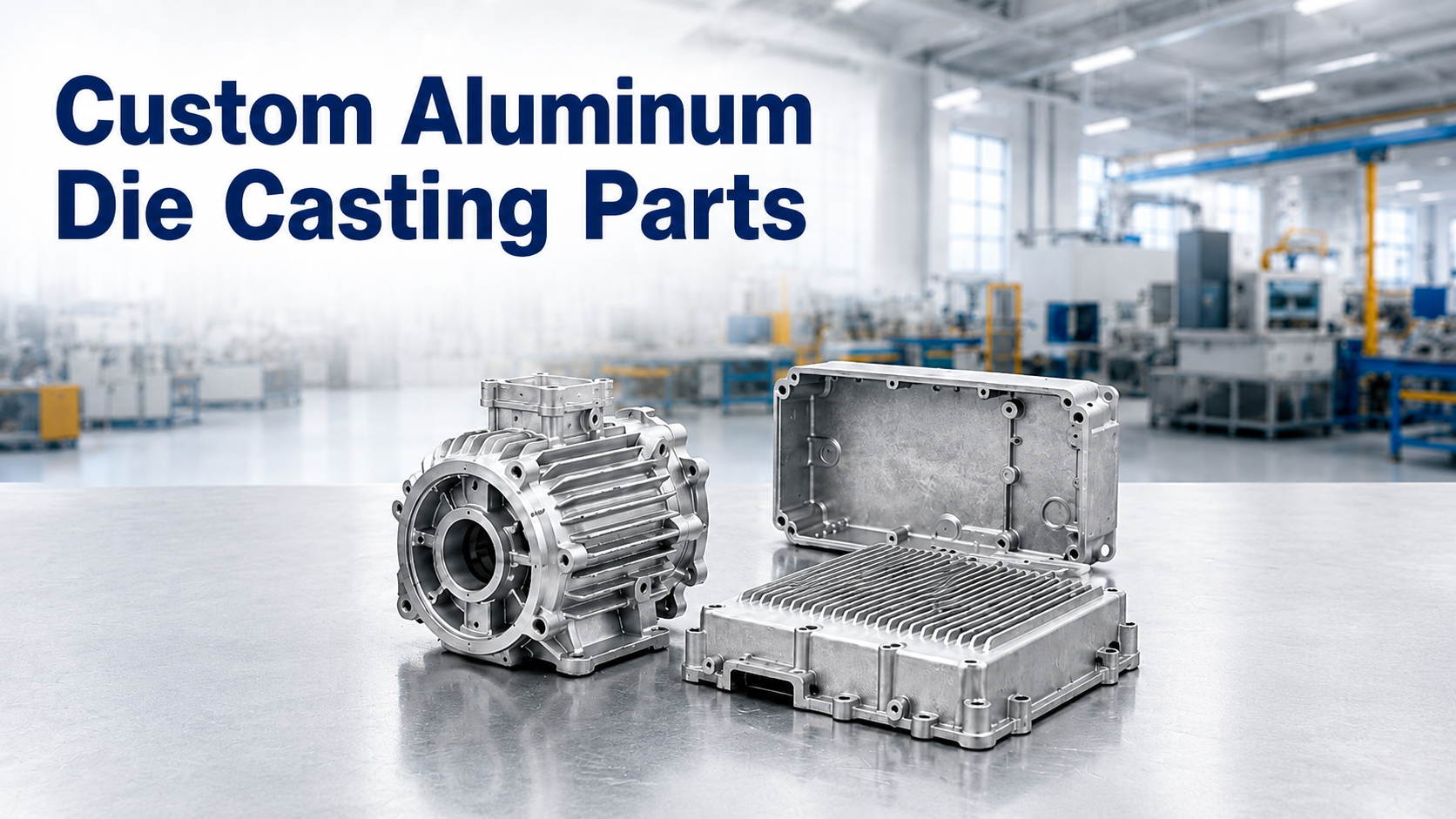
Custom aluminum die casting parts are widely used in industrial equipment, automotive systems, electronic housings, motor components, brackets, covers, and precision hardware. These parts are usually made according to customer drawings, product designs, or specific application requirements.
However, a die cast part is rarely only about casting. Many custom aluminum die casting parts also need CNC machining after casting. Critical holes, threads, sealing surfaces, mounting faces, bearing seats, and tight‑tolerance areas often require extra machining to meet final assembly requirements.
At XY‑GLOBAL, we support custom aluminum die casting projects from DFM review and mold development to die casting, CNC post‑machining, surface finishing, and final inspection. Our goal is to help you receive parts that are not only easy to cast, but also ready for real assembly and end‑use performance.

Why Aluminum Die Casting Works Well for Custom Metal Parts
Aluminum die casting is often chosen when a part needs a complex shape, stable batch production, and reasonable unit cost.
Compared with machining every part from a solid aluminum block, die casting can reduce material waste and production time when the quantity is suitable. The mold can form ribs, bosses, walls, holes, and outer shapes directly during casting.
This makes aluminum die casting useful for parts with structural details, such as housings, covers, brackets, motor components, electronic enclosures, and industrial hardware.
It is also suitable for medium to high-volume production. Once the mold is completed and the process is stable, die casting can produce parts with good repeatability.
Aluminum is also popular because it is lightweight, corrosion resistant, and suitable for many industrial applications. It can help reduce product weight while keeping enough strength for functional use.

When Does Custom Aluminum Die Casting Make Sense
Custom aluminum die casting usually makes sense when the part design is stable and the expected production volume is enough to support mold development.
If the project is still in the prototype stage, or the design may change many times, CNC machining may be faster and more flexible. But when the design is confirmed and the part needs repeated production, die casting can become a more practical route.
This is especially true when the part has a custom shape, medium to high production demand, and several functional areas that need stable quality. CNC post-machining can still be used for critical holes, threads, sealing surfaces, or mounting areas.
At XY-GLOBAL, we review the drawing, material, expected quantity, machining areas, and finishing requirements before production. This helps determine whether custom aluminum die casting is the right route for the project.
Materials for Custom Aluminum Die Casting Parts
Common aluminum die casting materials include ADC12, A380, A360, and other aluminum‑silicon alloys. These materials are widely used because they offer good castability, strength, corrosion resistance, and cost efficiency. They can meet the needs of many industrial and commercial products.
The right material depends on the part function. Some parts need better strength. Some need better corrosion resistance. Some need better thermal performance. Some need better surface treatment results. For example:
An electronic housing may need good dimensional stability and surface coating.
A motor part may need strength and accurate machining areas.
A heat‑related component may need better thermal conductivity.

Material selection should be reviewed together with the part design, production volume, surface finish, and working environment. At XY‑GLOBAL, we can help customers review material options based on the drawing and application requirements. This helps avoid choosing a material that looks fine on paper but creates problems during casting, machining, or finishing.
Surface Finishing Options for Die Cast Aluminum Parts
Many custom aluminum die casting parts need surface finishing after casting and machining. Surface treatment can improve appearance, corrosion resistance, wear resistance, and product protection. It can also help the part match the final product design.
Common surface finishing options include:
- Powder coating
- Painting
- Polishing
- E‑coating
- Bead blasting
- Chromate conversion coating
Surface finishing should be considered early in the project. It may affect the final dimensions, masking areas, appearance standard, and inspection method. For example, powder coating adds thickness to the surface. If a part has tight assembly areas, this coating thickness must be considered during machining and tolerance planning. Some surfaces may need masking before coating. Some holes may need to be machined after surface treatment.
These details matter. A good manufacturing plan should connect die casting, CNC machining, and surface finishing together. If each step is planned separately, problems may appear later during assembly or field use.
DFM Considerations for Custom Aluminum Die Casting Parts
DFM—design for manufacturability—is very important for custom aluminum die casting parts. Before mold development, the part design should be reviewed carefully. Wall thickness, draft angle, ribs, bosses, corners, holes, parting line, machining allowance, and surface treatment areas can all affect the final result.
A small design issue may create a big production problem. For example, uneven wall thickness may increase the risk of shrinkage or porosity, sharp corners may create stress concentration and a critical machined surface may not have enough extra material for CNC machining.
These problems are easier and cheaper to solve before tooling starts.
At XY‑GLOBAL, our team reviews the drawing before production and provides DFM feedback when needed. We check which areas can be formed by die casting, which areas should be CNC machined, and which surfaces need special attention during finishing and inspection. This early review helps reduce manufacturing risk and improves the chance of stable batch production.
Common Applications of Custom Aluminum Die Casting Parts
Custom aluminum die casting parts are used in many industries because they can combine complex shape, lightweight structure, and stable production.
Automotive Industry
Aluminum die cast parts may be used for housings, brackets, covers, and structural components. These parts often need strength, weight reduction, and consistent batch quality.
Electronics Industry
Die cast aluminum parts are often used for enclosures, heat sink structures, covers, and connector housings. These parts may need surface coating, accurate holes, and good appearance.
Industrial Equipment
Aluminum die casting can be used for machine housings, motor parts, pump components, handles, frames, and mounting parts. These components often need good durability and stable assembly fit.
Automation and Machinery
Custom die cast aluminum parts can help reduce weight while keeping enough strength for the working environment.
The application may be different, but the manufacturing logic is often the same: use die casting to form the main structure, then use CNC machining and finishing to complete the critical areas.
How XY‑GLOBAL Supports Custom Aluminum Die Casting Projects
At XY-GLOBAL, we support custom aluminum die casting projects from early design review to final production. Before tooling starts, our team reviews the drawing, part structure, material requirement, expected quantity, tolerance needs, and surface finish requirements.
This early review helps us check whether the part is suitable for die casting, whether the wall thickness is reasonable, and whether important areas need extra attention during mold design, machining, finishing, or inspection.
In one custom aluminum die casting project, a customer needed an aluminum housing with threaded holes, flat mounting faces, and powder coating. XY-GLOBAL reviewed the DFM details before tooling and supported casting, CNC post-machining, surface finishing, and final inspection.
After the manufacturing plan is confirmed, we can support mold development, aluminum die casting production, surface finishing, and final inspection. For parts with critical holes, threads, sealing surfaces, or assembly areas, CNC post-machining can also be arranged when needed.
Quality control is part of the full process. During production, we check casting condition, surface quality, key dimensions, machining areas, coating requirements, and final appearance based on the customer’s drawing and application needs.
The goal is not only to produce a cast aluminum part, but to deliver a part that can fit, assemble, and perform correctly in the final product.
Conclusion: Building Better Custom Aluminum Die Casting Parts
Custom aluminum die casting parts are not only about making aluminum parts with a mold. A good project needs the right design, suitable material, proper tooling, stable casting, surface finishing, inspection, and CNC post-machining when key features require higher accuracy.
Die casting helps form the main structure efficiently. Surface treatment improves protection and appearance. Inspection confirms whether the final part meets the drawing and application requirements. For critical holes, threads, sealing surfaces, mounting faces, or other precision areas, CNC machining can also be used to improve fit and function.
If your aluminum part needs a custom die cast structure with reliable finishing and inspection support, XY-GLOBAL can help review your drawings, material requirements, tolerance needs, and surface finishing plan.
Contact us to discuss your custom aluminum die casting project and find a practical manufacturing route for your parts.

分享:
Medical Parts Manufacturing: What Buyers Should Know Before Starting a Project
What Are Laser Scanner Components and Where Are They Used?