


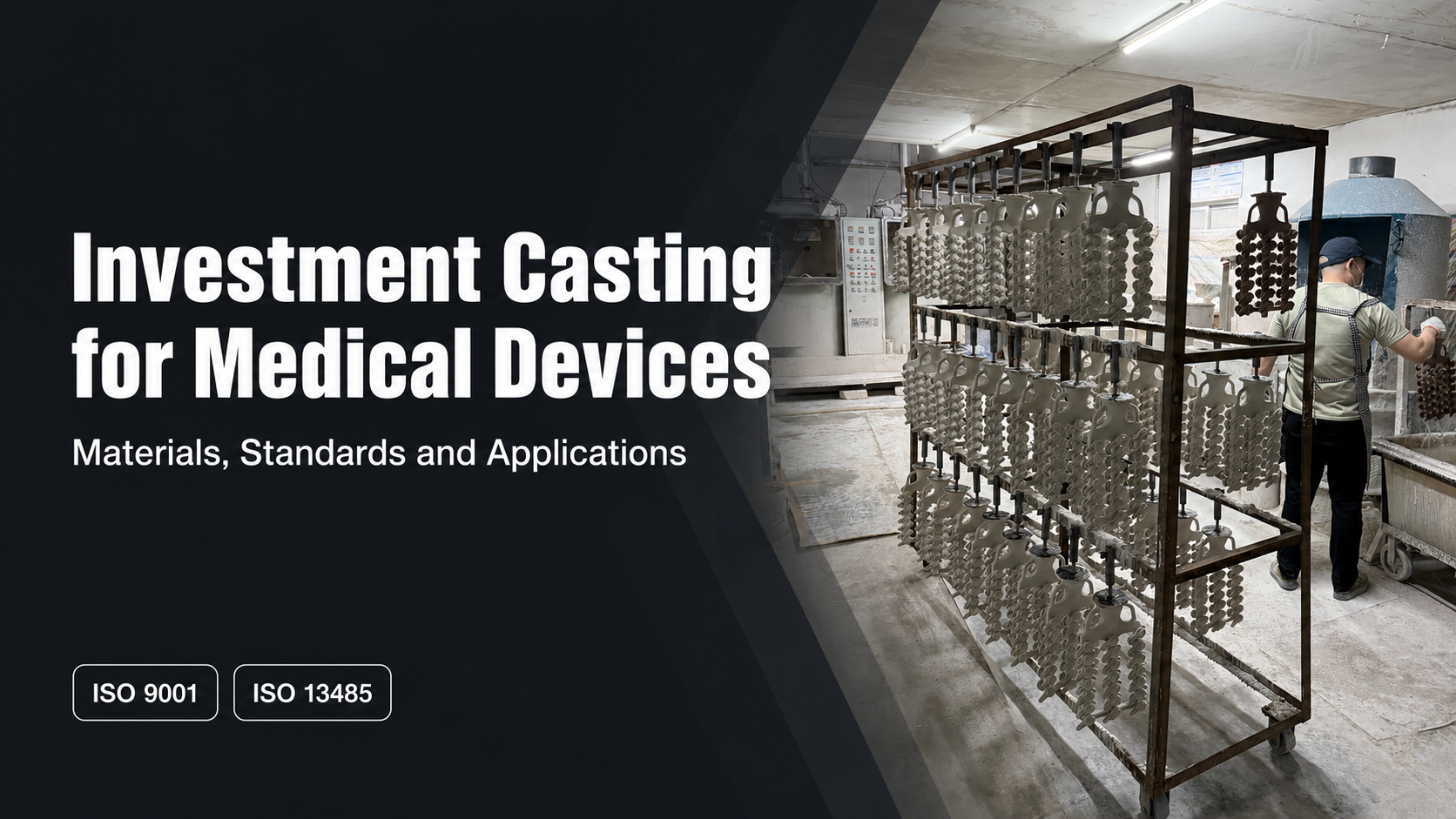
Medical device components face a constraint most industrial parts don't: the material has to be biocompatible, which immediately rules out most of the alloys that are easiest to manufacture with. A knee implant or a surgical instrument can't be made from aluminum or zinc regardless of how convenient the process would be — it has to be cobalt-chrome, implant-grade stainless steel, or titanium.
That constraint is what makes investment casting relevant here. Die casting is limited to non-ferrous alloys with low melting points, which excludes every material on the biocompatible list. Investment casting's ceramic shell can withstand the pouring temperatures those alloys require, making it one of the few near-net-shape processes capable of producing complex medical components in the materials the application actually demands.
This article covers the biocompatible alloys used in medical investment casting, the ASTM and ISO standards governing them, typical applications from orthopedic implants to surgical instruments, and the post-casting processing and traceability requirements that distinguish medical work from general industrial casting.

Why Investment Casting Suits Medical Components
Beyond material capability, investment casting fits medical work for a few practical reasons. The as-cast surface finish — typically Ra 3.2 μm or better — reduces the post-machining and polishing required to reach the smooth, cleanable surfaces medical devices need. Complex organic geometries common in orthopedic implants can be cast near-net-shape rather than machined from solid, which matters when the material is expensive and difficult to cut. And tooling cost is significantly lower than die casting, which suits the moderate production volumes typical of most medical device programs.
Biocompatible Alloys Used in Medical Investment Casting
| Alloy | Standard | Key Properties | Typical Use |
|---|---|---|---|
| CoCrMo (cobalt-chrome-molybdenum) | ASTM F75 | Exceptional wear resistance and strength, non-magnetic | Knee and hip joint implants, dental components |
| 316L stainless steel | ASTM F138 | Excellent corrosion resistance, low carbon content, cost-effective | Surgical instruments, temporary implants, hardware |
| Titanium and Ti alloys | ASTM F136 / F1108 | High strength-to-weight ratio, excellent biocompatibility, osseointegration | Permanent implants, spinal hardware |
The "L" in 316L designates low carbon content, which minimizes carbide precipitation during welding or heat treatment — precipitation that would otherwise compromise the corrosion resistance the material was chosen for in the first place. ASTM F138 additionally imposes strict limits on carbon, sulfur, and non-metallic inclusion content beyond standard 316L, which is why implant-grade material cannot be substituted with commercial-grade stock even when the alloy designation looks identical on a certificate.
Titanium's advantages and limitations in medical applications, including its behavior during machining operations, are covered in more depth in our article on titanium medical devices.

Applications in Medical Device Manufacturing
Orthopedic implants — knee and hip joint components, where CoCrMo's wear resistance directly determines implant service life under repeated articulation.
Spinal hardware — cages, plates, and fixation components requiring complex geometry in titanium or implant-grade stainless steel.
Surgical instruments — handles, jaws, ratchet mechanisms, and other components with intricate features that would be costly to machine from solid.
Dental components — frameworks and prosthetic components where CoCrMo's combination of strength and biocompatibility is well established.
Endoscopic instrument housings — complex small components requiring both dimensional accuracy and a cleanable surface finish.
Post-Casting Processing Requirements
An as-cast medical component is rarely a finished component. Several post-casting steps are effectively mandatory rather than optional:
Passivation — stainless steel components are passivated to remove free iron from the surface and restore the passive chromium oxide layer that provides corrosion resistance. Without it, an otherwise correct 316L part can corrode in service.
Precision machining — mating surfaces, threads, and dimensionally critical features are typically machined after casting, since as-cast tolerances of ±0.1–0.25 mm are not sufficient for interfaces that must fit precisely.
Surface finishing — polishing or electropolishing to achieve the smooth, cleanable surface required for sterilization and, in implants, for controlling tissue interaction.
Cleaning and inspection — removal of all casting residue, followed by dimensional and often visual/surface inspection against the device's specification.
Standards, Traceability and Documentation
What genuinely separates medical casting from industrial casting is often not the metal — it's the documentation trail around it. ISO 13485 is the quality management standard for medical device manufacturing, and it governs process control, change management, and record-keeping rather than any specific machining parameter.
Practically, this means each production lot needs material certification traceable back to the specific heat of alloy used, casting and heat treatment parameters recorded per lot, dimensional inspection results retained, and any process change documented and approved rather than made informally on the floor. For components going into an implant, this trail may need to remain retrievable for years after the device is placed. A supplier that can cast the alloy but can't produce this documentation is not a viable medical supplier, regardless of part quality.

Investment Casting vs Machining vs MIM for Medical Parts
| Process | Best Suited For | Limitation |
|---|---|---|
| Investment casting | Complex geometry, moderate volume, near-net-shape in implant alloys | As-cast tolerance requires post-machining on critical features |
| CNC machining | Tight tolerances, prototypes, low volume, simpler geometry | High material waste with expensive alloys; some geometries not machinable |
| Metal injection molding (MIM) | Small, complex, high-volume components | Part size limits; higher tooling investment than investment casting |
These processes are frequently combined rather than chosen exclusively — a cast component finished by precision machining on its critical interfaces is the most common configuration in medical work.
XY-Global's Medical Investment Casting Capability
At XY-Global, investment casting for medical components is supported under ISO 13485 and ISO 9001 certified processes, covering implant-grade stainless steel, cobalt-chrome, and titanium alloys with typical as-cast tolerances in the ±0.1–0.25 mm range. Because we also operate CNC machining in-house, cast components can move directly into precision finishing of critical interfaces without transferring between suppliers — which keeps the traceability chain intact and avoids the documentation gaps that arise when casting and machining sit with separate vendors.
Our engineering team can review your material specification, tolerance requirements, and volume to advise whether investment casting, machining, or MIM fits your component, and free prototype support allows the design to be validated before committing to tooling. Our broader medical device manufacturing capability covers the machining side of the same workflow.

FAQ
Can die casting be used for medical implants?
No. Die casting is limited to aluminum, zinc, and magnesium, none of which are biocompatible implant materials. Implant alloys like CoCrMo, 316L, and titanium require investment casting, machining, or MIM.
What's the difference between 316L and implant-grade 316L?
Implant-grade 316L conforms to ASTM F138, which imposes tighter limits on carbon, sulfur, and non-metallic inclusions than commercial 316L. Commercial-grade material cannot be substituted even though the alloy designation appears the same.
Do investment cast medical parts still require machining?
Usually yes, on critical features. As-cast tolerances of ±0.1–0.25 mm are not sufficient for precise mating interfaces, threads, or bearing surfaces, so those features are typically machined after casting.
What documentation should a medical casting supplier provide?
Material certification traceable to the specific alloy heat, lot-level casting and heat treatment records, dimensional inspection results, and evidence of ISO 13485-compliant process and change control.

分享:
Precision Titanium CNC Milling Services for Complex Parts
Precision Machining Parts Shops for High-Tolerance Custom Parts