


"A Practical Perspective from Years on the Shop Floor"
The first time people see a 5-axis machine running, they’re impressed.
The table rotates. The spindle tilts. Toolpaths look dense and precise.
It feels like the machine can make anything.
But years in machining taught me this: complex parts are not about impressive motion. They are about control and stability. They are about what actually happens where the tool meets the material.
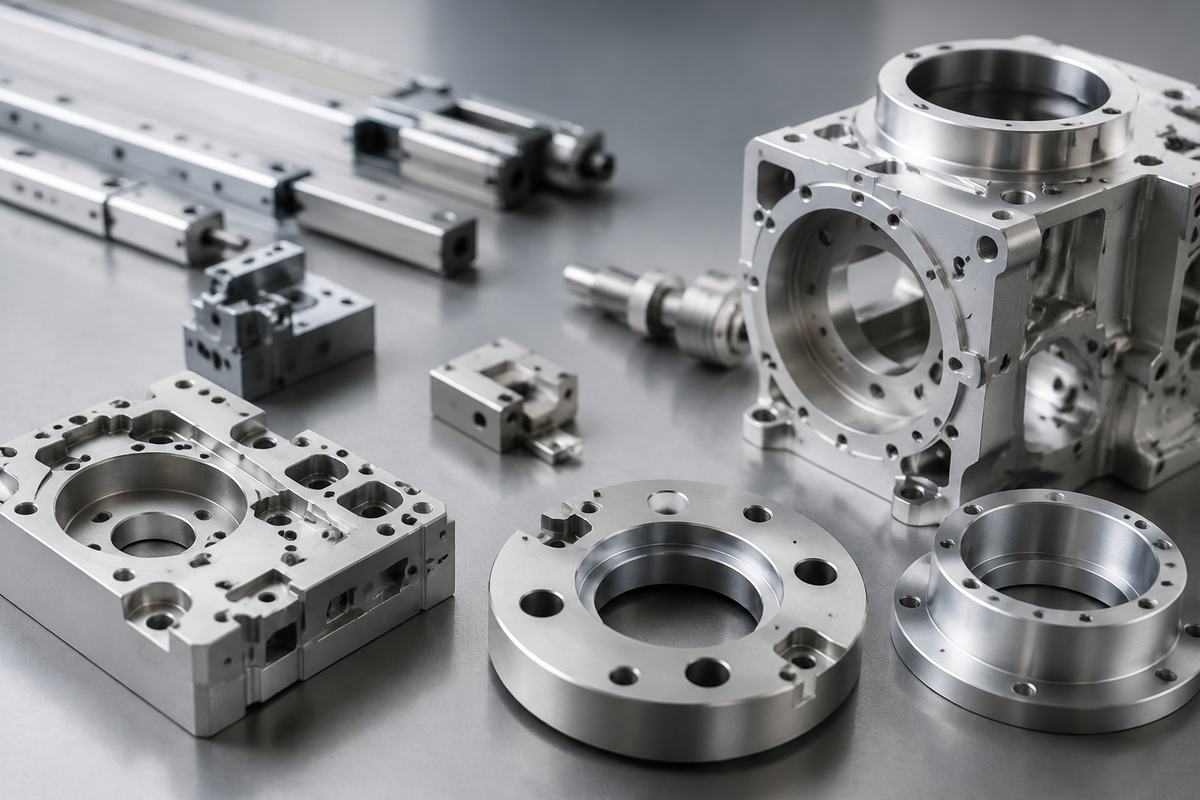
This is especially true when producing high-precision CNC machining parts, where even a small variation can affect the final result.
Complexity is not visual. It is mechanical.
A CNC Machine Is Just a Controlled Motion System
If you break a CNC machine down, there is nothing mystical about it.
The controller reads the program and sends commands. Servo motors move the axes. Encoders report position back to the system. The spindle holds the tool and removes material.
That’s it.
People talk about tight tolerances all the time. But tolerance numbers don’t come from magic. They come from a stable control loop.
If motion is precise and repeatable, the path can be executed again and again with minimal variation.
Complex machining starts with controlled movement, especially when producing CNC machining parts that require stable and repeatable accuracy.

More Axes Don’t Mean “More Advanced.” They Mean Fewer Errors.
A 3-axis machine can do a lot. But angled features, side walls, and complex geometry often require flipping the part.
Every time you re-clamp, you add risk. Each new setup increases the chance of misalignment.
In theory, you can adjust for it. In reality, errors accumulate.
A 5-axis machine reduces that risk. It allows the tool to approach the part from different angles without moving the part itself.
Fewer setups often mean more consistency. Not because the machine is fancy, but because you removed unnecessary steps.
This becomes especially important when producing high-precision CNC machining parts, where positional accuracy must stay stable across multiple operations.
That is where the real value lies.
The Real Difficulty Is Rarely the Shape
After enough years in machining, your idea of “complex” changes.
Some parts look complicated. They have curves and surfaces everywhere. But if the toolpaths are clear and the material is stable, they are manageable.
Other parts look simple. Those are often the ones that cause trouble.
A deep and narrow cavity weakens the tool as it reaches inside.
Vibration increases. Surface finish suffers.
A long, thin wall may move as internal stresses are released. Even with a correct program, the material shifts.
A large flat surface with strict finish requirements can drift if heat is not controlled.
These issues have nothing to do with appearance. They are about physics.
Complexity lives in stiffness, heat, and material behavior—not in geometry alone. Many challenging CNC machining parts fail not because of shape, but because of these physical limits.

Tool Access Matters More Than Toolpath Beauty
In meetings, people often focus on the program. They ask about tool strategies and advanced CAM features.
On the shop floor, the question is simpler: can the tool cut cleanly and stay stable?
You can simulate a toolpath perfectly. But once the cutter extends too far, rigidity drops.
The sound changes. You will start hearing chatter.Then,the surface begins to show it.
The software did its job. Physics did not cooperate.
If an inside corner is designed too sharp, you must use a smaller cutter. A smaller tool means slower feeds, longer cycle time, and higher breakage risk.
So when we review a drawing, we rarely think first about programming. We think about access.
Can the tool enter? Can it stay rigid? Will chips evacuate properly? Where will heat build up?
Cause machining does not happen on a screen. It happens between steel and carbide.
CNC Works for Complex Parts Because It Stays Consistent
Complex parts often require long sequences of precise, continuous movement.
Manual machining depends heavily on the operator. Even experienced machinists have natural variation in movement and timing.
CNC does not get tired. It does not adjust based on feel. Once parameters are set and verified, it repeats the same motion exactly.
That consistency becomes critical in production.
Making one good part is possible in many ways. Making fifty identical parts within the same tolerance band is a different challenge.
This is why industries that rely on high-precision CNC machining parts depend heavily on CNC systems for repeatable production.
Complex parts demand consistency. CNC delivers it.

Experience Is About Knowing What to Watch
Over time, the way you read a drawing changes.
Then,you will stop counting surfaces.
You will start thinking about distortion. You think about clamping strategy. You think about heat flow and how the material will react under stress.
Experience is not memorizing numbers. It is understanding relationships—between machine, tool, and material.
Complex parts are not mysterious. They are controlled engineering problems.
Why We Focus on Complex Structural Components
Over the years, we have focused on high-precision structural parts.
Not because “complex” sounds impressive, but because we know what makes these parts fail.
Multi-axis surfaces, deep cavities, thin walls, and tight repeatability all push the same limits. They test rigidity,test control and test the process.
When the machine is rigid, the tool is right, and the fixture holds, the job becomes predictable.
That is when “complex” turns into something you can run with confidence.
If you have a part that looks simple but never runs stable—or a multi-axis part that must be finished in one setup
———talk to us. We will look at it like manufacturers.
Not just to quote a price.
But to break down the problem and solve it.
FAQ
What makes a CNC part complex?
A CNC part is considered complex when it includes deep cavities, thin walls, tight tolerances, or multi-surface geometries. These features often require advanced machining strategies or multi-axis CNC machines.
Can complex parts be machined with a 3-axis CNC machine?
Some complex parts can be produced on a 3-axis machine, but parts with angled surfaces or difficult tool access often require 5-axis CNC machining to reduce setups and improve accuracy.

分享:
精密 CNC 制造:免费 CNC 原型及终身保修
Brass CNC Machining for Precision Custom Parts