


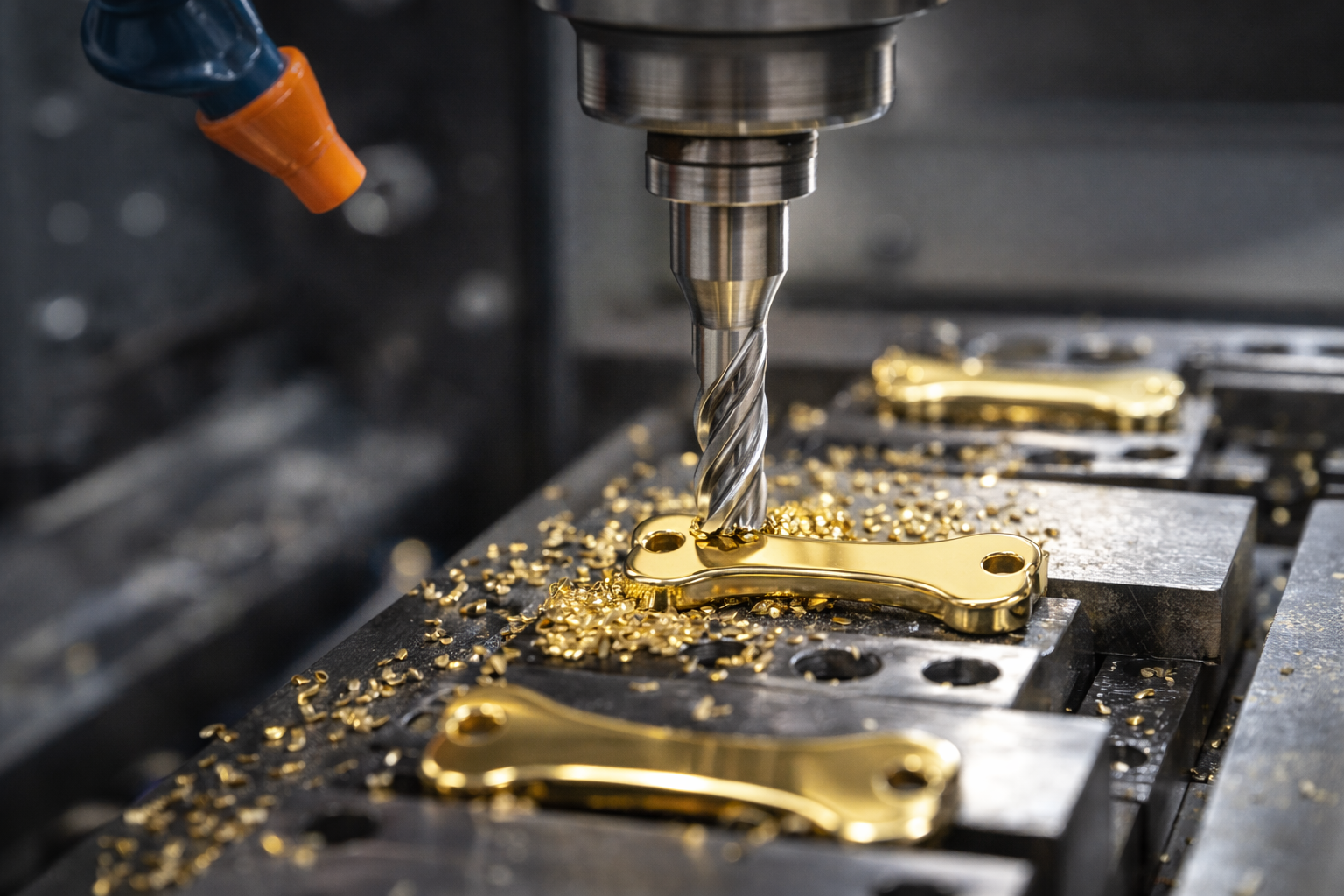
Brass CNC machining is widely used for parts that need good machinability, electrical conductivity, corrosion resistance, and a clean machined surface. Common applications include connectors, fittings, terminals, bushings, sleeves, pins, valve parts, decorative components, and small precision assemblies.
Brass is easier to machine than stainless steel or titanium, but precision brass parts still require proper process control. Burrs, scratches, thin-wall deformation, poor chip evacuation, and unstable surface finish can increase cost during production, especially when the part needs polishing, plating, or batch repeatability.
XY-Global manufactures custom brass CNC machined parts based on customer drawings, 3D models, material requirements, tolerance needs, and surface finish standards. Our engineering team supports CNC milling, CNC turning, drilling, tapping, deburring, polishing preparation, and batch inspection for brass components.

Brass CNC Machining Parameters
Cutting parameters depend on machine rigidity, tool diameter, part geometry, coolant method, and material grade. The values below can be used as a practical starting reference for C36000 brass machining.
| Process | Typical Reference Range |
|---|---|
| Spindle speed | 10,000–24,000 RPM for small carbide end mills |
| Feed rate | 500–1,500 mm/min depending on tool size and feature geometry |
| Axial depth of cut | 0.1–0.5 mm for small precision features |
| Radial width of cut | 5–25% of tool diameter for finishing or thin-wall control |
| Finish pass allowance | 0.05–0.15 mm depending on surface requirement |
| Edge chamfer for burr control | 0.03–0.10 mm where design allows |
| Typical machined surface finish | Ra 0.8–1.6 μm |
| Improved finish with optimized pass | Ra 0.4–0.8 μm, depending on geometry |
For brass parts with cosmetic surfaces, cutting parameters alone are not enough. Tool sharpness, chip evacuation, fixture contact points, and handling method must also be controlled.
Main Quality Risks in Brass CNC Machining
The most common problem in brass machining is not material removal. It is controlling small defects that affect assembly, appearance, or repeat production.
Burrs often appear around holes, slots, internal corners, thin edges, and curved profiles. If burrs are left for manual removal, labor cost increases and edge consistency becomes harder to control.
Surface scratches can appear because brass is softer than many engineering metals. Poor chip evacuation, rough clamping, or uncontrolled part handling can leave visible marks, especially before polishing or plating.
Thin-wall deformation can occur when small features are machined with unsuitable cutting depth, weak fixturing, or an incorrect machining sequence.
Dimensional drift can appear in batch production if tool wear, thermal change, fixture repeatability, and inspection frequency are not controlled.
For precision brass components, the machining plan should define the cutting sequence, datum surface, clamping area, finishing allowance, deburring method, and inspection points before production starts.

DFM Guidelines for Custom Brass Parts
A good brass part design can reduce machining time, burr risk, and finishing cost. During drawing review, XY-Global usually checks the following points:
| Design Area | Recommendation |
|---|---|
| Sharp internal corners | Add radius where possible. Sharp inner corners require small tools and longer machining time. |
| Thin walls | Avoid extremely thin unsupported walls. Thin brass sections may vibrate or deform. |
| Small holes | Confirm hole diameter, depth, and tolerance. Deep small holes may require special drilling strategy. |
| Edge condition | Define whether edges should remain sharp, deburred, chamfered, or rounded. |
| Cosmetic surfaces | Mark visible surfaces clearly on the drawing to avoid clamp marks or scratches. |
| Tight tolerance areas | Identify CTQ dimensions separately for focused inspection. |
| Surface finish | Specify Ra value only where needed. Over-specifying all surfaces increases cost. |
| Plating or polishing | Leave enough allowance if post-processing will remove material. |
For many brass parts, a small design adjustment such as adding a 0.05 mm chamfer, increasing an internal radius, or relaxing a non-critical tolerance can reduce production cost without affecting function.
Tolerance and Surface Finish Control
For general brass CNC machined parts, tolerance requirements often range from ±0.05 mm to ±0.10 mm. For precision features, ±0.02 mm is commonly achievable with proper fixturing and inspection. Tighter tolerances may require additional finishing passes, better datum control, and more frequent inspection.
Surface finish depends on tool condition, cutting path, feed rate, and geometry. A standard machined brass surface may reach around Ra 0.8–1.6 μm. With optimized finishing passes, sharp tools, and stable chip control, finer results such as Ra 0.4–0.8 μm may be possible on suitable surfaces.
For decorative brass parts, surface finish should be discussed together with polishing, plating, brushing, or coating requirements. A part that looks acceptable after CNC machining may still show small tool marks after polishing if the machining direction or surface preparation is not planned correctly.
Case Study: C36000 Brass Pendant Component
A U.S. customer needed a custom brass pendant for retail jewelry products. The part was made from C36000 brass and had a bone-shaped profile with internal curves and thin edges.
| Item | Requirement |
|---|---|
| Material | C36000 brass |
| Part size | 32 mm × 12 mm × 4 mm |
| Surface finish before polishing | Ra 0.8 μm |
| Tolerance requirement | ±0.02 mm |
| Annual volume | 20,000 pcs |
The main production issues were burrs along the curved edges, visible tool marks on the brass surface, and small dimensional variation around thin sections.
XY-Global adjusted the machining process in three areas.
First, we used micro-grain carbide end mills with polished flutes to improve chip evacuation and reduce chip adhesion. Second, we optimized the roughing tool path to lower cutting force around thin areas. Third, we added a controlled 0.05 mm chamfer pass to reduce edge burrs before polishing.
| Result | Final Performance |
|---|---|
| Final tolerance | ±0.015 mm |
| Machined surface finish | Ra 0.6 μm before polishing |
| Cycle time | 2.8 minutes per part |
| Batch defect rate | <0.4% |
This case shows that even a small brass component can require detailed process control. Material machinability helps, but stable production still depends on tooling, tool path planning, burr control, fixturing, and inspection.
 Inspection Points for Brass CNC Machined Parts
Inspection should match the function of the part. Not every dimension needs the same level of control.
For precision brass components, common inspection points include external dimensions, hole diameter, hole position, thread quality, flatness, edge condition, surface roughness, and cosmetic appearance.
For functional parts, inspection usually focuses on tolerance, fit, thread, sealing surface, or assembly position. For decorative brass parts, inspection should also include visible scratches, tool marks, dents, polishing consistency, and plating preparation.
Common inspection tools include calipers, micrometers, pin gauges, thread gauges, height gauges, surface roughness testers, optical inspection, and CMM inspection for more complex tolerance requirements.
What to Provide for a Brass CNC Machining Quote
To prepare an accurate quotation, please provide:
| Information | Why It Matters |
|---|---|
| 2D drawing | Defines dimensions, tolerance, surface finish, and inspection requirements |
| 3D model | Helps evaluate geometry, tool path, and machining sequence |
| Brass grade | Affects machinability, cost, strength, and surface result |
| Quantity | Influences fixture planning, cycle time, and unit price |
| Surface finish requirement | Determines machining, polishing, plating, or brushing needs |
| Critical dimensions | Helps define inspection priority and process control |
| Application | Helps confirm whether the material and tolerance are suitable |
| Visible surfaces | Helps avoid clamp marks and handling scratches |
If the brass grade has not been confirmed, XY-Global can help review the part drawing and suggest a suitable material based on function, appearance, cost, and production quantity.
Custom Brass CNC Machining at XY-Global
XY-Global supports custom brass CNC machining for prototypes, small batches, and repeat production. We work with C36000, C26000, C28000, C46400, and other brass materials based on customer requirements.
Our engineering team reviews drawings before production to check material selection, tolerance feasibility, machining risk, burr control, surface finish requirements, and inspection methods.
If you need custom brass parts with clean edges, stable dimensions, controlled burrs, and consistent surface quality, send us your drawing, 3D model, material requirement, quantity, and finish standard. We will review the project and provide practical manufacturing feedback.

分享:
Complex CNC Machining Parts: A Practical Guide to Complex Components
CNC Machining vs Metal Injection Molding: The Core Differences