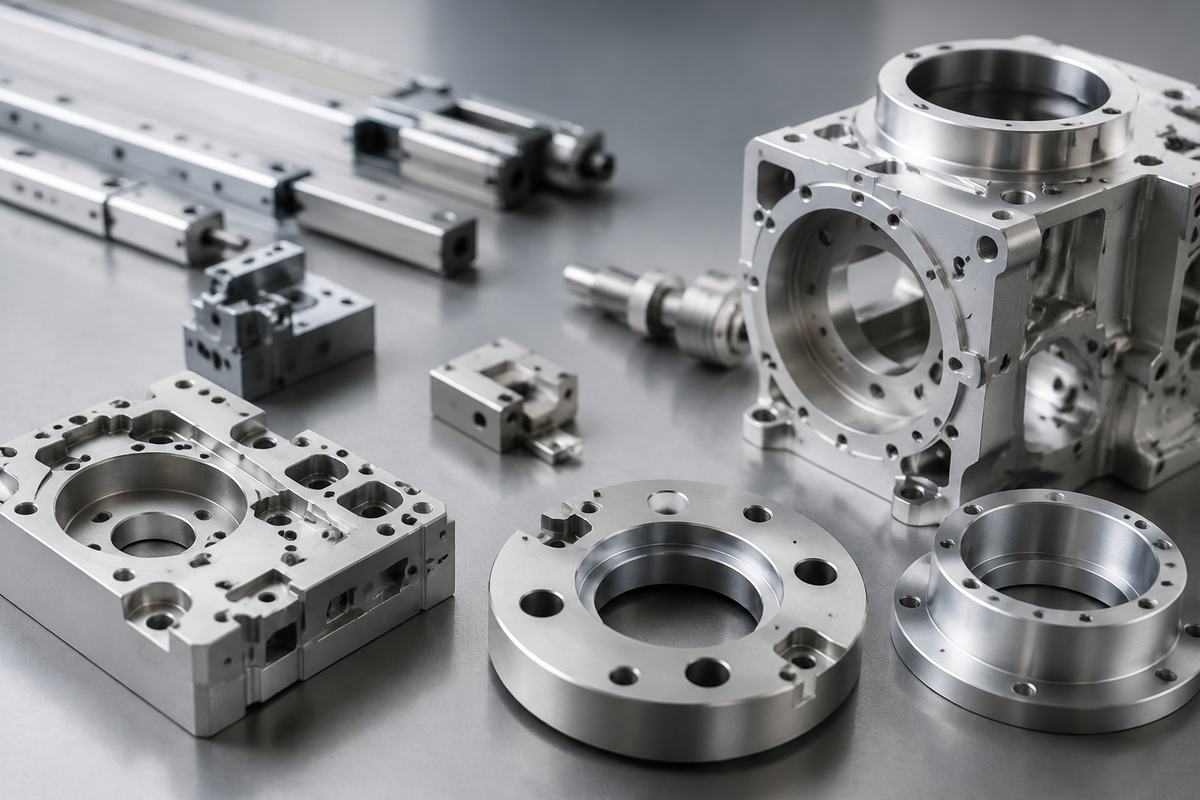
Aluminum enclosures and housings that must stay sealed, corrosion-resistant, and dimensionally stable are difficult to produce with traditional fusion welding. TIG and MIG welding melt the base material, which introduces porosity, distortion, and heat-affected zones that can compromise both airtightness and post-weld machining accuracy.
As demand grows for lightweight, sealed aluminum assemblies — from electronics enclosures to thermal management housings — manufacturers increasingly need a joining process that preserves material properties while holding tight tolerances through final machining. Friction stir welding (FSW) addresses this by joining metal without melting it, and pairing well with CNC machining when both processes are controlled by the same production team.
This article explains what friction stir welding is, which aluminum grades and joint types it works best with, typical process parameters and joint strength, and how combining friction stir welding with CNC machining supports sealed, precision aluminum enclosures from prototype through production.

What Is Friction Stir Welding?
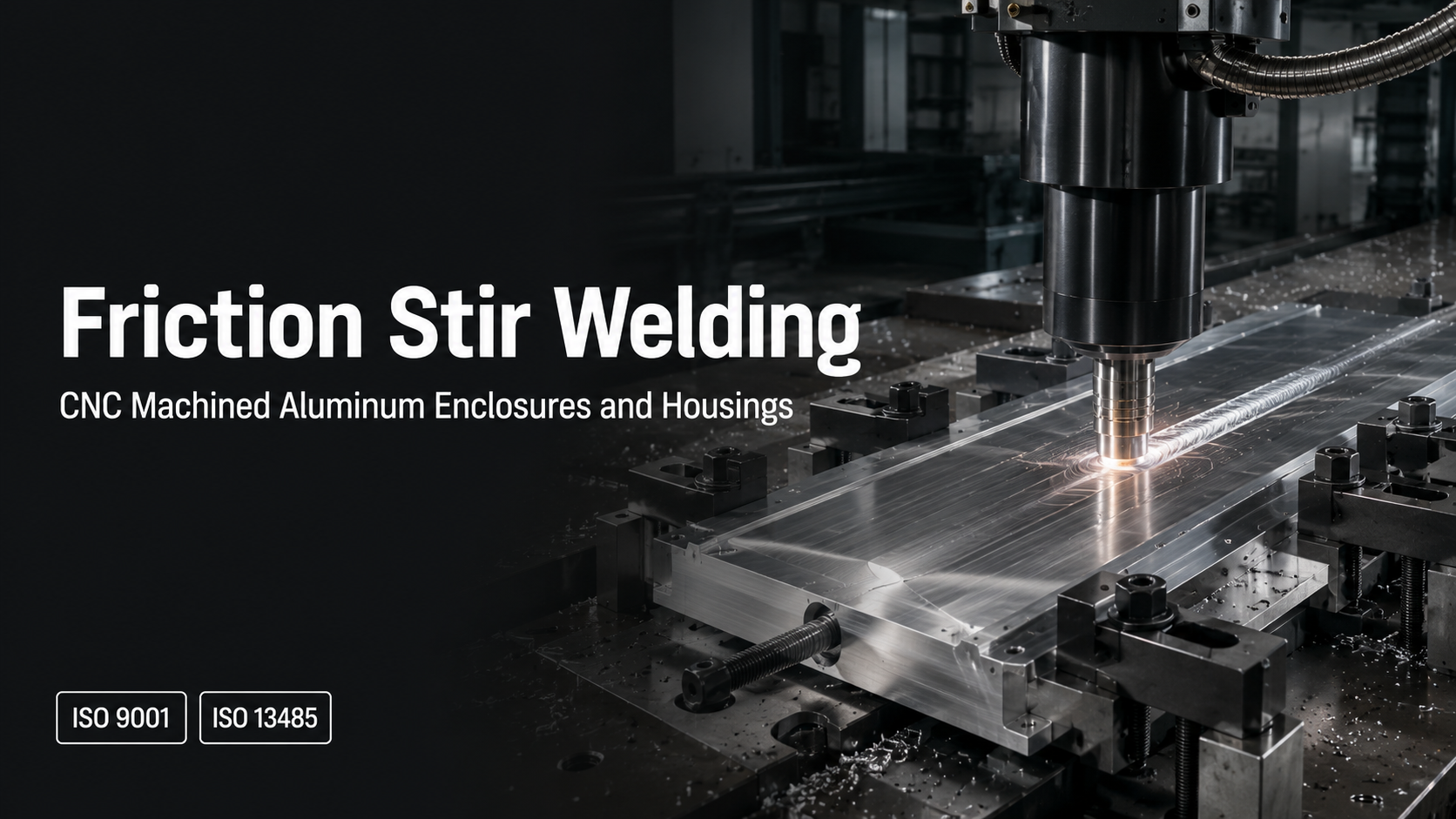
Friction stir welding is a solid-state joining process. A rotating tool with a shoulder and probe is plunged into the joint line between two workpieces and moved along the seam. Friction between the tool and the material generates localized heat, softening the aluminum without reaching its melting point. The tool then mechanically stirs and forges the softened material together as it travels along the joint.
Because the base metal never melts, friction stir welding avoids the solidification defects associated with fusion welding, such as porosity, hot cracking, and shrinkage voids. This makes it well suited for joints that must remain airtight and structurally consistent, including sealed enclosures and pressure-retaining housings.
Why Combine Friction Stir Welding With CNC Machining?
FSW and CNC machining share a common requirement: both depend on rigid fixturing and precise motion control to produce accurate, repeatable results. When friction stir welding is performed in-house alongside CNC machining, both processes can be planned as part of a single workflow rather than handled by separate subcontractors.
This matters for three practical reasons:
Reduced part handling. Machined blanks can be welded and then returned to CNC fixtures for finish machining without shipping between facilities, which lowers the risk of damage and reduces lead time.
Better distortion control. Because FSW is a lower-heat-input process than fusion welding, welded assemblies distort less before finish machining, so sealing surfaces and mounting features can be held to tighter tolerances after welding.
Consistent quality ownership. When one supplier controls both the weld and the machining steps, dimensional issues introduced by welding can be caught and corrected before the part reaches final inspection, rather than after it has already left a welding subcontractor.

Materials and Joint Types Suited for FSW
Friction stir welding was originally developed for aluminum and remains most widely used on aluminum alloys, though it can also join other non-ferrous metals under the right parameters.
| Material | FSW Weldability | Typical Joint Type | Common Use |
|---|---|---|---|
| 6061-T6 Aluminum | Excellent | Butt / Lap | General enclosures, brackets, structural housings |
| 6063 Aluminum | Excellent | Butt | Extruded housings, heat sinks |
| 7075 Aluminum | Good (some softening in heat-affected zone) | Butt | High-strength structural panels |
| 5083 Aluminum | Excellent | Butt / Lap | Thick-wall and marine-grade enclosures |
| Dissimilar Al alloys | Achievable with parameter control | Lap preferred | Lightweight hybrid assemblies |
Butt joints are the most common configuration for sealed enclosures, since a continuous, full-penetration weld line is easier to inspect and seal along a flat mating surface. Lap joints are used where overlapping sheet or plate sections are more practical for the assembly geometry.
Process Parameters and Joint Strength
Joint quality in friction stir welding depends on the balance between tool rotation speed, traverse (welding) speed, and tool geometry. These parameters are established through trial welds before production begins.
| Parameter | Typical Range (6061 Aluminum Reference) |
|---|---|
| Tool rotation speed | 700 – 1600 RPM |
| Traverse (weld) speed | 60 – 150 mm/min |
| Shoulder diameter | 10 – 15 mm, depending on plate thickness |
| Typical joint tensile strength | Approximately 70% – 76% of base material strength |
Traverse speed has the strongest influence on joint tensile strength, followed by tool tilt angle and rotation speed. Because these parameters interact, new material thicknesses or alloy combinations are validated with sample welds and destructive testing before a production parameter set is finalized.

Typical Applications
Friction stir welding is used wherever a sealed or structurally consistent aluminum joint is needed without the distortion risk of fusion welding:
Sealed electronics and instrument enclosures — housings that must maintain an airtight seal for environmental protection or optical alignment.
Thermal management housings — cold plates, heat sinks, and liquid-cooled enclosures where joint integrity affects both sealing and heat transfer, similar to the requirements seen in custom sheet metal parts for liquid cooling systems.
Structural aluminum panels — stiffened panels and brackets that require a full-strength joint without added weight from fasteners.
Battery and power enclosures — larger, thick-section aluminum assemblies where multi-pass welding is combined with precision machining of sealing surfaces.
Quality Control and Inspection After Welding
Because friction stir welds do not melt the base material, visual inspection alone cannot confirm internal joint quality. A combination of inspection methods is typically applied:
Dye penetrant or X-ray inspection to detect surface or subsurface defects such as voids or lack of fusion along the weld line.
Dimensional inspection by CMM after welding and finish machining, to confirm that sealing surfaces and mounting features remain within tolerance.
Leak or pressure testing for enclosures that must maintain an airtight or watertight seal in service.
Post-weld machining is often used to bring sealing faces, o-ring grooves, and mounting bores back to final tolerance, and to prepare the surface for treatments such as black anodizing where corrosion resistance or a controlled surface finish is required.
XY-Global's In-House FSW and CNC Capability
At XY-Global, friction stir welding is performed in-house, not outsourced, which allows welding and CNC machining to be planned as a single production sequence rather than coordinated across separate suppliers. This is particularly useful for aluminum enclosures and housings that require both a sealed joint and tight post-weld tolerances on mounting or mating surfaces.
Our capabilities include:
Friction stir welding of 6061, 6063, 5083, and 7075 aluminum alloys
Butt and lap joint configurations for enclosures, panels, and brackets
Post-weld CNC machining to restore critical tolerances on sealing and mounting features
Dimensional inspection by CMM and surface finish control after machining
Support from prototype welds through production volume
Frequently Asked Questions
Is friction stir welding stronger than traditional welding?
Friction stir welds typically retain roughly 70–76% of the base aluminum's tensile strength, which is comparable to or better than many fusion-welded aluminum joints, while avoiding porosity and hot cracking defects common in melted welds.
Can friction stir welding be used on machined parts, not just flat plate?
Yes. FSW is commonly applied to machined or extruded aluminum components before or after certain machining steps, as long as the joint geometry provides adequate material thickness and a rigid fixturing surface for the tool.
Does friction stir welding leave a visible mark on the part?
The process leaves a characteristic surface texture along the weld line and a small exit hole where the tool is withdrawn. Both can be removed or blended by post-weld machining when a clean finished surface is required.
What thickness range is suitable for friction stir welding?
FSW is commonly used on aluminum sections from about 1.5 mm up to 50 mm or more, with thicker sections typically requiring multi-pass welding and higher-capacity equipment.
Friction stir welding gives aluminum enclosures and housings a solid-state joint that avoids the distortion and porosity risks of fusion welding, while remaining compatible with tight post-weld machining tolerances. When welding and CNC machining are handled by the same in-house team, sealed aluminum assemblies can move from raw material to finished, inspected parts within a single controlled workflow. If you are developing a sealed aluminum enclosure or housing that requires both welding and precision machining, our engineering team can review your design and recommend a joint configuration suited to your application.


공유하다:
Precision Titanium CNC Machining: Materials, Tolerances and Machining Strategies