


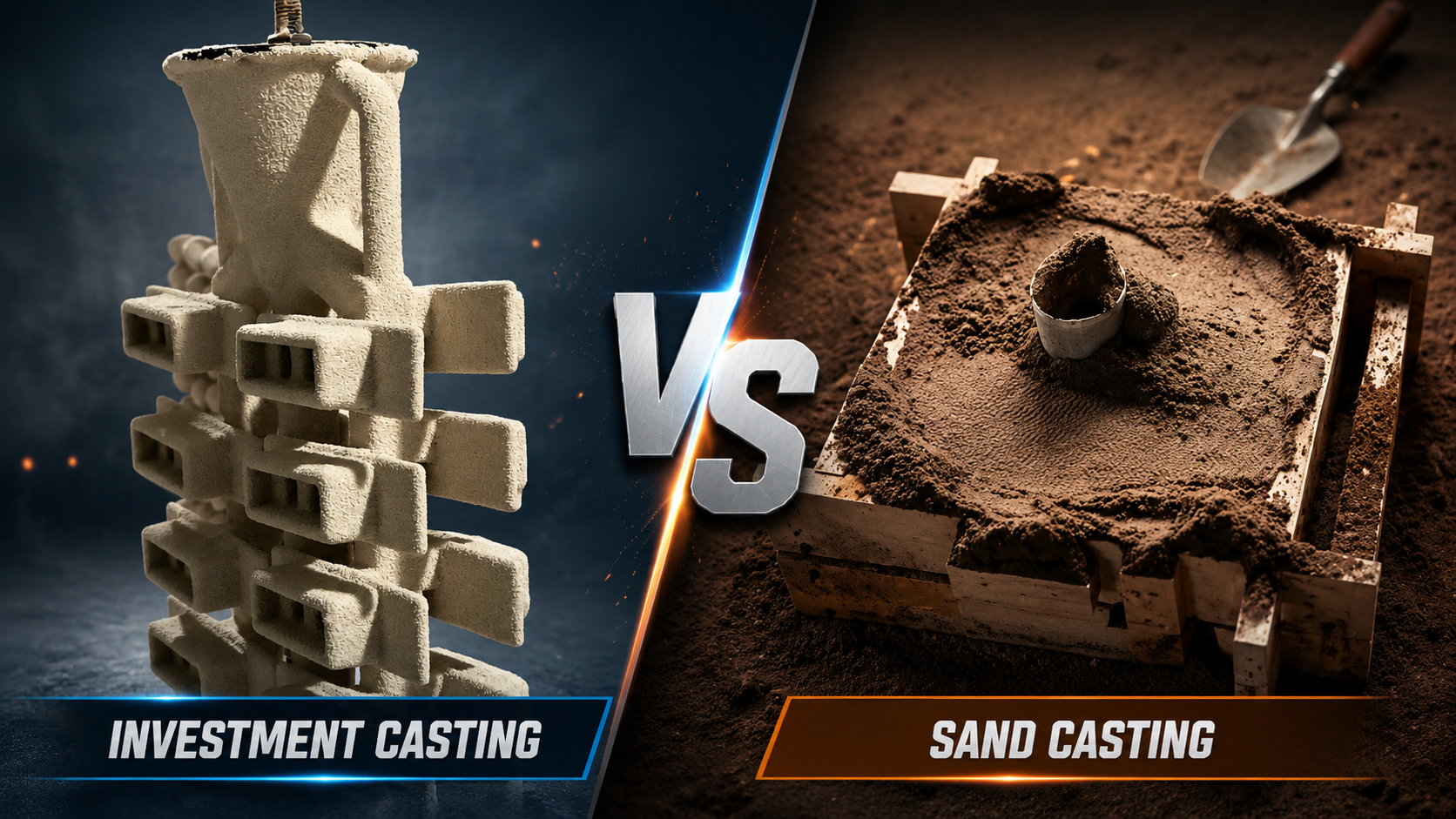
Choosing between investment casting and sand casting looks simple at first.
Investment casting gives you better detail and a smoother surface. Sand casting is usually cheaper and works well for much larger parts.
That is all true. But it is not enough to choose a manufacturing process.
A sand-cast blank may cost less and still produce a more expensive finished part once machining, grinding, inspection, and finishing are added. On the other hand, there is little reason to pay for investment casting when the part is large, simple, and does not need tight dimensional control.
So, the question is not which casting process is better, but rather which one gets your drawing to a finished, usable part at the lowest reasonable cost.
Read this article, we will compare investment casting and sand casting from a practical manufacturing perspective to help you choose the right process based on your actual application — not just the lowest casting price.

1. Investment Casting Vs Sand Casting At A Glance
If you only need the short answer, start here.
| Factor | Investment Casting | Sand Casting |
| Mold Type | Disposable Ceramic Shell | Sand-Based Mold |
| Pattern | Usually Wax | Wood, Resin, Metal Or Printed Pattern |
| Part Complexity | Very High | Low To High, Depending On Mold Design |
| Dimensional Accuracy | Generally Higher | Generally Lower |
| Surface Finish | Smoother | Rougher |
| Parting Line | Normally None On The Casting Body | Usually Present |
| Thin Features | Better Suited | More Restricted |
| Large, Heavy Parts | Possible, But Less Economical As Size Increases | Major Advantage |
| Tooling Cost | Usually Higher | Usually Lower |
| Design Changes | More Costly After Production Tooling | Often Easier |
| Secondary Machining | Often Reduced | Often More Extensive |
| Best Fit | Complex, Precision, Near-Net-Shape Parts | Large, Simpler, Cost-Sensitive Parts |
2. The Real Difference Starts With The Mold
Both processes are old. Very old.
Lost-wax casting, which later developed into modern investment casting, has been used in different forms for thousands of years. Early examples date back several thousand years, when craftsmen used natural wax to create patterns before surrounding them with refractory material.
The process later moved beyond artwork and decorative objects. By the late 19th and early 20th centuries, lost-wax techniques were being used in dentistry. Industrial use grew much faster during the 20th century as manufacturers needed more complex metal parts, tighter dimensional control, and alloys that were expensive or difficult to machine.
Sand and clay molding has an equally long history. Early clay molds were already being used in ancient China, and written descriptions of sand-based metal casting appeared centuries ago.
Modern sand casting looks very different from those early methods. Automated molding lines, resin-bonded systems, shell molds, precision cores and even 3D-printed sand molds are now part of industrial production.
The history tells us something useful.
Neither process survived for thousands of years because it was universally better than the other.
They survived because they solve different manufacturing problems.
3. How Investment Casting And Sand Casting Processes Work
Both investment casting and sand casting follow the same basic principle: molten metal is poured into a mold and solidifies into the final shape.
The biggest difference is not the metal itself, but how the mold is created and removed. Investment casting uses a disposable wax pattern and ceramic shell, while sand casting uses a sand mold built around a reusable pattern.
Investment Casting Process
Investment casting is also commonly known as lost wax investment casting.
A wax pattern is produced first. Several patterns can be attached to a central runner to form a wax tree. That tree is coated several times with ceramic slurry and refractory material until a strong shell is formed.
The wax is then removed. The shell is fired and preheated, molten metal is poured into the cavity, and the ceramic shell is broken away after solidification.
It sounds like a long process because it is.
But those extra steps are also what give investment casting some of its main advantages.
The ceramic shell follows the wax pattern closely. More importantly, the wax pattern does not have to be mechanically pulled out of the finished mold. It is melted out.
That gives designers much more freedom when working with complex contours, fine details and shapes that would otherwise be difficult to release from a conventional mold.

Sand Casting Process
Sand casting starts with a pattern of the required component.
Sand mixed with a suitable binder is packed around that pattern. In a typical two-part mold, the upper half is called the cope and the lower half the drag.
Once the mold is formed, the pattern is removed. Cores may be installed to create internal cavities, the mold halves are closed, and molten metal is poured into the cavity.
That pattern-removal step is important.
The pattern has to come out without damaging the mold. Because of that, draft angles, parting lines and core design become important very early in the process.
The sand itself also affects the result.
Finer sand can help create a smoother surface, but it can also reduce mold permeability. That matters because gases still need a path out of the mold during pouring.
So even something that sounds simple — choosing finer sand — involves a manufacturing trade-off.
This is one reason it is misleading to treat all sand casting as one basic process. A manually produced green-sand mold and a modern resin-sand or automated molding system can give very different results.

4. Key Differences Between Investment Casting And Sand Casting
Although both investment casting and sand casting use molten metal to create finished components, the manufacturing results can be very different.
The difference does not come from the metal itself, but from the way the mold is created, how the pattern is removed, and how much work is required after casting.
For engineers and buyers, the most important factors are usually not just the casting process itself, but how it affects the final part — including dimensional accuracy, surface finish, design flexibility, machining requirements, tooling investment, and overall manufacturing cost.
The following sections compare these key factors and explain when each process makes more sense.
4.1 Dimensional Accuracy: Investment Casting Usually Has The Advantage
This is one of the clearest differences in investment casting vs sand casting.
Investment casting starts with a controlled wax pattern and a ceramic shell that closely reproduces its geometry. Sand casting introduces more variables around pattern removal, sand condition, mold assembly, cores and parting surfaces.
That usually gives investment casting better as-cast dimensional control.
Published industry references sometimes give tolerance values around 0.1 mm for the first 25 mm, with additional allowance as dimensions increase. But that number should be treated as a reference, not as a universal promise.
The real result depends on the alloy, geometry, size of the part, shell system and foundry process.
This matters because not every dimension on a drawing behaves the same way.
A small bore is not the same as a 150 mm overall length. A long thin arm is not the same as two holes controlled by positional tolerance. A flat mounting surface may require a completely different control strategy again.
So, it's not what tolerance investment casting can achieve, but which dimensions can be controlled directly by casting, and which ones should be finished afterward.
For example, an outside profile, rib or curved surface may be left as-cast. A bearing bore, sealing face or precision datum may still be CNC machined.
4.2 Surface Finish Is Not Just About Appearance
Investment casting normally produces a smoother surface than conventional sand casting.
According to published data, investment casting often places standard surface quality in the low single-digit micrometer RMS range. Actual results still depend on the shell system, alloy, pouring conditions and finishing requirements.
Sand casting naturally reproduces the texture of the sand mold.
It also normally leaves a visible parting line. Depending on the final drawing, this may lead to more grinding, shot blasting, machining or polishing after casting.
And this is where surface finish starts to affect more than appearance.
It affects cost.
Take a simple example. A sand-cast blank may cost $10 while the investment-cast blank may cost $15.
If we stop there, sand casting looks like the obvious choice.
But suppose the sand casting needs another $5 of machining, $2 of grinding and additional handling before it meets the drawing.
The investment casting may only need local machining on one datum and two critical holes.
Now the comparison looks very different.
This is why the lowest casting price does not always produce the lowest finished-part price.
4.3 Complex Geometry: Where Investment Casting Works Better
Consider a large rectangular housing with thick walls and simple features. There may be little reason to use investment casting.
Now change the part. Add curved surfaces. Add ribs. Add small bosses. Add recessed areas and fine details. Put features on several sides. Add areas that would otherwise need multiple machining setups.
At that point, investment casting becomes much more interesting.
The reason goes back to the wax pattern.
The wax is eventually melted out of the ceramic shell. It does not have to be pulled from the mold in the same way a reusable sand-casting pattern does.
That makes some undercuts, transitions and complex surface details much easier to produce.
This does not mean sand casting cannot make complex parts. It can.
Cores allow internal cavities. More advanced molding techniques can handle fairly complicated shapes. Printed sand molds and cores have expanded those limits even further.
But there is a difference between technically possible and commercially sensible.
If a sand casting needs several cores, more complex pattern equipment and extensive machining afterward, an investment casting may ultimately be the simpler manufacturing route.
That is why geometry needs to be reviewed together with cost.
4.4 Investment Casting Can Go Thinner, But One Number Does Not Tell The Whole Story
Investment casting is commonly used for parts with relatively thin or detailed sections.
Some published investment casting references mention section thicknesses down to around 0.6 mm. Individual foundries may publish much more conservative numbers based on their own alloys and process capability.
That difference is important.
There is no single minimum wall thickness that works for every investment casting.
A short, thin stainless steel feature is not the same as a long thin wall. A thin wall beside a large heavy section is different again.
When reviewing a thin-wall investment casting, several things need to be considered together: alloy fluidity, flow length, section transitions, local mass and how the metal fills the shell.
The goal is not simply to make the wall as thin as possible.
It is to make it thin and still manufacture it consistently.
That is a much more useful design target.
4.5 Part Size Can Change The Answer Very Quickly
You will often hear: Investment casting is for small parts. Sand casting is for large parts.
There is some truth in that, but it is too simple.
Industrial investment casting can cover a surprisingly wide size range. Published references include parts from only a few grams to several hundred kilograms.
So investment casting is not automatically limited to tiny components.
The issue is usually economics.
As the casting becomes larger, the wax pattern becomes larger. The ceramic shell becomes heavier. Shell building takes more material. Handling becomes harder. Furnaces and pouring equipment also need enough capacity.
At some point, sand casting becomes much more attractive.
This is why large pump housings, machine bodies, engine components and heavy industrial structures are still commonly sand cast.
A specific foundry may quote sand-casting capabilities measured in thousands of pounds while limiting its investment casting range to much smaller parts.
Those are foundry-specific limits rather than universal process rules, but they show the general direction clearly.
As parts get larger and heavier, sand casting usually becomes more competitive.
4.6 Material Choice Does Not Automatically Decide The Process
Both casting processes can work with a broad range of metals.
Investment casting materials commonly include stainless steel, carbon steel, alloy steel, aluminum alloys, copper alloys and many other specialty materials.
Sand casting also works with steel, aluminum, cast iron, ductile iron, bronze, brass and many other ferrous and non-ferrous alloys.
So the decision should not be reduced to: Stainless steel means investment casting.
or: Aluminum means sand casting.
A complex stainless steel component with fine details may be an excellent candidate for stainless steel investment casting.
A large and relatively simple steel housing may still be better suited to sand casting.
The same applies to alloy steel.
For a relatively compact, complex alloy steel investment casting, near-net-shape production may remove a large amount of CNC work. For a much larger structural component, sand casting may still offer better overall economics.
Material is important.
But geometry, size and machining requirements often decide the process.
4.7 Tooling And Design Changes Matter More Than Many Buyers Expect
This becomes especially important during product development.
Investment casting normally uses tooling to produce repeatable wax patterns.
Once production tooling is completed, a major geometry change may require tool modification, new inserts or even new tooling.
That is manageable in stable production.
It is less attractive when the design is still changing every few weeks.
Sand-casting patterns, especially some wood or resin patterns, can often be easier and cheaper to modify.
So if Revision A becomes Revision B next week, and Revision C arrives shortly after that, jumping directly into production investment casting tooling may not be the best decision.
At that stage, CNC prototypes, printed patterns, prototype castings or temporary tooling may make more sense.
Once the design becomes stable, the economics change again.
That is why we prefer to look at both the drawing and the product stage before deciding on the manufacturing route.
4.8 Production Volume Alone Does Not Decide The Winner
Another common rule is: Sand casting is for low volume. Investment casting is for high volume.
That is also too simple. Both processes can support production.
Modern sand casting can be highly automated. Automated molding systems have been used for decades, and modern equipment can provide very good repeatability.
Investment casting can also work efficiently for repeat production. Multiple wax patterns can be assembled on one tree, allowing several components to be poured together.
So quantity alone is not enough.
A complex stainless steel component at 5,000 pieces per year may be a strong investment casting project because the process removes multiple machining operations.
A large simple housing at the same annual volume may still make more sense as a sand casting.
The more useful question is:
What happens to total unit cost as the volume increases?
That depends on geometry just as much as quantity.
4.9 The Most Important Comparison Is Total Finished-Part Cost
This is probably the most important part of the whole discussion.
When buyers compare investment casting vs sand casting, they naturally start with the quotation for the casting blank.
That makes sense.
But the blank is only one part of the manufacturing cost.
The final part may still need heat treatment, machining, grinding, surface finishing, inspection and rework before it can be shipped.
So we prefer to think about cost like this: Total Finished-Part Cost = Casting + Tooling Allocation + Machining + Heat Treatment + Finishing + Inspection + Scrap And Rework
This is where a higher-cost casting process can sometimes lead to a lower-cost finished component.
5. When To Choose Investment Casting Vs Sand Casting
There is no single answer to whether investment casting or sand casting is the better process.
The right choice depends on the part itself — including geometry, size, tolerance requirements, production volume, machining needs and overall manufacturing cost.
In general, investment casting is usually a better fit for complex, precision components where reducing machining and improving as-cast quality are important.
Sand casting is often a better choice for larger, heavier parts where lower tooling cost and design flexibility are more valuable.
In all, the best process is not the one with the lowest casting price. It is the one that delivers the required finished part with the best balance of cost, quality and manufacturing reliability.
At XY-GLOBAL, we provide DFM support and engineering evaluation before production to help customers identify the most suitable manufacturing approach for their parts. The chart below provides a clear guide for your selection:
| Your Part Looks Like This | Process To Evaluate First |
| Small / Medium + Complex + Precision | Investment Casting |
| Large + Simple + General Tolerance | Sand Casting |
| Complex Stainless Steel Component | Investment Casting |
| Large Cast Iron Housing | Sand Casting |
| Many Fine Details In One Part | Investment Casting |
| Prototype With Frequent Design Changes | Sand Casting / CNC / Prototype Casting |
| High Machining Cost From Solid | Investment Casting |
| Heavy Machine Base | Sand Casting |
| Better As-Cast Surface Required | Investment Casting |
| Tight Bore But General Outer Geometry | Casting + CNC |
| High-Volume Complex Steel Part | Investment Casting |
| Large Part With Plenty Of Machining Stock | Sand Casting |
Investment Casting And CNC Machining Often Work Better Together
Many people think investment casting means the part comes out completely finished and ready for assembly.
In reality, investment casting is a near-net-shape process. Its main purpose is to create complex geometry close to the final shape and reduce unnecessary machining, not to eliminate machining completely.
For example, a casting can produce the overall shape, ribs, bosses and curved surfaces directly. CNC machining can then be used only for critical features such as:
-
precision bores
-
sealing surfaces
-
mounting datums
-
tight threads
-
critical tolerance areas
This approach avoids machining the entire component from solid material while still achieving the accuracy required by the drawing.
In many projects, the most economical solution is not choosing between casting and machining.
It is combining them: Investment casting creates the complex shape. CNC machining finishes the features that require precision.
At XY-GLOBAL, we offer one-stop manufacturing solutions, including casting, CNC machining, finishing and inspection, to help customers receive production-ready components.
Need Help Choosing A Casting Process?
If you are comparing investment casting vs sand casting for a custom component, the easiest way to start is with the drawing. Send us your 2D/3D file, material, quantity and critical requirements.
At XY-GLOBAL, our engineering team can review the part geometry, casting feasibility and downstream machining requirements before recommending a manufacturing route.
For investment casting projects, we can support the process from casting and heat treatment through CNC machining, surface finishing and inspection.
The goal is not just to quote the casting blank.
It is to find a practical way to manufacture the finished part.
XY-GLOBAL Manufacturing Team
XY-GLOBAL is an ISO 9001 and ISO 13485 certified custom manufacturing company, supporting customers from early product development through prototyping and mass production.
Our work often starts before production. We support DFM, engineering design, process selection and assembly, helping customers choose a practical manufacturing process to reduce overall product cost. Plus,
we place strong emphasis on communication and quality with 24/7 online communication and CMM inspection.
Our team responds quickly, works to understand the real problem behind each project, and provides inspection reports based on actual measurement data. If a quality issue is caused by us, we take responsibility and provide replacement parts at no additional cost. For urgent prototypes, production can sometimes start within 1 day, with samples delivered in as little as 7 days, depending on the project. For more complex programs, we can also use Gantt charts to show tooling and production progress clearly.
At XY-GLOBAL, our goal is simple: help customers turn a design into a reliable, manufacturable product with fewer problems along the way.
Investment Casting Vs Sand Casting FAQs
1. What is the main difference between investment casting and sand casting?
Investment casting uses a disposable wax pattern and ceramic shell to create highly detailed components, while sand casting uses a sand mold formed around a reusable pattern.
In general, investment casting is better suited for complex parts requiring tighter dimensional control, smoother surface finish and reduced machining. Sand casting is often preferred for larger components where lower tooling cost and production flexibility are more important.
2. Is investment casting more expensive than sand casting?
Investment casting usually has a higher initial tooling and processing cost because it involves wax pattern production, ceramic shell building and additional steps.
However, the casting price alone does not always represent the final part cost. For complex components, investment casting can reduce machining operations and finishing requirements, which may lower the total manufacturing cost.
The best process depends on the complete production route, not only the casting quotation.
3. What types of parts are suitable for investment casting?
Investment casting is commonly used for parts that require complex geometry, good surface finish and high dimensional consistency.
Typical applications include:
-
Stainless steel precision components
-
Alloy steel parts
-
Medical components
-
Aerospace components
-
Pump and valve parts
-
Industrial machinery components
For parts with multiple features that would require extensive CNC machining, investment casting can often provide a more efficient solution.
4. Can XY-Global provide DFM support for investment casting projects?
Yes. XY-GLOBAL provides DFM (Design For Manufacturing) support before tooling and production.
Our engineering team reviews part geometry, wall thickness, draft requirements, machining allowance, critical tolerances and manufacturing risks to help optimize the design for precision investment casting.
Early DFM review can help reduce tooling changes, improve casting quality and achieve a more cost-effective production solution.
5. What is the minimum order quantity for XY-Global investment casting services?
XY-GLOBAL supports both prototype and production investment casting projects.
There is no fixed MOQ for all parts because the suitable production quantity depends on factors such as part size, material, tooling requirements and project stage.
For new product development, we can support prototype evaluation and small-batch production before moving into higher-volume manufacturing.
Please contact our engineering team with your drawing, material and quantity requirements, and we can recommend the most suitable production approach.

Share:
Micromachining Services For Medical Device Components
3D Printing in Medicine: Real Applications, Manufacturing Process and Future Trends