


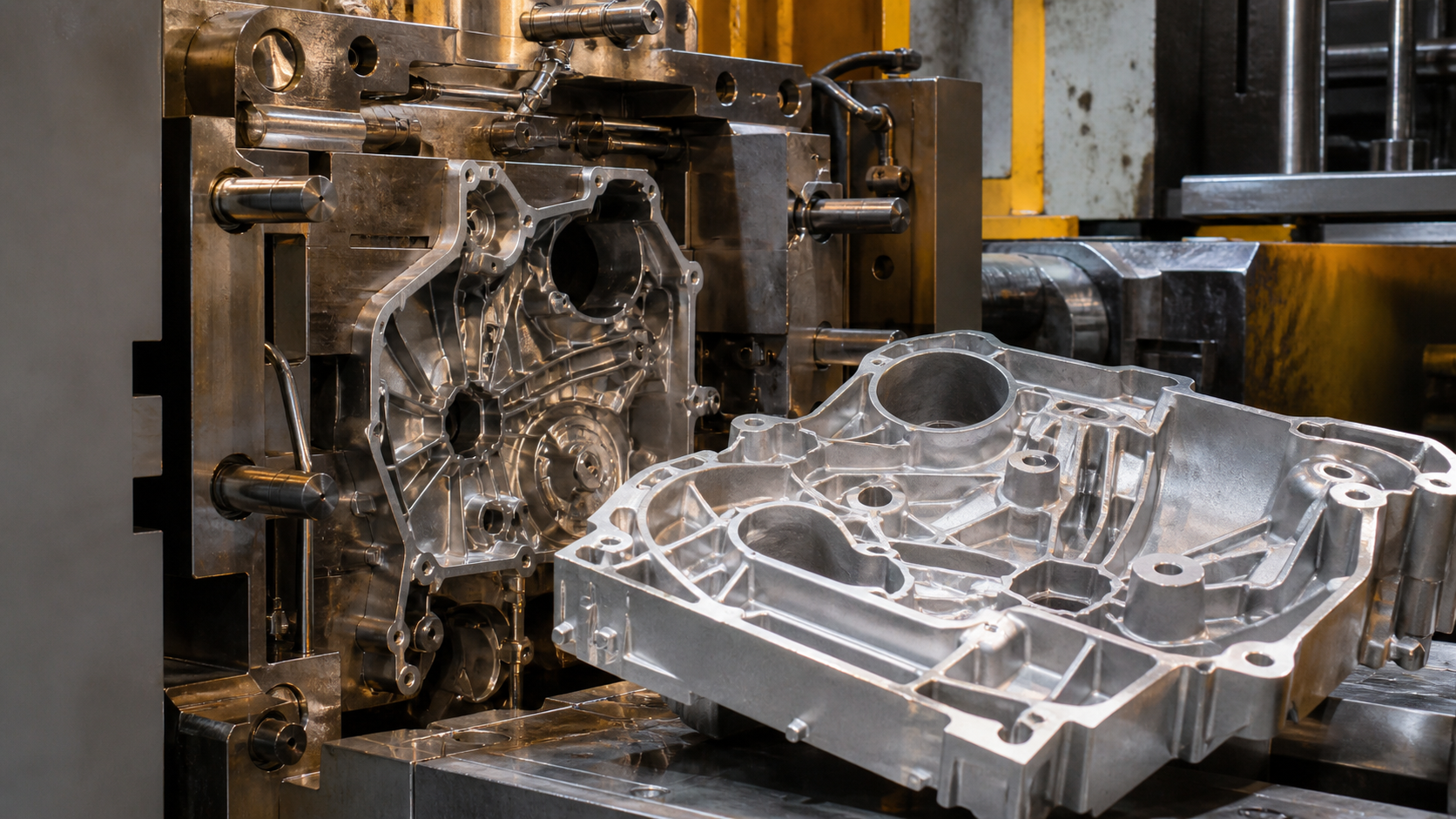
What makes A380 aluminum die casting so common
When buyers look for A380 aluminum die casting, they are usually trying to balance three things at the same time: complex part geometry, good surface finish, and reasonable production cost. That is exactly why A380 remains one of the most widely used die casting alloys in industrial manufacturing. It is commonly selected for housings, covers, brackets, frames, and other aluminum parts that need repeatable quality in medium- to high-volume production.
Why A380 is used in die casting
A380 aluminum alloy is not widely used because of its superior paper-based mechanical properties, but rather because of its reliability in actual die-casting production.
In A380 die casting, this alloy fills complex cavities well, flows more easily into relatively thin sections than many other aluminum alloys, and maintains consistent surface quality after casting. This makes it ideal for parts with reinforcing ribs, bosses, mounting structures, and decorative exterior surfaces.
For many applications, stable casting performance and production efficiency are more important than pursuing the highest tensile strength.

Typical properties of A380 aluminum
The exact values may vary slightly depending on casting conditions and supplier standards, but A380 is generally known for the following property range:
- Density: about 2.7 g/cm³
- Tensile strength: around 310 MPa
- Yield strength: around 160 MPa
- Elongation: typically about 3%
- Thermal conductivity: around 90–100 W/m·K
These numbers help explain why A380 aluminum die casting is widely used for structural but not heavily impact-loaded parts. It provides enough strength for many housings and functional components, while still giving the processing advantages needed in die casting production.
Where A380 aluminum die casting is commonly used
A380 is commonly found in parts that need good shape complexity and repeatability rather than extreme ductility.
Typical applications include:
- motor housings
- gearboxes and covers
- LED lamp housings
- electronic enclosures
- automotive brackets and frames
- industrial equipment bodies
In these products, A380 aluminum die casting helps reduce machining time because many features can be cast directly into the part. If the mold design is done well, only a limited number of critical areas need secondary machining.
What buyers should pay attention to
A380 works well, but it is not a “one alloy fits all” solution.
For example, if the part will require heavy welding, A380 may not be the best choice. If the application needs very high elongation or repeated impact resistance, another alloy or another process may be better. Also, die-cast parts are not judged by alloy alone. Final quality also depends on tool design, gate layout, venting, wall thickness, cooling balance, and machining allowance.
For most A380 aluminum die casting projects, a few design rules matter a lot:
- keep wall thickness as uniform as possible
- avoid unnecessary thick sections that may cause shrinkage
- control machining allowance carefully
- design ribs and bosses for both strength and castability
A material can be good, but poor part design will still create unstable results.

A simple project example
One example is a custom aluminum control housing for industrial equipment.
The customer needed a part with:
- outer size about 180 × 120 × 55 mm
- wall thickness around 2.5–3.0 mm
- several mounting bosses and cable outlet features
- cosmetic outer surface
- post-machined mounting faces with tolerance of ±0.05 mm
In this case, A380 aluminum die casting was a practical choice because the part geometry was not simple enough for low-cost machining, but the volume was high enough to justify die casting tooling. After casting, only the sealing face and a few mounting holes required CNC finishing. This reduced total production cost and kept the part consistent in batch production.

Surface finish and post-processing considerations
One reason buyers like A380 aluminum die casting is that it can support a clean external appearance when the mold and process are controlled properly.
Typical post-processing may include:
- deburring
- shot blasting
- powder coating
- painting
- chromate conversion coating
- CNC machining on critical features
The actual surface result depends not only on the alloy, but also on mold polish, venting, release agent control, and how much porosity is present in cosmetic areas.
If appearance matters, that should be discussed at the quotation stage, not after the first samples are made.

Why A380 aluminum die casting remains a practical choice
There are many aluminum die casting alloys on the market, but A380 remains one of the most widely used because it performs well under real manufacturing conditions. It offers a practical balance of castability, mechanical strength, dimensional stability, and production cost.
For buyers, the value of A380 aluminum die casting is not defined by alloy data alone. It depends on how well the material, die design, gating, venting, cooling, and machining plan work together. When these factors are controlled properly, A380 can deliver parts that are efficient to produce, easy to finish, and consistent from sampling to mass production.

分享:
Precision Carbon Fiber CNC Machining and Cutting Services
Precision Machined Metal Parts: What Buyers Actually Need to Know