


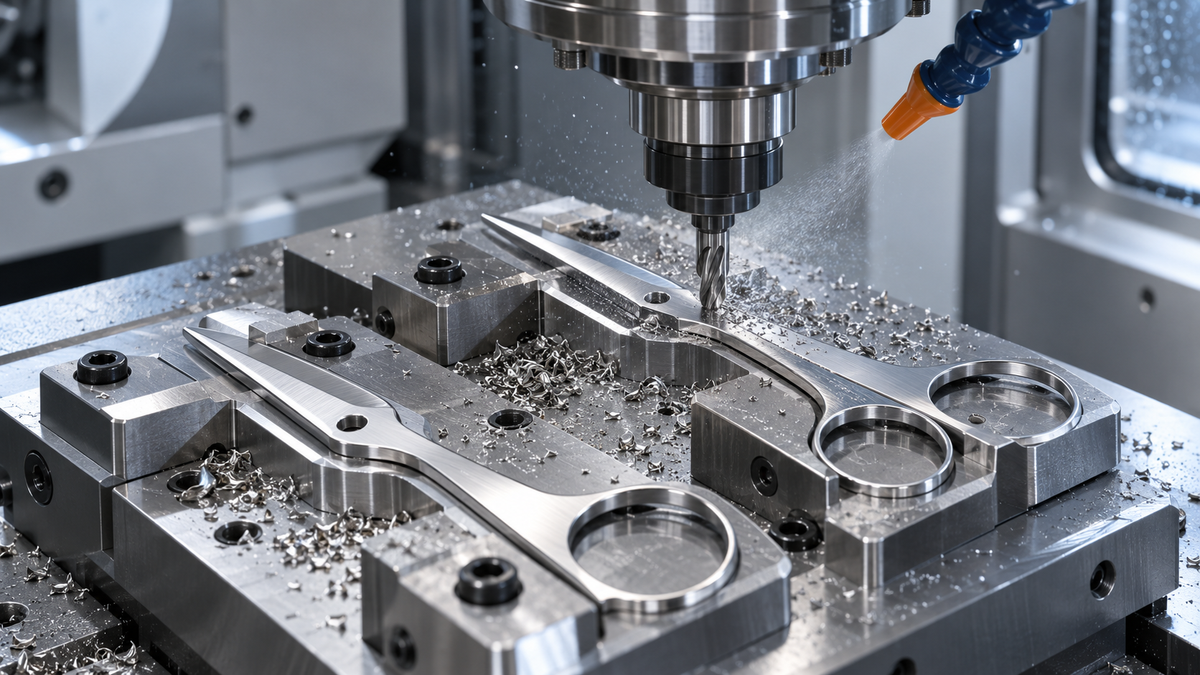
In surgical instrument manufacturing, stainless steel selection directly affects product performance, durability, sterilization reliability, and long-term clinical use.
For cutting, grasping, clamping, and precision mechanical instruments, stainless steel for surgical instruments must provide a balanced combination of:
- Hardness and wear resistance
- Corrosion resistance after repeated sterilization cycles
- Dimensional stability after heat treatment
- Surface cleanliness
- Machinability and manufacturing consistency
A surgical scissors blade, precision forceps jaw, or mechanical surgical component may experience hundreds or thousands of sterilization cycles during its service life. High-temperature steam sterilization, cleaning chemicals, and repeated mechanical loading can gradually affect material performance if the correct stainless steel grade and manufacturing process are not selected.
For this reason, medical device manufacturers typically evaluate stainless steel based on the complete application requirements, including mechanical loading, sterilization environment, surface requirements, and production capability—not simply by choosing a general “medical-grade” stainless steel.

Key Requirements for Stainless Steel Used in Surgical Instruments
1. Corrosion Resistance During Repeated Sterilization
Surgical instruments must maintain their surface integrity after repeated exposure to:
- Autoclave sterilization (typically 121°C–134°C steam cycles)
- Cleaning chemicals
- Moist environments
- Biological fluids
Poor material selection or inadequate surface processing may lead to:
- Pitting corrosion
- Crevice corrosion
- Surface discoloration
- Reduced cleaning performance
- Premature component failure
When evaluating stainless steel for surgical instruments, manufacturers should consider not only the chemical composition of the alloy but also:
- Heat treatment condition
- Surface roughness
- Passivation quality
- Manufacturing process control
2. Hardness and Wear Resistance
Many surgical instruments rely on precise contact surfaces and repeated mechanical movement.
Examples include:
- Scissor blades
- Forceps jaws
- Cutting edges
- Hinged mechanisms
Insufficient hardness may result in:
- Faster wear
- Loss of cutting performance
- Increased mechanical play
- Reduced service life
However, higher hardness is not always better.
Extremely hard materials may become more difficult to machine and may increase the risk of:
- Cracking
- Heat treatment distortion
- Edge damage during finishing
The ideal material selection requires balancing hardness, toughness, corrosion resistance, and manufacturability.
Common Stainless Steel Grades for Surgical Instruments
| Material Grade | Typical Hardness | Tensile Strength | Common Applications |
|---|---|---|---|
| 420 Stainless Steel | 45–52 HRC | 650–900 MPa | Surgical scissors, forceps jaws, cutting components |
| 440C Stainless Steel | 58–62 HRC | Up to ~1900 MPa | High-wear surgical cutting instruments |
| 17-4PH Stainless Steel | 28–44 HRC | 930–1300 MPa | Structural components, joints, mechanical parts |
| 316L Stainless Steel | 15–25 HRC | 485–620 MPa | Corrosion-sensitive medical components |
Actual values may vary depending on heat treatment condition and material supplier specifications.
420 Stainless Steel: A Widely Used Material for Surgical Cutting Instruments
420 stainless steel is one of the most commonly used stainless steels for surgical instruments because it provides a good balance between:
- Hardness
- Toughness
- Corrosion resistance
- Manufacturing efficiency
Typical applications include:
- Surgical scissors
- Hemostatic forceps
- Tissue forceps
- Precision gripping components
- Cutting mechanisms
Typical properties:
| Property | Typical Range |
|---|---|
| Hardness | 45–52 HRC |
| Tensile Strength | 650–900 MPa |
| Density | Approximately 7.7 g/cm³ |
| Heat Treatment | Quenching and tempering |
The performance of 420 stainless steel depends heavily on heat treatment control.
Incorrect heat treatment may result in:
- Uneven hardness
- Dimensional distortion
- Reduced toughness
- Lower fatigue performance
For precision surgical components, manufacturers often use a controlled process sequence:
Rough machining → Heat treatment → Precision machining → Grinding → Polishing
This approach helps maintain dimensional accuracy while achieving the required mechanical properties.

440C Stainless Steel: High Hardness Material for Precision Surgical Tools
440C stainless steel is a high-carbon martensitic stainless steel known for its excellent hardness and wear resistance.
Typical properties:
| Property | Value |
|---|---|
| Hardness | 58–62 HRC |
| Tensile Strength | Approximately 1900 MPa |
| Carbon Content | Around 1.0% |
| Chromium Content | 16–18% |
440C is commonly selected for:
- Microsurgical scissors
- Precision cutting instruments
- High-wear surgical components
- Long-life cutting edges
However, the higher hardness also creates manufacturing challenges:
- Faster cutting tool wear
- Lower machining efficiency
- Higher heat treatment sensitivity
- More demanding surface finishing requirements
Manufacturing 440C surgical components often requires:
- Rigid CNC machining equipment
- Optimized cutting parameters
- Precision grinding
- Controlled polishing processes
17-4PH Stainless Steel: High-Strength Material for Surgical Mechanisms
Not every surgical component requires a sharp cutting edge.
Many instruments contain mechanical structures that require:
- High strength
- Fatigue resistance
- Dimensional stability
- Reliable mechanical performance
17-4PH precipitation-hardening stainless steel is commonly used for:
- Instrument joints
- Structural components
- Precision connectors
- Mechanical assemblies
Typical advantages:
- High tensile strength
- Excellent dimensional stability
- Good corrosion resistance
- Strong fatigue performance
However, suitability depends on the specific medical application. For components involving direct patient contact, manufacturers must consider applicable regulatory requirements and material specifications.
316L Stainless Steel: Excellent Corrosion Resistance and Cleanability
316L stainless steel is widely recognized for its corrosion resistance and chemical stability.
It is often used for:
- Medical components requiring high corrosion resistance
- Surgical instrument supporting structures
- Components exposed to cleaning environments
- Certain implant-related applications
Typical properties:
| Property | Typical Range |
|---|---|
| Hardness | 15–25 HRC |
| Tensile Strength | 485–620 MPa |
| Chromium | 16–18% |
| Nickel | 10–14% |
| Molybdenum | 2–3% |
Although 316L provides excellent corrosion resistance, it generally has lower hardness than heat-treated 420 or 440C.
Therefore, it is not always the best choice for applications requiring:
- Sharp cutting edges
- High wear resistance
- Long-term mechanical contact performance
Precision Machining Challenges for Stainless Steel Surgical Instruments
CNC Machining and Dimensional Control
Surgical instruments often contain:
- Small precision features
- Thin sections
- Complex curved surfaces
- Tight mechanical fits
- Sharp functional edges
Critical manufacturing controls include:
- Dimensional tolerances
- Position accuracy
- Surface finish
- Burr control
- Heat treatment deformation compensation
Typical precision requirements may include:
| Feature | Typical Requirement |
|---|---|
| Critical dimensions | ±0.01–0.05 mm |
| Surface roughness | Ra 0.1–0.4 μm |
| Flatness | 0.02–0.05 mm |
| Concentricity | Within 0.02 mm |
Advanced manufacturing processes may include:
- 3-axis / 4-axis / 5-axis CNC machining
- Precision grinding
- Deburring
- Manual finishing
- Surface treatment coordination
Surface Finishing Requirements for Surgical Stainless Steel
Precision Polishing
Polishing improves:
- Surface cleanliness
- Corrosion resistance
- Ease of cleaning
- Visual appearance
For surgical applications, polishing is not only cosmetic. The final surface texture can influence:
- Bacterial adhesion
- Cleaning efficiency
- Corrosion behavior
Typical surface roughness requirements:
| Application Area | Recommended Ra |
|---|---|
| General external surfaces | 0.2–0.4 μm |
| Precision contact surfaces | 0.1–0.2 μm |
| High cleanliness requirements | ≤0.1 μm |
Passivation Treatment
Passivation improves the protective chromium oxide layer on stainless steel surfaces.
A controlled passivation process helps enhance:
- Corrosion resistance
- Surface stability
- Long-term durability
Important factors include:
- Surface cleanliness before treatment
- Removal of free iron contamination
- Chemical process control
- Final cleaning process
Electropolishing
Electropolishing removes microscopic surface imperfections and improves:
- Surface smoothness
- Cleanability
- Corrosion resistance
However, dimensional changes must be considered, especially for:
- Sharp edges
- Small holes
- Precision mating surfaces
Material Traceability and Quality Requirements for Medical Manufacturing
Medical device customers typically require more than dimensional compliance. They need confidence that every production batch is controlled and traceable.
Common quality documentation includes:
- Material certificates (MTC)
- Heat lot traceability
- Heat treatment records
- Inspection reports
- Surface treatment records
- First Article Inspection (FAI)
- Production batch records
Common material standards include:
- ASTM F899 — Stainless Steel for Surgical Instruments
- ASTM F138 — Stainless Steel for Surgical Implant Applications
- ASTM A564 — Precipitation-Hardening Stainless Steel

How to Select the Right Stainless Steel for Surgical Instruments?
Material selection should be based on the function of the component.
| Application Requirement | Recommended Materials |
|---|---|
| Cutting edge performance | 420 / 440C Stainless Steel |
| High wear resistance | 440C Stainless Steel |
| High-strength mechanical components | 17-4PH Stainless Steel |
| Maximum corrosion resistance | 316L Stainless Steel |
| Repeated sterilization applications | Application-dependent selection |
Engineers should also consider:
- Heat treatment requirements
- Sterilization environment
- Contact requirements
- Surface finish specification
- Production volume
- Required documentation level
XY-GLOBAL: ISO 13485 Certified Stainless Steel Medical Component Manufacturer
Selecting the right material is only the first step. The manufacturing partner also plays a critical role in achieving consistent medical component quality.
XY-GLOBAL provides precision stainless steel machining services for medical device manufacturers, supporting prototype development, low-volume production, and mass production.
As an ISO 13485 certified manufacturer, XY-GLOBAL follows a medical device quality management system focused on process control, documentation, and manufacturing consistency.

Our capabilities include:
- Precision machining of 420, 440C, 316L, and 17-4PH stainless steel
- CNC machining for complex medical components
- Precision grinding and finishing
- Surface treatment coordination
- Material certification and batch traceability
- First Article Inspection (FAI)
- Dimensional inspection reports
For stainless steel surgical instrument projects, our engineers work closely with customers during:
- Material evaluation
- DFM review
- Prototype development
- Process optimization
- Production ramp-up
Why Choose XY-GLOBAL for Stainless Steel Surgical Instrument Manufacturing?
A reliable stainless steel for surgical instruments supplier requires more than machining capability.
XY-GLOBAL combines:
✓ ISO 13485 certified quality management system
✓ Experience with medical and precision components
✓ Support for 420, 440C, 316L, and 17-4PH stainless steel
✓ Precision CNC machining capability
✓ Complete material and production traceability
✓ Prototype-to-production manufacturing support
By integrating material engineering, precision manufacturing, and quality control, XY-GLOBAL helps medical device companies develop reliable stainless steel components for demanding surgical applications.
Conclusion
The selection of stainless steel for surgical instruments requires a comprehensive understanding of material properties, manufacturing processes, and application requirements.
420 stainless steel remains a popular choice for cutting and gripping instruments due to its balanced performance. 440C provides superior hardness and wear resistance for precision cutting applications. 17-4PH supports high-strength mechanical components, while 316L offers excellent corrosion resistance and cleanability.
For medical device manufacturers, the best results come from combining the right material grade with controlled heat treatment, precision machining, advanced surface finishing, and a reliable ISO 13485 manufacturing partner.


공유하다:
Casting CNC Machining Services For Complex Metal Parts