


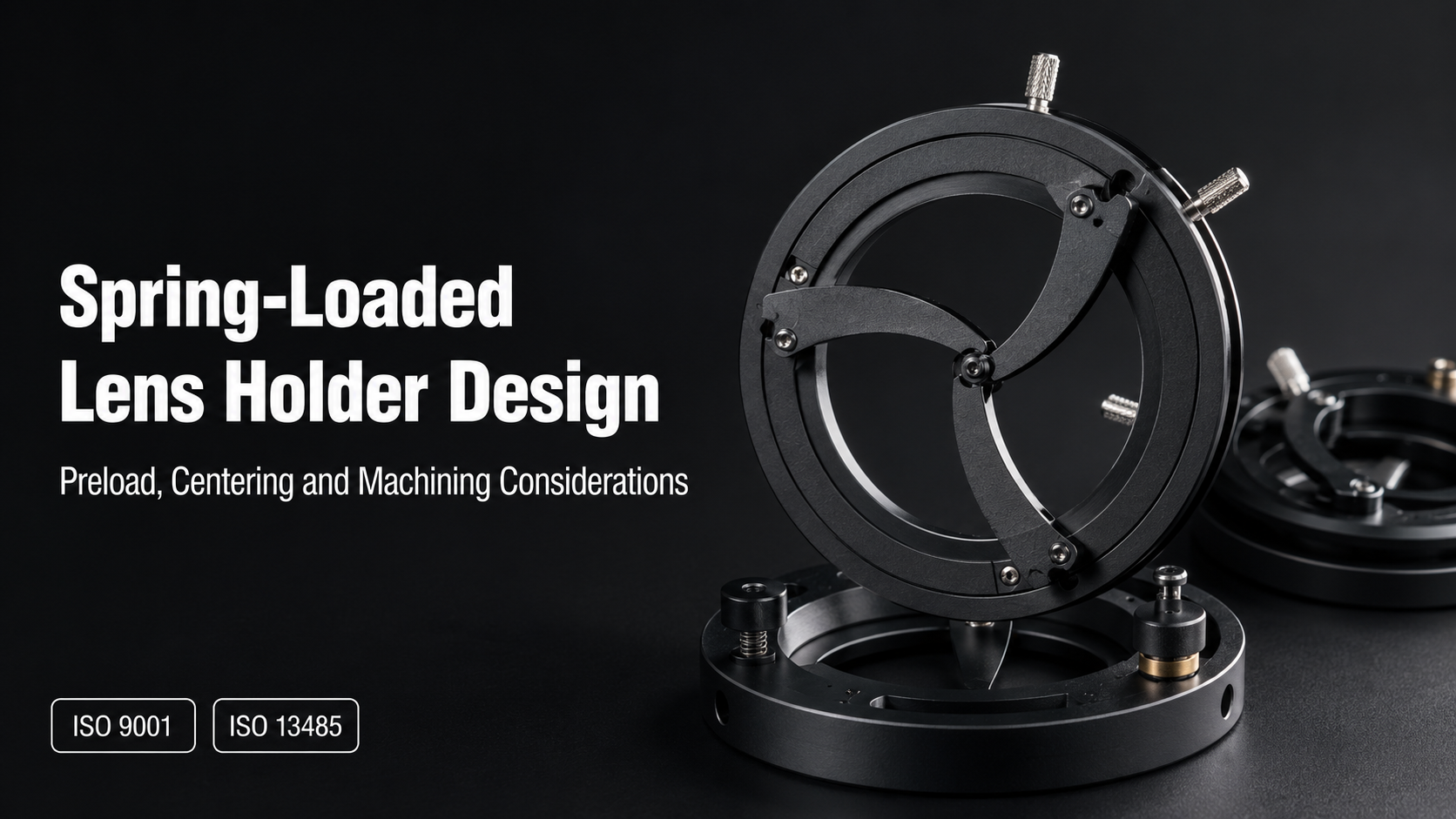
A rigidly fixed lens holder works only as long as every dimension in the stack — the lens diameter, the bore, the retaining feature — stays exactly where it was machined. In practice, thermal expansion, vibration, and normal manufacturing tolerance stack-up all shift that relationship slightly, which can leave a lens loose in its seat or, in the opposite case, overstressed against a hard mechanical stop.
This becomes more important as optical assemblies are used across wider temperature ranges and more demanding mechanical environments — machine vision cameras on moving equipment, laser diode collimators, medical scopes, and outdoor or aerospace optics all need a lens holder that keeps the optic centered and seated without relying on a perfect, zero-tolerance fit.
This article explains what a spring-loaded lens holder is, the common preload mechanisms used to achieve it, why preload force matters for centering and wavefront quality, and what machining considerations go into producing this type of holder accurately.
What Is a Spring-Loaded Lens Holder?
A spring-loaded lens holder uses a spring element — rather than a hard mechanical stop alone — to apply a controlled, continuous force that keeps a lens seated against its locating surface. Instead of clamping the lens rigidly between two fixed surfaces, the spring absorbs small dimensional changes while maintaining consistent contact pressure.
This is different from a standard threaded retaining ring or fixed shoulder design, where the lens is held by direct mechanical contact with no compliance built into the mounting. In a spring-loaded lens holder, the spring element provides a defined preload force across a working deflection range, so the lens stays properly seated even as the surrounding metal expands, contracts, or experiences shock loading.

Common Preload Mechanisms
Several spring configurations are used in optomechanical lens holders, each suited to different force ranges, axial travel, and assembly space.
| Mechanism | Typical Preload Force | Axial Travel | Common Use |
|---|---|---|---|
| Wave spring | Low to moderate, distributed evenly | Moderate | General lens cells requiring even axial preload in limited space |
| Belleville (disc) spring stack | Adjustable by stack configuration | Low | Compact assemblies needing precise, tunable preload force |
| Canted coil spring | Constant force across a wider deflection range | High | Assemblies with larger tolerance stack-up or thermal range |
| Spring-loaded fingers (integral flexure) | Low, self-centering | Low to moderate | Quick-change or self-centering lens holders |
Spring-loaded fingers are often machined directly into the holder body as thin flexure sections rather than added as separate spring components. This self-centering approach grips the lens from multiple points around its circumference, which helps center the optic on the mount's axis without a separate alignment step.
Why Preload Matters: Centering, Thermal Compensation, and Wavefront Error
Preload force in a spring-loaded lens holder does three jobs at once, and getting the force wrong in either direction creates a different problem.
Centering. A properly preloaded spring keeps the lens pressed against its locating diameter or seat, so the optical axis stays aligned with the mount's mechanical axis even as small clearances exist elsewhere in the fit.
Thermal compensation. Aluminum housings and glass lenses expand at different rates as temperature changes. A spring absorbs this differential expansion by deflecting slightly, rather than transmitting the full mismatch as stress into the lens or the housing.
Wavefront error control. Too little preload allows the lens to shift under vibration or shock, degrading alignment. Too much preload can distort the lens surface itself, introducing wavefront error even though the lens is held perfectly still. Preload force is typically specified as part of the optical design, not left to the machinist's judgment during assembly.
Machining Considerations for Spring-Loaded Lens Holders
Producing a spring-loaded lens holder involves the same alignment-critical machining discipline as a standard optical mount, plus additional features specific to the spring mechanism.
Spring seat pockets. The pocket or step that locates the spring must control depth accurately, since spring seat depth directly sets the preload force once the assembly is closed.
Flexure slots for integral spring fingers. When spring-loaded fingers are machined directly into the holder body, slot width and depth control the finger's stiffness. Too thin, and the finger may yield permanently under repeated use; too thick, and it will not deflect enough to provide compliance.
Concentricity between the spring seat and the lens locating bore. If these two features are not concentric, the spring will apply an uneven, off-axis force, which can tilt the lens rather than center it.
Material selection for spring fingers. Integral spring fingers usually need a material with good fatigue resistance, since they may be compressed and released repeatedly during assembly, disassembly, or thermal cycling. This is a different consideration than the general housing material selection used for a standard optical mount.

Typical Applications
Spring-loaded lens holders are used where a lens must stay centered and seated across changing conditions rather than in a single fixed state:
Machine vision and industrial camera lenses — exposed to vibration and temperature swings on production equipment.
Laser diode collimators — where sub-micron centering directly affects beam quality.
Medical and endoscopic optics — repeated sterilization cycles introduce thermal cycling that a rigid mount cannot absorb without stress.
Quick-change or field-serviceable optics — self-centering spring fingers allow a lens to be removed and reinstalled without a separate alignment fixture.
Quality Control: Verifying Preload Force
Because preload force is a functional requirement, not just a dimensional one, inspection typically goes beyond checking bore and pocket dimensions:
Force verification using a calibrated gauge to confirm the assembled spring produces the specified preload range before the holder is accepted.
Dimensional inspection by CMM of spring seat depth, bore concentricity, and locating features that determine preload once assembled.
Functional cycling checks for holders with integral spring fingers, to confirm the flexure returns to its original position after repeated deflection.
XY-Global's Capability for Spring-Loaded Lens Holders
At XY-Global, spring-loaded lens holders are produced using the same tolerance control applied to our broader CNC machined optical mounts, with additional attention to spring seat depth, flexure geometry, and concentricity between the spring feature and the lens bore. These holders are often produced as part of a larger custom lens barrel assembly, where the spring-loaded element sits within a multi-section housing.
Our capabilities include:
Precision spring seat and flexure machining to ±0.01 mm
Concentricity control between spring features and lens locating bores
Integral spring finger machining for self-centering designs
Preload force verification during inspection
Prototype through production support
FAQ
How is preload force specified for a spring-loaded lens holder?
Preload force is normally defined by the optical designer based on the lens material, mass, expected vibration environment, and acceptable wavefront error, then translated into a spring seat depth and spring selection by the mechanical designer.
What's the difference between spring-loaded fingers and a separate spring component?
Integral spring fingers are machined directly into the holder as thin flexure sections, avoiding a separate part, while wave springs and Belleville stacks are discrete components assembled into a pocket. The choice depends on available space, required force, and assembly complexity.
Can spring-loaded lens holders be used in cryogenic or high-temperature environments?
Yes, with proper spring material and preload selection. Some designs use radial centering pads combined with a spring stack calculated to maintain correct preload at both room temperature and the extreme operating temperature.
Do spring-loaded holders cost more to machine than fixed lens holders?
Typically yes, because of the additional pocket and flexure features and the need for concentricity control between the spring feature and the lens bore, but the added cost is often justified when the assembly must survive thermal cycling or vibration.
A spring-loaded lens holder trades the simplicity of a rigid, fixed mount for the ability to keep a lens centered and properly seated across thermal changes, vibration, and normal tolerance stack-up. Getting this right depends on controlling spring seat depth, flexure geometry, and concentricity as carefully as any other alignment-critical feature in the assembly. If you are designing an optical assembly that needs to hold tolerance across a temperature range or vibration environment, our engineering team can review your preload requirements and recommend a suitable holder design.

공유하다:
CNC Machining vs 3D Printing for Custom Parts
CNC Machined Optical Sensor Housing: Design, Materials and Manufacturing