In optical engineering, individual lenses and glass elements rarely perform in isolation. They function as part of a larger system — a carefully integrated structure where each component must be positioned, aligned, and held with exacting consistency. That structure is the optical assembly.
For engineers designing cameras, laser systems, medical imaging devices, machine vision equipment, or scientific instruments, the optical assembly is where mechanical and optical precision converge. A single poorly machined housing or an out-of-tolerance barrel can misalign an entire optical train, causing degraded image quality, wavefront error, or outright system failure.
This article covers what optical assemblies are, how they are manufactured, what precision requirements they impose, and how to select a machining partner capable of supporting your project from early prototype to stable production.

What Are Optical Assemblies?
An optical assembly is a structured combination of optical and mechanical components that work together to collect, direct, focus, filter, or detect light. Unlike a standalone lens element or mirror, an optical assembly integrates multiple parts — typically including lenses or optical elements, lens barrels or tubes, retaining rings, spacers, flanges, and mounting structures — into a complete functional unit.
Optical assemblies appear across a wide range of applications: industrial machine vision systems, laser processing heads, medical endoscopes and imaging modules, surveillance and defense optics, semiconductor inspection equipment, and research-grade scientific instruments.
What makes optical assemblies technically demanding is not only the quality of the glass elements. The mechanical components that hold, position, and align those elements are equally critical. If a lens barrel is out of round, if a flange surface is not flat enough, or if a spacer is the wrong thickness, the optical performance of the entire assembly can be compromised — even when every glass element is individually perfect.
Core Components in a Precision Optical Assembly
Most precision optical assemblies share a common set of mechanical elements, each with specific dimensional and surface requirements.
Lens barrels and tubes are the primary structural housings that hold and position optical elements along the optical axis. They must be machined to tight bore diameters, controlled roundness, and accurate thread pitches. For multi-element assemblies, coaxiality between barrel sections is a critical parameter.
Retaining rings and threaded rings secure lenses within the barrel without introducing stress or misalignment. Their thread form, face flatness, and perpendicularity to the optical axis must all be controlled.
Spacers and shims define the air gaps between optical elements. Their thickness tolerance directly affects back focal distance, optical path length, and system performance. Even a 5–10 μm error in spacer thickness can be significant in high-precision systems.
Flanges and mounting interfaces connect the optical assembly to the broader instrument or platform. Their flatness, parallelism, and hole position accuracy affect how well the assembly can be aligned and maintained in the final system.
Focus and zoom adjustment mechanisms introduce additional requirements — controlled thread pitch, smooth helical travel, and repeatable positioning without backlash or tilt.
Each of these components must be machined with precision, but precision alone is not enough. They must also work together. The challenge of optical assembly manufacturing is systemic, not just dimensional.
Why Mechanical Precision Defines Optical Assembly Performance
In most mechanical engineering applications, a tolerance of ±0.05 mm is considered relatively tight. In optical assemblies, tolerances at that level may be insufficient.
The reason is that optical systems are sensitive to positional errors in a way that ordinary mechanical assemblies are not. A lens element that is tilted by even 0.01° can introduce coma or astigmatism. A lens that is decentered by 10 μm can reduce contrast and resolution. A barrel bore that is out of round can cause uneven pressure on a lens element, deforming the glass and shifting its optical properties.
For many precision optical assemblies, mechanical tolerances in the range of ±1–5 μm are required for critical features. Surface finish requirements for internal bore surfaces may be Ra ≤ 0.1–0.4 μm to reduce stray light scatter and support lens seating.
This means that optical assembly manufacturing is not a standard CNC machining job. It requires a machining partner with the equipment, process knowledge, and inspection capability to work consistently at these levels — and to understand why those tolerances matter in the context of the final optical system.
| Assembly Component | Typical Critical Tolerance | Why It Matters |
|---|---|---|
| Lens barrel bore diameter | ±1–5 μm | Controls lens fit and centration |
| Spacer thickness | ±2–10 μm | Affects back focal distance and optical path |
| Flange flatness | ≤ 2–5 μm | Determines tilt and alignment to mounting surface |
| Thread pitch and form | Controlled to standard | Affects smooth travel and lens positioning |
| Barrel coaxiality | ≤ 3–10 μm | Maintains optical axis alignment across elements |
| Internal surface roughness | Ra ≤ 0.1–0.4 μm | Reduces stray light and supports clean lens seating |

CNC Machining Processes for Optical Assembly Components
Most mechanical components in optical assemblies are produced by CNC machining. The choice of process depends on part geometry, tolerance requirements, material, and production quantity.
CNC turning is the primary process for round components such as lens barrels, rings, spacers, and sleeves. Turning can achieve tight diameter tolerances, controlled surface finish on internal and external bores, and accurate thread forms. For optical barrels, it is common to turn both the outer diameter and the bore in a single setup to control coaxiality.
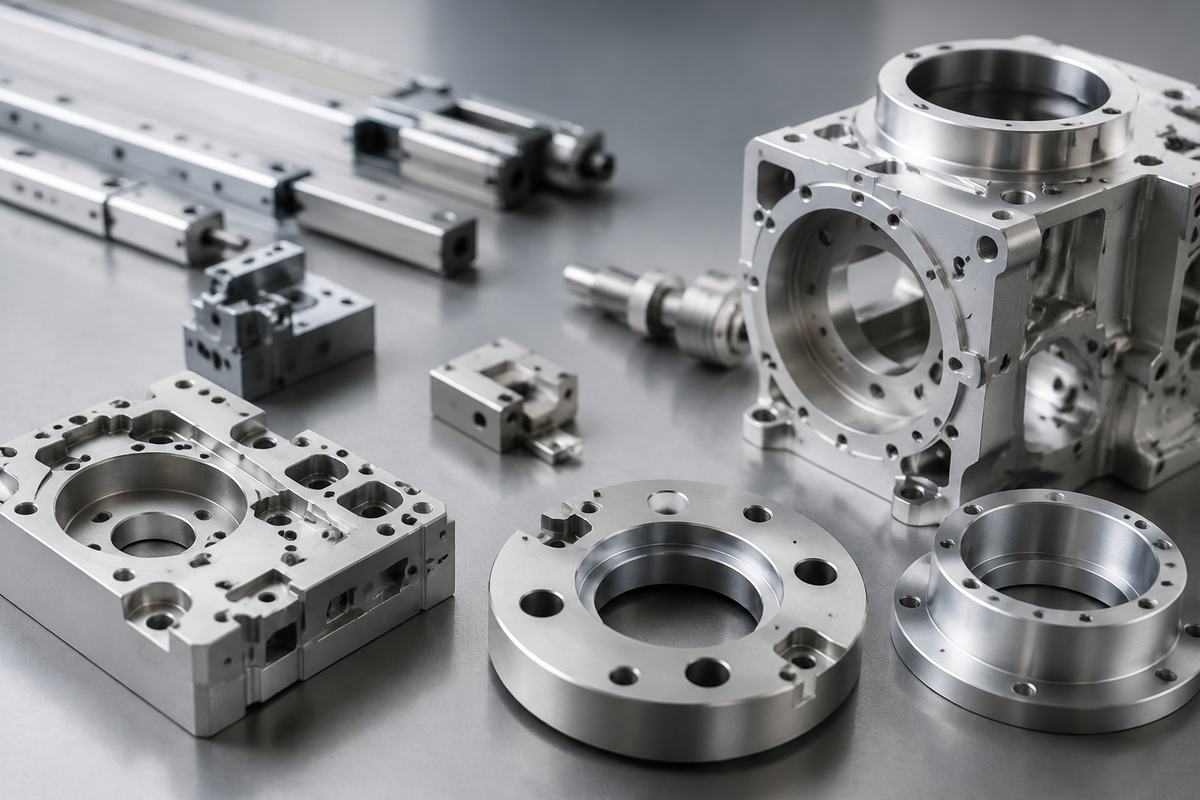
CNC milling is used for flanges, mounting plates, brackets, and housings with flat surfaces, pockets, or multiple hole patterns. Multi-axis milling can produce complex optical structures with angled surfaces or integrated features.
5-axis CNC machining is valuable for parts that combine multiple functional surfaces in a single component, or that require accurate positioning of features relative to a defined datum. Reducing setups helps minimize accumulated positional error — a significant advantage for optical components where every micron counts.
For assemblies requiring fine-pitch threads or tight-tolerance bores beyond standard turning capability, additional processes such as thread grinding, honing, or fine boring may be used to reach final dimensional targets.
Material Selection for Optical Assembly Housings and Structures
The material used for optical assembly components affects machineability, dimensional stability, weight, thermal behavior, and corrosion resistance.
Aluminum alloys (typically 6061 or 7075) are the most common choice. They offer a good balance of machinability, light weight, and thermal conductivity. Anodizing provides corrosion resistance and a low-reflectance black finish useful for stray light control. The primary limitation is thermal expansion — aluminum has a relatively high CTE, which matters in systems used across wide temperature ranges.
Stainless steel is used when higher strength, corrosion resistance, or lower CTE is needed. Medical optical devices often require stainless steel for biocompatibility and sterilization resistance.
Titanium alloys provide a lower CTE than aluminum with high strength-to-weight ratio. They are used in aerospace and defense optical assemblies where dimensional stability across temperature is critical.
Invar and Super Invar are iron-nickel alloys with extremely low CTE, used in high-stability optical systems such as space instruments or precision metrology equipment.
Material selection should be made early in the design process, in coordination with the machining supplier and the optical system requirements. Changing materials late in development can affect tolerances, surface treatment options, and manufacturing lead time.
Surface Finish and Coating Requirements in Optical Assemblies
Internal barrel surfaces adjacent to optical elements may require smooth finishes to prevent particulate accumulation, reduce stray light, and support clean lens seating. Black anodizing or matte black coatings on internal surfaces are commonly applied to aluminum barrels to suppress internal reflections.
Seating surfaces for lenses must be flat and smooth to avoid introducing tilt or stress when the retaining ring is tightened. Any burr or surface irregularity at the lens seat can push the element out of position.
One important consideration is the effect of surface treatment on dimensional tolerance. Anodizing adds 5–25 μm per surface depending on the process. For tight-tolerance bores, the machined dimension must account for this addition. Confirming the finishing specification and its dimensional effect before machining starts is essential.
Alignment, Centering, and Integration Challenges
Manufacturing individual components to print is necessary but not sufficient. Optical assemblies must also be correctly integrated — meaning the elements must be aligned, centered, and secured in a way that meets optical system performance requirements.
Centration — the process of aligning each lens element to the optical axis — is one of the most critical aspects of optical assembly. Even if each component is perfectly machined, assembly errors during integration can introduce tilt or decenter that degrades performance.
For high-precision assemblies, this may involve active alignment during integration, where the assembly is tested optically as components are added. In other cases, precision-bored housings and machined datum surfaces provide passive alignment, relying on tight mechanical tolerances to achieve acceptable centration.
Stray light control is another integration challenge, addressed through internal surface coatings, baffles, aperture stops, and thread profiles designed to break up reflections.
Quality Control and Inspection for Optical Assemblies
Quality control for optical assembly components requires understanding which features are functionally critical and applying appropriate inspection methods to verify them.
CMM inspection is commonly used for geometric features such as bore diameter, roundness, flatness, coaxiality, and hole position. Surface roughness is measured using contact profilometers or optical profilers. Thread inspection for fine-pitch optical threads requires thread gauges or CMM stylus measurement.
For assemblies intended for medical devices, ISO 13485-certified quality systems require documented process controls, traceability from raw material to finished part, and formal first article inspection reports.
A capable optical assembly machining supplier should be able to discuss inspection requirements proactively, confirm appropriate measurement methods for critical features, and provide documentation that supports the customer's internal quality process.

From Optical Assembly Prototype to Production
Many optical assembly projects begin with a prototype phase. At this stage, the primary goal is to verify that the mechanical design supports the required optical performance — that the tolerances are correct, the assembly is practical, and the finished unit meets functional expectations.
Prototype machining for optical assemblies requires fast turnaround, flexibility for design changes, and close communication between the customer's engineering team and the machining supplier. DFM feedback during this phase can identify features that are difficult to machine, tolerances that are unnecessarily tight, or surface treatment choices that will affect final dimensions.
When the design is confirmed and the project moves toward production, the focus shifts to process stability, repeatability, and cost control. A machining partner that supports both phases — prototype and production — can make this transition smoother and reduce the risk of quality problems at scale.
Why Choose XY-GLOBAL for Custom Optical Assembly Manufacturing
XY-GLOBAL provides precision CNC machining services for optical assembly components, including lens barrels, housings, spacers, rings, flanges, and custom optomechanical structures.
Our machining capability includes CNC turning, CNC milling, and 5-axis machining, with dimensional accuracy to ±1 μm and surface finish to Ra ≤ 0.1 μm for optical-grade components. We hold ISO 9001 and ISO 13485 certifications, supporting customers across commercial optics, medical imaging, machine vision, aerospace, and scientific instrumentation.
For optical assembly components, we provide DFM review to identify manufacturing risks before production begins, in-process inspection at critical stages, and final dimensional inspection with documentation. Surface finishing services including black anodizing, hard anodizing, passivation, and bead blasting are available.
We support projects from first prototype through series production, with production start within one day of drawing confirmation and free prototype support for new projects.
FAQ
How tight are the tolerances for CNC machined optical assembly components?
XY-GLOBAL achieves dimensional tolerances to ±1 μm on critical features such as bore diameters and seating surfaces, with surface roughness to Ra ≤ 0.1 μm. Achievable tolerances depend on part geometry, material, and feature type. We review each drawing to confirm what is practical before production begins.
What materials are commonly used for optical assembly housings?
Aluminum alloys (6061, 7075) are most common for machinability and weight. Stainless steel is used for medical or high-corrosion applications. Titanium and Invar are used where low thermal expansion is required.
Can XY-GLOBAL support black anodizing for stray light control?
Yes. Black anodizing is available for aluminum optical assembly components. Dimensional allowance for anodize build-up should be specified on the drawing or confirmed during DFM review.
How is quality documented for optical assembly components?
Inspection reports can include dimensional reports, CMM data, surface roughness records, and first article inspection documents. For ISO 13485 projects, full traceability and process documentation are available.
What is the minimum order quantity?
XY-GLOBAL supports single prototypes through series production. There is no minimum order quantity requirement for prototype work.
Conclusion
Optical assemblies are technically demanding products where mechanical precision and optical performance are inseparable. The quality of lens barrels, housings, spacers, and mounting structures determines whether the assembly functions as designed — from the first prototype to a full production run.
For engineers and product teams working on optical systems, selecting a machining partner that understands both the dimensional requirements and the optical context is essential.
If you are developing custom optical assembly components, XY-GLOBAL can support your project from initial design review through finished parts — with the precision, documentation, and engineering communication that optical applications require.


공유하다:
맞춤형 CNC 부품을 위한 고정밀 가공 서비스
Stainless Steel CNC Machining Services: From Material Selection to Precision Manufacturing