


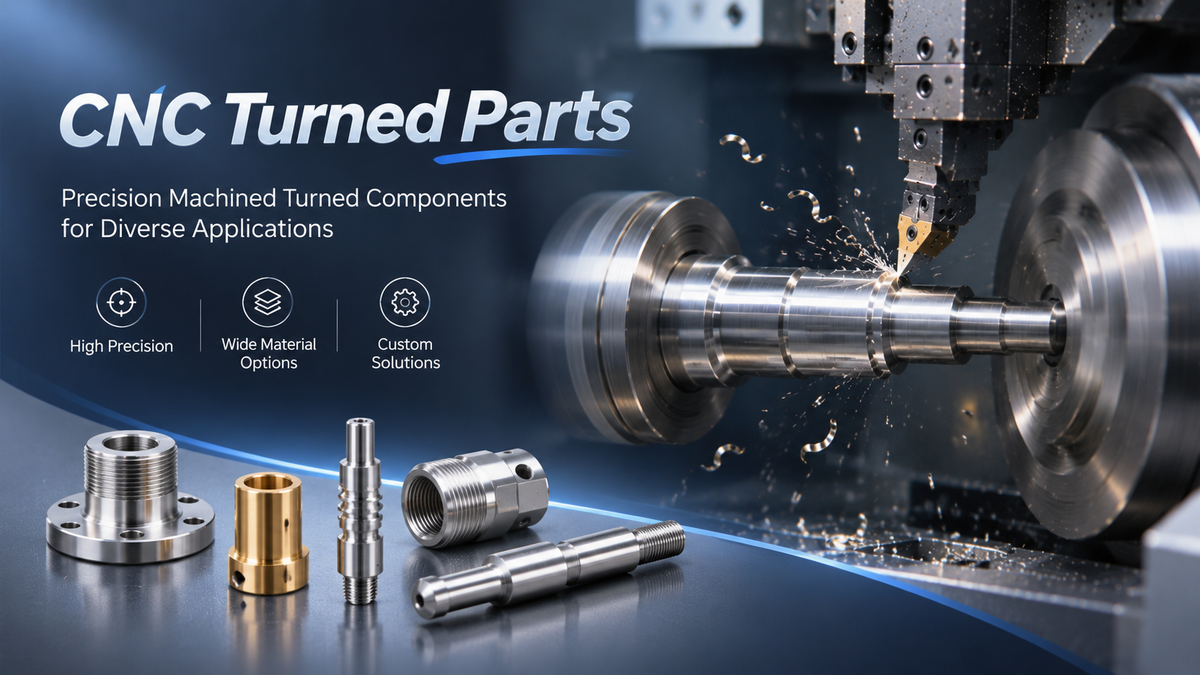
CNC turned parts are found in many types of industrial equipment, from mechanical transmission systems to automation machinery. Shafts, bushings, sleeves, flanges, and custom components are all common examples.
Most of these parts have round or cylindrical features and are made through CNC turning. This process can produce outer diameters, internal holes, flat faces, tapers, threads, and grooves. It also offers good accuracy and consistent results, making it suitable for both simple and complex parts.
In this article, we'll look at how CNC turned parts are made, the different turning operations, machining accuracy, and common applications.

What Are CNC Turned Parts and How Are They Made?
CNC turned parts are components produced through CNC turning, a machining process where the workpiece rotates while a cutting tool removes material to create the required shape.
Simply put, the workpiece spins, and the cutting tool moves.
During machining, the workpiece rotates around the lathe spindle. The cutting tool moves along or across the workpiece, following a programmed path.
The direction of the tool determines the surface being machined. Moving parallel to the workpiece's axis produces cylindrical surfaces, while moving at an angle creates tapers. Curved tool paths can also be used for more complex round shapes.
Unlike conventional turning, CNC turning uses computer programs to control tool movement. This helps maintain consistent dimensions when producing precision turned parts with multiple features.
What Makes CNC Turning Suitable for Precision Parts?
CNC turning has several advantages when manufacturing parts with rotational features:
-
Good accuracy: Outer diameters, internal holes, end faces, and grooves can often be machined in one setup, helping maintain concentricity and alignment.
-
Efficient machining: Turning uses a continuous cutting process and works well for prototypes, small batches, and larger production runs.
-
Cost-effective production: Turning tools are relatively simple. A well-planned process can also reduce extra setups and machining steps.
-
Material flexibility: Common materials include carbon steel, alloy steel, stainless steel, aluminum alloys, copper alloys, and certain engineering plastics.
Different materials require different cutting tools and machining parameters, so the process needs to be adjusted for each part.

Common Machining Processes for CNC Turned Parts
Most CNC turning work involves machining cylindrical or other rotational surfaces. The main operations include external turning, internal turning, facing, taper turning, threading, and grooving.
External Turning
External turning removes material from the outside of a rotating workpiece. The cutting tool moves along its length to produce straight diameters, stepped surfaces, and other fitting features.
This is a common operation for drive shafts, positioning shafts, connecting shafts, and similar components.
Internal Turning
Internal turning, also known as boring, is used to machine the inside of a hole. Usually, a hole is drilled first and then finished with a boring tool to reach the required size.
It can also be used for stepped and blind holes. When the inner and outer surfaces are machined in the same setup, it's easier to maintain concentricity between them.
Facing
Facing creates a flat surface at the end of a rotating workpiece. The cutting tool moves across the end face to remove material and achieve the required dimension.
It's commonly used for shaft shoulders, flanges, and sleeves.
Taper Turning
Taper turning produces a conical surface at a specific angle. These surfaces are often used in machine tool spindles, drill shanks, and locating pins.
Tapered fits can provide accurate positioning while allowing parts to be assembled and removed. With CNC turning, different taper angles and sizes can be machined through programmed tool movements.
Threading and Grooving
Thread turning cuts internal or external threads by coordinating the workpiece's rotation with the cutting tool's movement.
Grooving uses a dedicated tool to cut relief grooves, sealing grooves, and other circular recesses.
For parts with several steps, threads, or grooves, the order of machining operations matters.
How Accurate Can CNC Turned Parts Be?
Machining accuracy depends on the material, cutting tools, machine condition, workholding, and the type of turning operation.
Turning is generally divided into four stages: rough turning, semi-finish turning, finish turning, and fine turning.
| Turning Process | Main Purpose | Typical Accuracy | Surface Roughness |
| Rough Turning | Remove excess material quickly | IT10–IT13 | Ra 50–12.5 μm |
| Semi-Finish Turning | Improve accuracy and prepare for finishing | IT9–IT10 | Ra 6.3–3.2 μm |
| Finish Turning | Achieve better accuracy and surface quality | IT7–IT8 | Ra 3.2–0.8 μm |
| Fine Turning | Produce high-precision surfaces with specialized tools | IT6–IT7 | Ra 0.8–0.2 μm |
Rough turning removes most of the unwanted material, usually with a larger depth of cut and higher feed rate.
Semi-finish turning improves dimensions and surface quality. For some parts, this is the final machining step. Others need further finishing.
Finish turning uses smaller cuts and lower feed rates to achieve better dimensional accuracy and a smoother surface.
For higher precision requirements, fine turning may be used with diamond or cubic boron nitride (CBN) cutting tools. Diamond tools are particularly useful for certain non-ferrous metals that need a high-quality surface finish.
These figures are typical reference ranges, not guaranteed results for every CNC lathe. Actual accuracy depends on the part design and machining conditions.
Common Types of CNC Turned Parts
CNC turning is widely used to make shafts, discs, flanges, bushings, sleeves, and other precision components.
Shafts
Shafts are among the most common CNC turned parts. Examples include drive shafts, positioning shafts, pins, connecting shafts, and stepped shafts.
They often have different diameters, shoulders, grooves, and threads. Most of these features can be produced through turning.
Discs and Flanges
Disc-shaped parts usually have a larger diameter and a relatively small thickness. Common examples include flanges, end covers, and connecting discs.
Turning is used to machine their outer diameters, center holes, end faces, and circular grooves. If the design includes bolt holes or other non-round features, drilling or milling may also be needed.
Bushings and Sleeves
Bushings and sleeves have both inner and outer cylindrical surfaces. Their dimensions and the alignment between these surfaces are important for proper fit and assembly.
Machining both surfaces in a suitable setup helps achieve the required accuracy.
Custom Precision Turned Parts
Not every CNC turned part is completely round. Some also have cross holes, milled slots, flat surfaces, or other features.
For example, a connecting component may need turning for its outer diameter and threads, followed by drilling or milling for additional features.
These operations can be completed separately or combined on a turn-mill machine, depending on the part design. This can reduce extra setups when machining more complex parts.
What to Consider When Ordering Precision Turned Parts
For custom precision turned parts, the material, part geometry, tolerances, and inspection requirements all affect how the parts are machined.
Material Selection
Common materials include aluminum alloys, stainless steel, carbon steel, alloy steel, copper alloys, and engineering plastics.
Aluminum alloys are lightweight and generally easy to machine. Stainless steel offers good corrosion resistance, while carbon steel and alloy steel are often used for shafts and mechanical parts that need different levels of strength.
Material selection should be based on the part's application and working conditions.
Part Design and Machining Process
Some part features are more challenging to machine than others.
Deep holes require attention to tool length, chip removal, and cutting stability. Thin-walled parts can deform during clamping or machining. Parts with multiple shoulders, threads, and grooves need a suitable machining sequence.
For more complex designs, drilling, milling, or turn-mill machining may be required.
Accuracy and Quality Control
Inspection covers more than individual dimensions. Concentricity, geometric tolerances, and critical fitting dimensions also need to meet the engineering drawing requirements.
Material inspection, first-article inspection, in-process inspection, and final inspection are important stages of quality control.
Depending on the material and application, parts may also need surface treatments such as anodizing, electroplating, or black oxide.
Partner with XY-GLOBAL for Custom CNC Turned Parts
The right machining process depends on the part's material, shape, tolerances, surface finish, and intended use.
At XY-GLOBAL, we bring over 15 years of CNC machining expertise with capabilities from CNC turning and CNC milling, to CNC grinding and wire EDM.
Our custom precision CNC machining services, including CNC turning and related machining processes. We work with customer drawings and project requirements to review suitable machining options for different parts.
Need custom CNC turned parts for your project?
Visit our CNC turning service page or send us your 2D or 3D drawings, material specifications, quantities, and tolerance requirements to discuss your project and request a quote.

공유하다:
How CNC Turn-Mill Machining Achieves ±0.005 mm Tolerances in Complex Parts
Aluminum Die Casting Components Supplier: What Really Matters When Choosing a Manufacturing Partner?