In precision manufacturing,process choice affects cost,lead time,quality, and design freedom.

Many buyers and engineers compare CNC milling vs CNC turning when they review a new part. The two processes both remove material with computer-controlled machines, but they do not solve the same problem.

The right choice depends on the shape of the part, the critical dimensions, the surface finish requirement, and the production volume.

A round shaft and a complex aluminum housing should not follow the same machining route. Good process selection starts with geometry, not preference.

This guide explains the difference between the two methods, where each one performs best, and how to select the right approach for production parts.

Quick Comparison Chart

Before we go deeper into each topic, here’s a quick side-by-side look at how CNC turning and milling compare.

Feature CNC Turning CNC Milling
Part Movement The part spins The tool moves
Best For Round, cylindrical parts Flat, square, or complex parts
Machine Type Lathe Milling machine
Tool Path 1-2 axes (mainly Z and X) Multi-axis (X, Y, Z)
Speed Fast for round shapes Slower for detailed or multi-face cuts
Accuracy Excellent for round tolerances Great for flatness, edges, and holes
Material Fit Soft metals, plastics, bar stock Hard metals, flat stock, odd shapes
Setup Time Often shorter and simpler Usually longer and more involved
Best Volume Use High-volume production Small batches or complex one-offs
Design Flexibility Limited to symmetrical shapes Can handle diverse, custom designs
CNC milling machine machining an aluminum housing with a carbide end mill during precision metal cutting

What Is CNC Milling?

CNC milling is a machining process in which the cutting tool rotates while the workpiece stays fixed on the machine table. The tool moves along programmed paths to remove material from the top, side, or multiple faces of the part.

This process is well suited for non-round components.

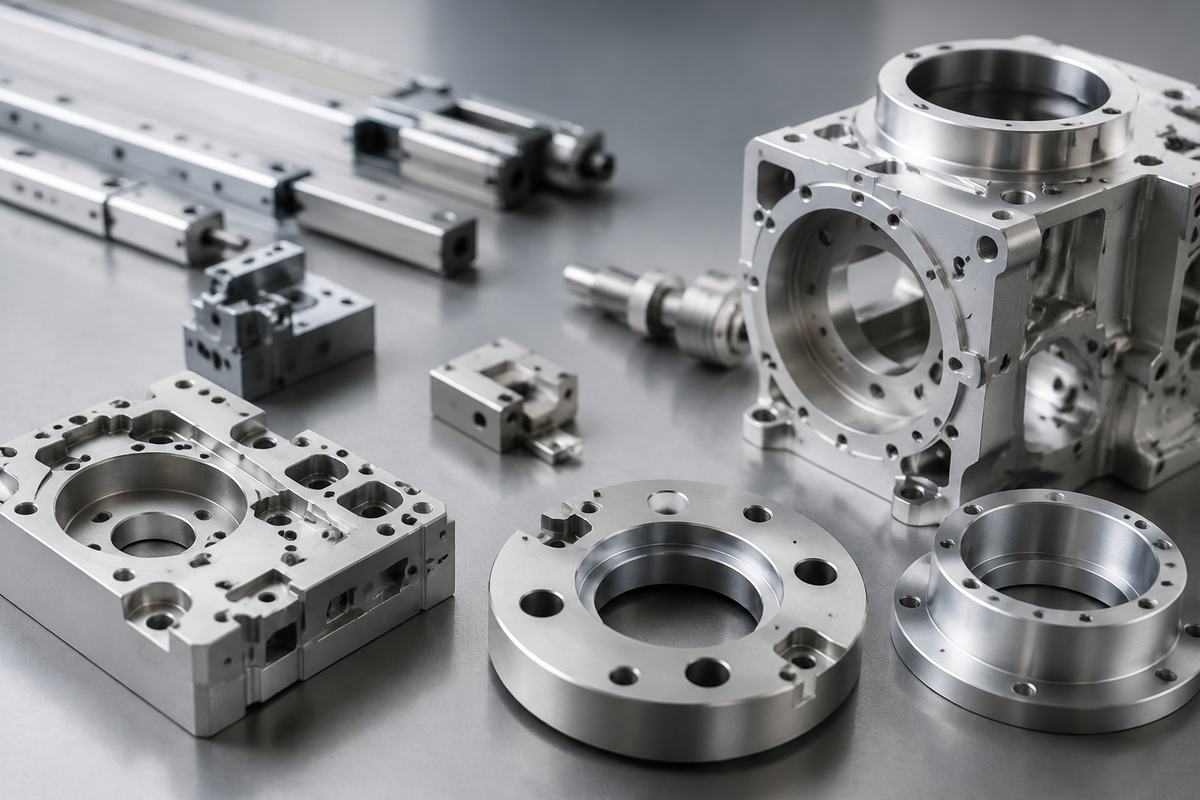
 It is commonly used to produce flat surfaces, pockets, slots, contours, threaded holes, and complex outer profiles. In practical production, CNC milling is often the better option for brackets, housings, plates, fixtures, and optical mechanical components.

One reason milling is so widely used is flexibility.

 A milling machine can handle simple square parts, but it can also machine complex features across several faces. That makes it useful for prototypes, custom parts, and medium-volume production where part geometry is more important than cycle speed.

For engineering teams, the key value of milling is feature freedom. If a part includes side holes, stepped faces, recessed areas, or irregular outer shapes, milling often becomes the primary process.

CNC turning machine cutting a stainless steel shaft with a carbide tool during precision lathe machining

What Is CNC Turning?

CNC turning works in a different way. In this process, the workpiece rotates while the cutting tool feeds into the material. Because the part spins around its centerline, turning is ideal for rotational or cylindrical geometry.

This makes turning the preferred method for shafts, bushings, pins, sleeves, threaded connectors, and similar round parts. It is especially effective when outer diameter, inner diameter, concentricity, and runout are important.

Turning also offers strong efficiency for repeat production. When the raw material is bar stock and the part shape follows a central axis, the machine can remove material quickly and consistently. For many standard cylindrical parts, this leads to shorter cycle times and lower cost per piece.

In real production environments, turning is not just about speed. It also helps maintain stable results on critical round features. When a design depends on smooth concentric surfaces and tight diameter control, turning usually gives a cleaner route than milling.

CNC Milling vs CNC Turning: Key Differences

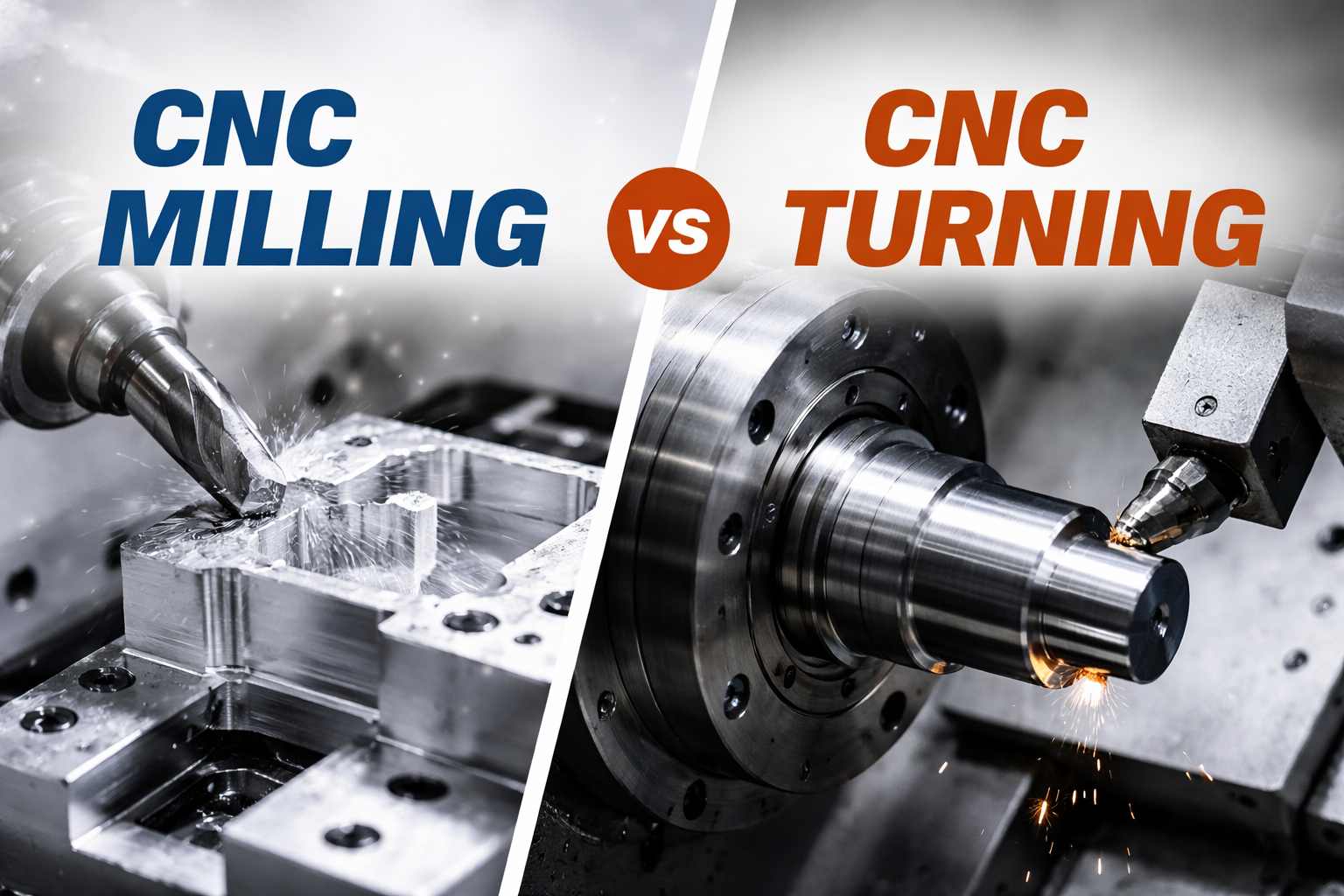
The core difference between the two processes is simple. In milling, the tool rotates. In turning, the part rotates. That difference changes the kind of geometry each process can produce well.

When teams evaluate CNC milling vs CNC turning, the first question should be:

Is the part mainly rotational, or does it contain multiple flat and irregular features? If the part is axisymmetric, turning is usually the better starting point. If it has pockets, side walls, or many machined faces, milling is often the better answer.

The second difference is feature type.

Turning is strong for outer diameters, inner bores, tapers, grooves, and threads on round components. Milling is strong for surfaces, slots, contours, drilled patterns, and non-rotational details.

The third difference is setup logic.

Turning often starts from round bar or tube stock. Milling often starts from plate, block, or near-net material. This affects material use, workholding, and cycle planning.

The fourth difference is production rhythm.

Turning can be very efficient for round parts in stable batches. Milling tends to offer more flexibility, but complex toolpaths and multiple setups can raise machining time.

For most engineers, this is the practical rule: turning follows the axis of a round part, while milling builds the shape of a complex part.

Free High Precision 0.1 m CNC Parts from China Factory

Precision, Surface Finish, and Cost Considerations

Precision is not only about the machine. It is also about whether the process matches the geometry.

Turning usually performs better on concentric diameters, roundness, and coaxial relationships. Milling usually performs better on planar features, hole positions, step heights, and multi-surface geometry.

Surface finish follows the same logic.

A turned surface on a cylindrical part can be very consistent because the cut follows a smooth rotational path. A milled surface can also achieve good finish, but it depends more on toolpath strategy, cutter selection, step-over, and part rigidity.

Cost depends on more than hourly machine rate. It also depends on how easily the part fits the process.

A simple shaft made on a lathe is often far more economical than trying to cut the same shape on a mill. On the other hand, a housing with deep pockets and side details would be inefficient to force into a turning workflow.

When comparing CNC milling vs CNC turning for precision parts, the best decision comes from the total manufacturing picture:

  • part geometry
  • critical tolerances
  • surface finish targets
  • material type
  • production volume

A process that looks cheaper at first can become expensive if it creates more setups, more inspection pressure, or more risk of scrap.

Comparison between CNC Turning & Milling

Choose CNC Turning when:

  • The part is axisymmetric (round or cylindrical)
  • The tolerance must reach ±0.005–0.01 mm
  • Surface finish needs Ra 0.8–1.6 μm
  • Production volume is medium to high

Choose CNC Milling when:

  • Flat surfaces, pockets, or slots
  • Multi-face or complex features
  • Varying tolerances across dimensions
  • Prototyping or low-volume production

In summary, CNC milling is commonly used for fixtures, optical mounts, electronics housings, medical device components, and custom automation parts because it handles complex, non-rotational features more effectively.

CNC turning, by contrast, is widely used for shafts, bushings, sleeves, nozzles, connectors, and other rotational parts because it offers better efficiency and consistency for cylindrical geometry.

Can a Part Require Both Milling and Turning?

Yes. In fact, many production parts require both processes.

A common example is a round component that starts with turning for the outer diameter, bore, and thread features, then moves to milling for flats, side holes, slots, or keyways. Another example is a precision connector with a turned body and milled secondary features for assembly.

This combined approach is common because many engineered parts are neither fully round nor fully prismatic.

They contain both rotational and non-rotational features. In these cases, the best manufacturing plan is not a debate between one process and the other. It is a sequence that uses each process where it performs best.

That is also where supplier experience matters. A capable machining partner should not only quote the drawing.

They should review the part, identify the critical features, and suggest a process route that balances quality, cost, and lead time. That practical judgment is part of real manufacturability support.

Conclusion

The difference between milling and turning is simple in theory, but important in practice.

Milling uses a rotating tool to cut complex, non-round geometry while turning uses a rotating part to produce cylindrical features with speed and consistency.

When buyers compare CNC milling vs CNC turning, the best choice depends on shape first, then tolerance, finish, material, and volume.

For round parts, turning is often the faster and more economical route.

For complex structural parts, milling usually offers the control and flexibility required. For many advanced components, the best answer is a combination of both.

A strong machining decision is not based on machine type alone. It is based on how well the process fits the part.

Visit our service page!

CNC Milling 

CNC Turning