


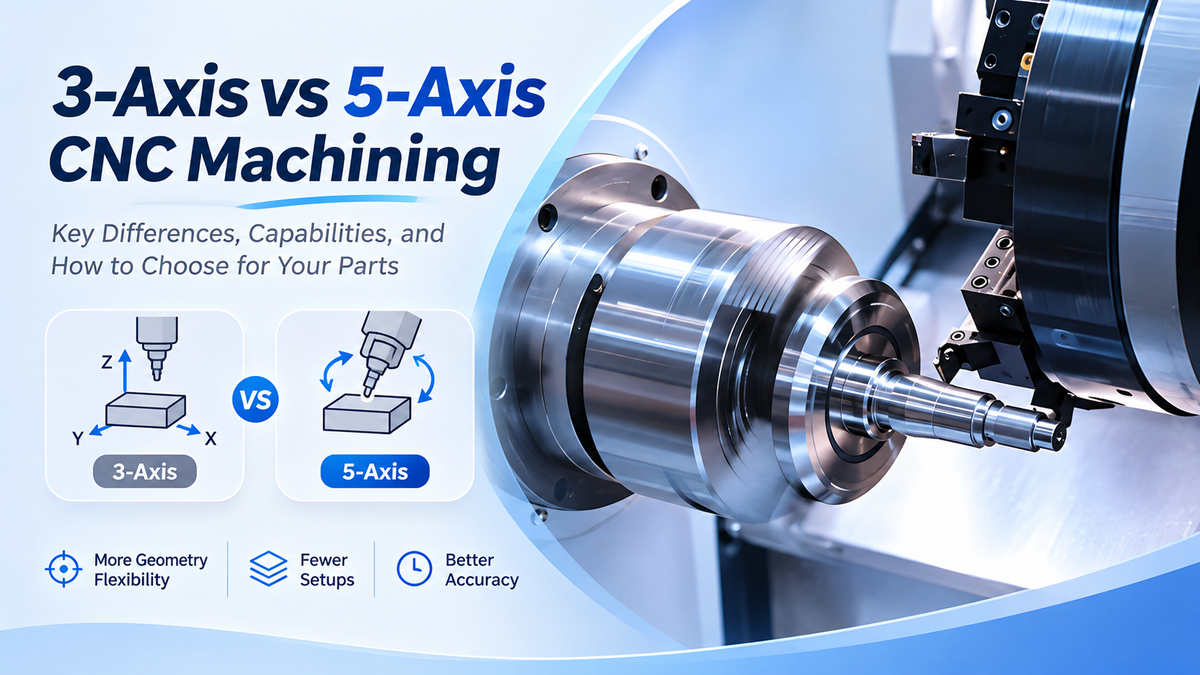
The wrong choice between 3-axis and 5-axis CNC machining can increase machining costs, require extra setups, or make tight tolerances harder to achieve. 3 axis cnc machining is often more economical for simple parts while 5 axis is better for multi-sided components with complex geometries.
At XY-GLOBAL, we bring over 15 years of expertise to help manufacture custom CNC machined parts with different design and production requirements.
In this blog, we'll compare 3-axis and 5-axis CNC machining in terms of capabilities, cost, accuracy, typical applications and decide how to choose the right process for your custom part.
Here's a quick overview of the main differences.
| Factor | 3-Axis CNC Machining | 5-Axis CNC Machining |
| Machine movement | X, Y, and Z linear axes | Three linear axes plus two rotary axes |
| Best suited for | Simple to moderately complex parts | Complex, angled, and multi-sided parts |
| Tool access | Mainly from a fixed orientation | More machining angles and tool orientations |
| Setup requirements | May require multiple setups | Often reduces the number of setups |
| Programming | Generally simpler | More complex, especially for simultaneous 5-axis |
| Machining cost | Usually lower for simple parts | Can reduce total costs for complex parts |
| Accuracy | High precision with proper setup | May improve consistency between features on different faces |
| Typical parts | Brackets, plates, housings, fixtures | Impellers, complex housings, aerospace components |
What Is 3-Axis CNC Machining?
3-axis CNC machining is one of the most common methods used to manufacture custom metal and plastic parts. A 3-axis CNC milling machine moves the cutting tool along three linear axes: X, Y, and Z. These movements allow the tool to remove material from a workpiece and create features such as holes, slots, pockets, and contoured surfaces.
For example, an aluminum mounting plate with several holes and milled slots can usually be produced on a 3-axis machine without complicated programming or special fixtures.
This makes 3-axis CNC milling a practical option for many industrial components, especially when most features can be reached from one machining direction.

Advantages and Limitations of 3-Axis CNC Machining
One of the biggest advantages of 3-axis machining is cost efficiency. The equipment is widely available, programming is generally straightforward, and many parts can be manufactured using standard fixtures.
This makes it suitable for CNC prototypes, low-volume production, and repeat manufacturing of relatively simple components.
Its main limitation becomes noticeable when a part requires machining from several directions. Additional setups can increase labor costs, fixture requirements, and the risk of positioning errors.
In these situations, 3+2 or 5-axis machining may provide a more efficient solution.
Common 3-Axis CNC Machined Parts
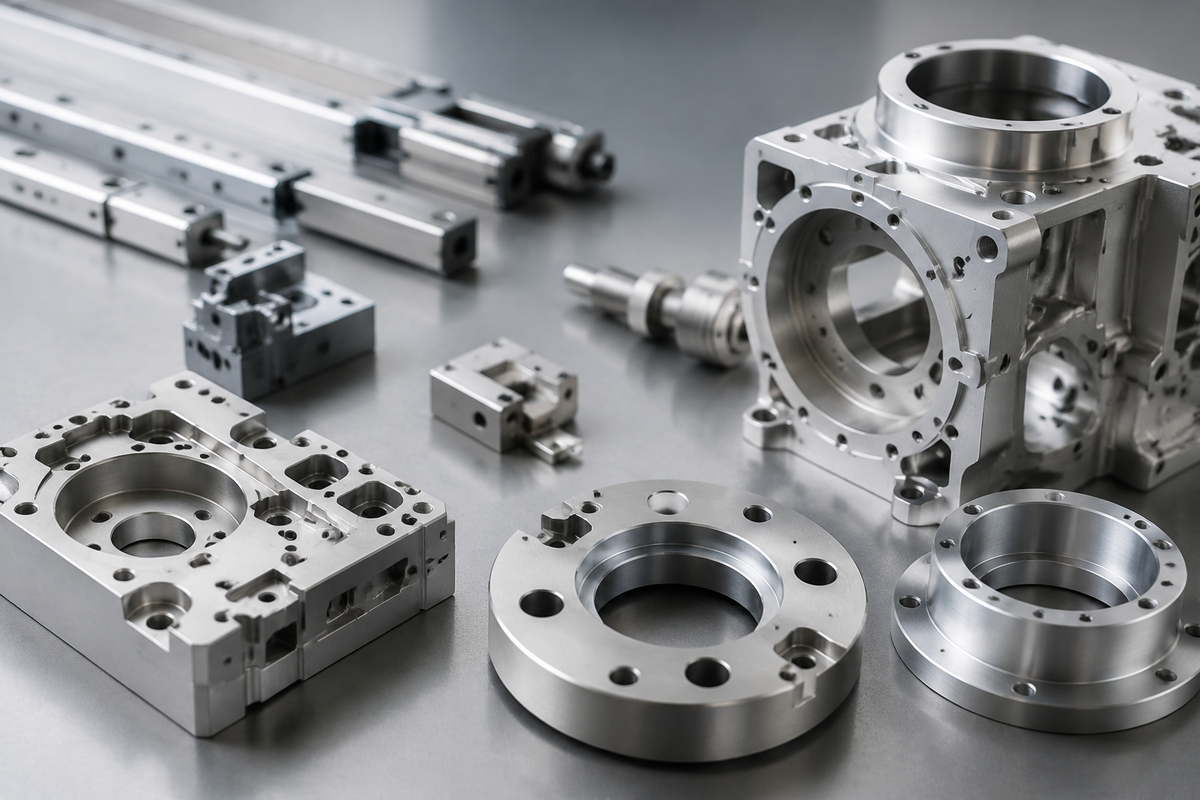
Typical 3-axis CNC machined parts include aluminum brackets, mounting plates, electronic enclosures, machine bases, fixture components, and simple precision housings.
These parts usually have accessible machining features and don't require the cutting tool to approach from many different angles.
Consider a custom aluminum bracket used in an automation system. It may have a flat mounting surface, several threaded holes, and a few milled slots. A 3-axis CNC machine can generally complete these operations efficiently.
However, 3-axis machining isn't limited to flat or simple shapes. With suitable cutting tools and CAM programming, it can also produce complex 3D contours and mold cavities.
The main limitation is tool accessibility.
When features are located on the back or sides of a part, the workpiece may need to be removed, repositioned, and clamped again. Each additional setup requires time and careful alignment.
For many standard components, this isn't a major issue. But for parts with tight positional tolerances between different faces, repeated setups can make manufacturing more difficult.
What Is 5-Axis CNC Machining?
5-axis CNC machining adds two rotary axes to the three linear movements used in conventional CNC milling.
These additional axes allow the machine to change the angle between the cutting tool and the workpiece. Depending on the machine configuration, the tool, the workpiece, or both may rotate.
This gives the cutting tool access to more areas of a component without repeatedly removing and repositioning the workpiece.
For example, a precision aluminum housing may include angled mounting holes, curved surfaces, and internal cavities. Producing these features on a 3-axis machine could require several setups or special fixtures.
A 5-axis CNC machine may be able to reach more of these features in fewer setups, making the manufacturing process more efficient.
Advantages and Limitations of 5-Axis CNC Machining
The main advantage of 5-axis machining is greater flexibility in tool positioning. It can improve access to complex features and reduce the number of setups needed for multi-sided components.
Fewer setups may also help maintain positional relationships between features on different faces, especially when tight tolerances are involved.
However, 5-axis machining generally involves higher equipment costs and more complex programming. Advanced toolpaths may require additional simulation and collision checking.
For simple parts, these additional capabilities may not provide enough benefit to justify the cost.
Common 5-Axis CNC Machined Parts
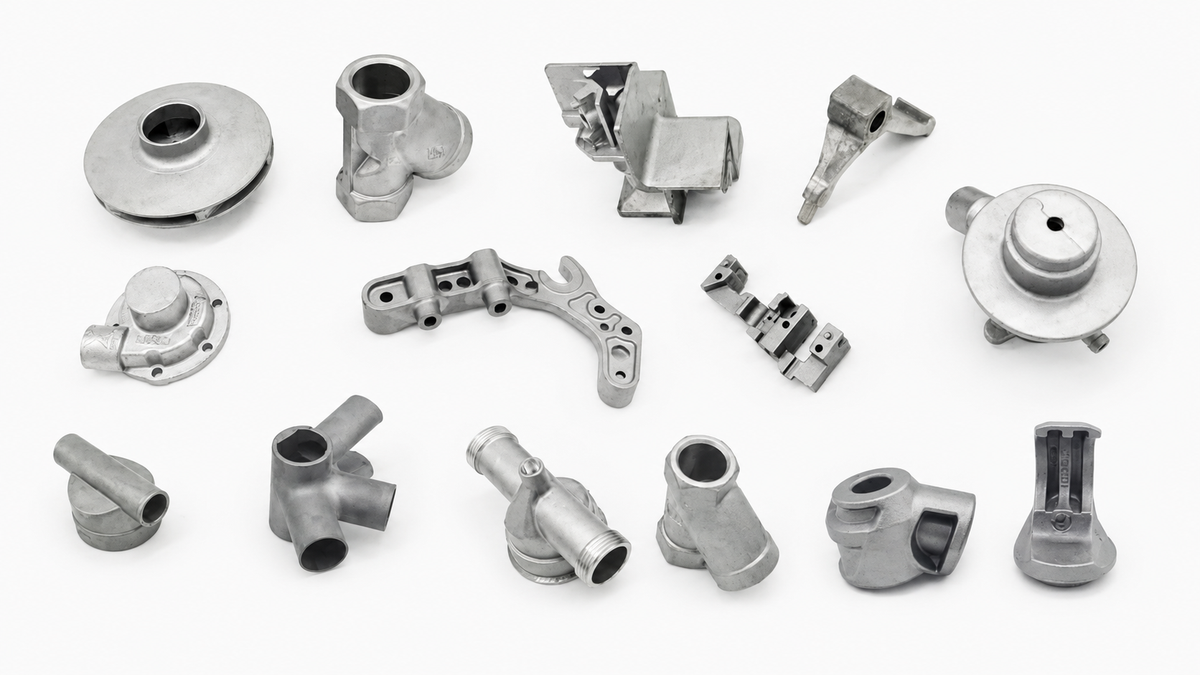
Typical 5-axis CNC machined parts include aerospace structural components, impellers, turbine blades, complex precision housings, molds, and medical components.
These parts often contain angled features, curved surfaces, or difficult-to-reach areas that require more flexible tool positioning.
An impeller is a good example. Its curved blades require the cutting tool to follow complex paths while maintaining suitable cutting angles. Simultaneous 5-axis machining allows the tool orientation to change continuously during cutting, making certain blade geometries easier to produce.
However, not every part with multiple machined sides requires simultaneous 5-axis machining. Some components can be manufactured more efficiently using 3+2 positional machining.

3+2 CNC Machining vs Simultaneous 5-Axis CNC Machining
3+2 machining and simultaneous 5-axis machining work differently although both methods use five-axis equipment.
In 3+2 positional CNC machining, the rotary axes first position the cutting tool or workpiece at a specific angle. Once the position is established, machining takes place using the three linear axes.
This approach works well for components with angled holes, sloped surfaces, and features located on several different faces.
For example, an aluminum housing with mounting holes at different angles may be machined using 3+2 positioning instead of several manual setups.
In simultaneous 5-axis CNC machining, the linear and rotary axes move together during cutting. This allows the tool to follow complex surfaces while continuously changing its orientation.
Simultaneous 5-axis machining is particularly useful for impellers, turbine blades, and certain freeform surfaces. However, it generally requires more advanced programming and process planning.
For parts with a few angled features, 3+2 machining may provide the required flexibility without the additional complexity of simultaneous 5-axis toolpaths.

3-Axis vs 5-Axis CNC Machining: Key Differences
The biggest differences between 3-axis and 5-axis machining become clearer when looking at actual manufacturing requirements.
Part Geometry and Tool Accessibility
Part geometry is usually the first factor a CNC machining manufacturer considers.
For components with flat surfaces, standard holes, and accessible pockets, 3-axis machining is often sufficient.
More complex parts may include angled holes, deep cavities, or features located on several sides. These designs can require additional setups when using a 3-axis machine.
For example, a simple aluminum enclosure with a top pocket and several mounting holes can usually be produced efficiently on a 3-axis machine.
If the same enclosure includes angled ports and precision features on multiple faces, 3+2 or 5-axis machining may reduce the amount of repositioning required.
The decision should be based on actual tool access rather than how complicated the CAD model appears.
Setup Time and Workholding
Every machining setup involves positioning and securing the workpiece.
When a part is removed and reclamped, the operator may need to establish its location again and verify its alignment before continuing.
For components that require machining on several sides, these operations can add considerable time.
A 5-axis machine may be able to access more features in one setup, reducing manual handling and the need for multiple fixtures.
This can be particularly helpful for low-volume complex parts, where setup costs represent a significant portion of the total manufacturing cost.
However, 5-axis machining doesn't always eliminate additional setups. Some parts still need to be repositioned to machine surfaces blocked by the fixture or remove temporary holding material.
Machining Accuracy and Tolerances
Both 3-axis and 5-axis CNC machines can produce high-precision components when the machining process is properly controlled.
The main advantage of 5-axis machining is not necessarily higher accuracy, but the ability to reduce positioning errors caused by repeated setups.
Consider a precision housing with mounting holes on one face and locating features on another. If these features must maintain a tight positional relationship, repeated clamping can make alignment more difficult.
Machining more features in a single setup may help maintain a consistent workpiece reference.
For parts with critical dimensions located on the same face, a capable 3-axis machine can often achieve the required tolerances without difficulty.
Actual machining accuracy also depends on machine calibration, thermal stability, cutting tools, workholding, and inspection methods.
Surface Finish
Both processes can produce good surface finishes, but their advantages depend on the geometry being machined.
For flat surfaces and accessible contours, 3-axis milling is usually effective.
For complex curved surfaces, 5-axis machining may allow the cutting tool to maintain a more suitable angle during cutting. This can improve cutting conditions and reduce tool marks in certain applications.
Still, surface finish is influenced by tool geometry, cutting parameters, toolpath spacing, material properties, and finishing operations.
If a component requires a specific surface roughness, it should be clearly defined on the engineering drawing.
Production Lead Time
5-axis machining can reduce production time by completing more operations in fewer setups.
However, complex 5-axis parts may require additional programming, simulation, and inspection.
Machine availability can also affect delivery schedules.
For example, a simple part may be completed faster on an available 3-axis machine than on a 5-axis machine with a longer production queue.
When comparing suppliers, it's better to evaluate the complete manufacturing lead time rather than machining time alone.
3-Axis vs 5-Axis CNC Machining Cost: Which Is More Economical?
In general, 3-axis CNC machines have lower hourly operating costs. Their programming and setup requirements are also usually simpler.
For straightforward components, this often makes 3-axis machining the more economical option.
However, the total cost of a custom CNC machined part includes more than machine time.
Material preparation, programming, fixtures, setup labor, cutting tools, inspection, and surface finishing can all affect the final quotation.
Why 5-Axis Machining Can Sometimes Reduce Total Cost
A complex part may require several setups on a 3-axis machine.
Each setup involves additional handling, alignment, and sometimes a separate fixture. These operations increase labor time and may require extra inspection.
With 5-axis machining, some of these operations can be combined.
Even though the machine hourly rate is higher, reducing setup time and fixture requirements may lower the overall cost.
Here's a simplified example.
Illustrative Cost Comparison for a Complex Custom Part
| Cost Item | 3-Axis Machining | 5-Axis Machining |
| Programming | $80 | $150 |
| Fixtures and setup | $240 | $100 |
| Machining | $300 | $350 |
| Inspection | $80 | $60 |
| Total | $700 | $660 |
(These figures are hypothetical and are intended only to illustrate how different cost factors affect the final price. They are not actual XY Global quotations.)
In this example, the 5-axis process has higher programming and machining costs. However, the reduction in setup and inspection costs makes the total slightly lower.
For a simple mounting bracket that can be completed in one setup, the result would likely be different.
How Production Volume Affects CNC Machining Costs
Order quantity can also change the most economical manufacturing approach.
For prototypes and small batches, programming and setup costs make up a larger share of the total price.
If a complex component requires several custom fixtures, 5-axis machining may help reduce the initial manufacturing cost.
For larger production runs, dedicated fixtures can make 3-axis machining more efficient. Once the setup process has been optimized, the lower machine hourly rate may provide significant savings over hundreds or thousands of parts.
This is why prototype machining and mass production sometimes require different manufacturing strategies.
When requesting a CNC machining quote, it's helpful to provide both your initial order quantity and expected future demand.
Which Process Is Best for Your Custom CNC Machined Parts?
The most suitable machining process depends on the features that need to be produced, the required tolerances, and the number of machining directions.
Aluminum Brackets and Mounting Plates
Aluminum brackets are widely used in automation equipment, robotics, electronics, and industrial machinery.
Most brackets contain flat surfaces, mounting holes, slots, and relatively simple pockets. These features are generally well suited for 3-axis CNC machining.
Even when machining is required on two sides, a simple second setup may be more economical than using a 5-axis machine.
Precision Housings and Enclosures
Custom CNC housings vary considerably in complexity.
A basic electronics enclosure with a large internal pocket and mounting holes can usually be produced using 3-axis milling.
More complex housings may include angled ports, internal cavities, and precision features on several faces.
In these cases, 3+2 or 5-axis machining may reduce setup requirements and help maintain critical positional relationships.
Aerospace and Lightweight Structural Components
Aerospace components often require a combination of low weight, structural strength, and dimensional accuracy.
Some designs include thin walls, deep pockets, angled surfaces, and complex internal features.
5-axis machining can be useful for improving tool access and reducing repeated repositioning.
However, many aerospace components are still manufactured using 3-axis or 4-axis CNC machines. The appropriate process depends on the individual part rather than the industry.
Impellers and Complex Curved Components
Impellers and turbine blades are common examples of parts that can benefit from simultaneous 5-axis machining.
Their curved surfaces require complex toolpaths, and the cutting tool may need to change orientation continuously during machining.
5-axis machining allows these operations to be performed more efficiently for suitable geometries.
Medical and Precision Instrument Components
Medical and precision instrument components may require complex shapes, fine surface finishes, and tight dimensional tolerances.
Simple stainless steel instrument parts may be produced using 3-axis machining, while components with complex contoured surfaces may benefit from 5-axis machining.
Material requirements, inspection standards, and surface finishing are also important considerations.
Quick CNC Machining Process Selection Guide
| Part Type | Suitable Machining Process | Main Reason |
| Flat mounting plate | 3-axis | Simple machining directions |
| Aluminum bracket | 3-axis | Accessible holes and slots |
| Basic electronics enclosure | 3-axis | Standard pockets and mounting features |
| Multi-sided precision housing | 3-axis with additional setups or 3+2 | Multiple machining directions |
| Component with angled holes | 3+2 | Fixed-angle tool positioning |
| Cylindrical component with circumferential features | 4-axis or turning with milling | Rotary access |
| Complex aerospace structural component | 3+2 or 5-axis | Tool access and setup requirements |
| Impeller or turbine blade | Simultaneous 5-axis | Complex curved surfaces |
| Precision mold with accessible cavities | 3-axis or 3+2 | Depends on cavity geometry |
| Complex freeform mold surface | 3-axis or 5-axis | Depends on tool accessibility |
These recommendations are general guidelines. The final manufacturing process should be determined after reviewing the CAD model, critical tolerances, material, and order quantity.
How Material and Production Volume Affect the Choice
Material selection and production volume can influence the most economical machining process.
Aluminum alloys such as 6061 and 7075 are commonly used for custom brackets, housings, and structural components. Their relatively good machinability makes them suitable for both 3-axis and 5-axis CNC milling.
Stainless steel and titanium require more careful control of cutting forces, heat, and tool wear. For complex components made from these materials, 5-axis machining may improve tool access, but suitable cutting tools and machining parameters remain essential.
Engineering plastics such as POM, PEEK, and nylon introduce different challenges, including thermal expansion, deformation, and sensitivity to clamping pressure. These factors need to be considered regardless of the machine configuration.
Production quantity is equally important.
For a small batch of complex prototypes, reducing custom fixture requirements may make 5-axis machining attractive.
For larger quantities of relatively simple parts, optimized 3-axis machining with dedicated fixtures may provide a lower cost per part.
The best approach is to evaluate material, geometry, and production volume together rather than selecting a machine based on one factor alone.
Case Study: 5-Axis CNC Machining of a Titanium Orthopedic Plate
Material: Ti-6Al-4V ELI, Grade 23, ASTM F136
Process: CNC milling, coordinate drilling, 3+2 positioning, and 5-axis contouring
Typical tolerance: ±0.01–0.025 mm; ±0.005 mm for selected critical features where required
Surface finish: Ra 0.4–0.8 µm as machined; Ra 0.1–0.4 µm after polishing or electropolishing
One of our customers requested a quote for a titanium orthopedic bone plate with a curved profile, angled screw holes, locking features, and smooth edge transitions. Although the part appears simple, its thin sections, anatomical contour, and multi-angle screw holes make it difficult to machine accurately with a conventional 3-axis process.
The main challenge is maintaining the relationship between the curved surface and the screw holes. Multiple 3-axis setups can introduce repositioning error and increase the risk of surface marks or deformation. Because titanium has low thermal conductivity, controlled cutting parameters, rigid fixturing, and effective cooling are also important.
A practical solution combines 3+2 positioning for angled holes and locking features with 5-axis finishing for the curved profile and edge transitions. This approach reduces repositioning, improves tool access, and helps keep the screw-hole positions consistent with the anatomical surface.
After machining, the plate is deburred, cleaned, and inspected. Critical hole positions, profiles, and surface finish can be verified using CMM inspection and surface-roughness measurement.
This example shows that 5-axis machining is not necessary for every part. It becomes valuable when curved surfaces, angled features, thin walls, and tight cross-feature relationships make repeated 3-axis setups inefficient or risky.
(This is an illustrative manufacturing scenario based on established CNC machining practices, not a documented customer project or validated medical-device production case.)
DFM Considerations to Reduce CNC Machining Costs
Design for Manufacturability (DFM) helps identify features that may increase machining difficulty or production cost.
A small design adjustment can sometimes reduce machining time, eliminate a special tool, or avoid an additional setup.
Avoid Unnecessarily Deep Pockets
Deep cavities often require long cutting tools, which are more likely to deflect or vibrate during machining.
5-axis machining may improve access to certain cavities, but reducing unnecessary pocket depth or adjusting the geometry can sometimes be a simpler solution.
Use Practical Internal Corner Radii
Milling cutters naturally leave radii in internal corners.
Very small internal corner radii require smaller tools, which can increase machining time and reduce tool rigidity.
Where the design allows, larger corner radii can improve machining efficiency.
Consider Thin-Wall Deformation
Thin walls are common in lightweight housings and structural components, but they can deform under cutting forces or clamping pressure.
Maintaining dimensional stability may require changes to the machining sequence, cutting parameters, or workholding method.
Using a 5-axis machine doesn't automatically eliminate these challenges.
Avoid Unnecessary Tight Tolerances
Not every feature on a precision component requires the same tolerance.
A bearing seat may need tight dimensional control, while a non-critical external surface may allow a wider tolerance.
Applying unnecessarily tight tolerances can increase machining and inspection costs.
Critical dimensions and datum relationships should be clearly identified on the engineering drawing.
Review Tool Access Early
Tool accessibility should be considered during the design stage, particularly for parts with deep cavities, angled holes, or features located on multiple faces.
The manufacturer needs enough clearance for the cutting tool and tool holder. Some features may require additional setups or special fixtures.
A DFM review can help identify design changes that simplify machining without affecting the part's intended function.
Partner with XY-GLOBAL for Custom 3-Axis and 5-Axis CNC Machining Services
Founded in 2010, XY-GLOBAL has been one of reliable and leading one-stop cnc machining suppliers trusted by customers worldwide. We provide custom CNC machining services for precision metal and plastic components, from prototyping to ongoing mass production with consistent quality and fast lead time.
Our machining capabilities include 3-axis, 4-axis, and 5-axis CNC milling, allowing us to work with a wide range of part geometries and manufacturing requirements with 0 MOQ. Plus, we work with over 45 materials and offer various post-processing options for different needs and applications.
We understand that not every custom part requires 5-axis cnc machining, so we will help choose a suitable approach based on your project requirements to save overall cost and time.
For more information, you can explore our CNC milling services and learn more about our custom CNC machining capabilities.
Not sure whether your part needs 3-axis or 5-axis machining?
Send us your CAD drawings for a free DFM review and competitive quotation. Our sales and engineering teams are available 24/7 to help you evaluate a suitable CNC machining solution.
Frequently Asked Questions About 3-Axis vs 5-Axis CNC Machining
1. Is 5-axis CNC machining better than 3-axis machining?
Not for every application. 5-axis machining offers greater flexibility for complex geometries, angled features, and multi-sided parts. However, 3-axis machining is often more economical for components with straightforward geometry. The best choice depends on part design, tolerances, material, and production quantity.
2. Can a 3-axis CNC machine make complex parts?
Yes. 3-axis CNC machines can produce many complex components using suitable cutting tools, advanced toolpaths, and multiple setups. However, certain angled features, deep cavities, and complex surfaces may be easier to machine using 3+2 or 5-axis equipment.
3. Does my part require 3-axis, 4-axis, 3+2, or 5-axis machining?
Most plates, brackets, housings, and simple blocks can be machined using 3-axis CNC. Multi-face parts can often use 3-axis flipping or 3+2 machining. Simultaneous 5-axis machining is usually recommended for complex curved surfaces, deep cavities, undercuts, or tight positional tolerances across different faces.
4. Is 5-axis machining always more precise than 3-axis machining?
No. 5-axis machining mainly reduces setups and improves tool access, which helps maintain accuracy across multi-face features. For features on the same face, a well-designed 3-axis fixture can also achieve high precision. Upload your CAD file, and we can assess whether 5-axis machining is needed.
5. Can 3-axis CNC machining produce parts with undercuts?
Shallow undercuts can sometimes be machined with special tools, T-slot cutters, or multiple setups. Deeper or complex undercuts usually require 4-axis, 5-axis, EDM, or a split-part design.

공유하다:
Self-Centering Chuck for a Lathe: What Actually Decides Your Runout