


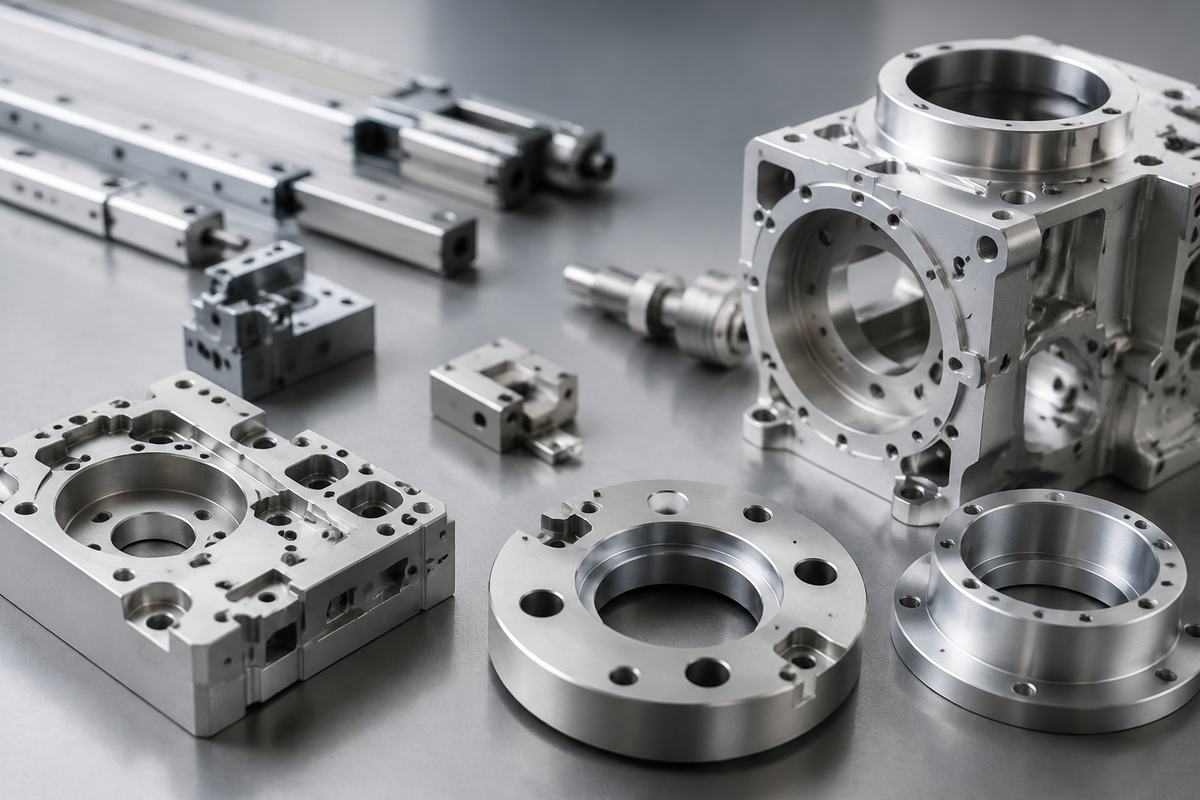
Ductile cast iron CNC machined parts are commonly used for high-load mechanical components requiring high strength, vibration damping, and dimensional stability.
Compared with gray cast iron, ductile iron has spherical graphite nodules that significantly improve tensile strength and impact resistance, making it suitable for machine bases, housings, brackets, hydraulic components, and automotive parts.
Common Ductile Cast Iron Grades for CNC Machining
Typical materials used for precision machining include:
| Material Grade | Tensile Strength | Yield Strength | Hardness |
|---|---|---|---|
| EN-GJS-400-15 | ≥400 MPa | ≥250 MPa | 130-180 HB |
| EN-GJS-500-7 | ≥500 MPa | ≥320 MPa | 170-230 HB |
| EN-GJS-600-3 | ≥600 MPa | ≥370 MPa | 190-270 HB |
| ASTM A536 65-45-12 | ≥448 MPa | ≥310 MPa | 143-187 HB |
Material selection depends on load requirements, wear conditions, and machining requirements.

CNC Machining Process for Ductile Iron Components
Ductile iron has good machinability, but machining parameters must be optimized due to graphite nodules and hard microstructures.
CNC Milling
Common applications:
- Mounting surfaces
- Precision slots
- Hydraulic channels
- Complex structural parts
Typical machining parameters:
- Cutting tool: Carbide end mills
- Cutting speed: 80-200 m/min
- Feed rate: 0.05-0.3 mm/tooth
- Depth of cut: 1-5 mm
For large castings, rough machining is usually followed by finishing machining to control deformation.
CNC Turning
Used for:
- Shafts
- Bushings
- Flanges
- Rotary housings
Typical parameters:
- Insert: Coated carbide inserts
- Cutting speed: 100-250 m/min
- Feed rate: 0.1-0.4 mm/rev
- Surface finish: Ra 1.6-3.2 μm
Proper tool selection is important because casting skin and carbide inclusions can accelerate tool wear.
Machining Challenges of Ductile Cast Iron
1. Casting Allowance and Surface Defects
Before machining, castings need to be inspected for:
- Shrinkage cavities
- Porosity
- Sand inclusions
- Casting deformation
A typical machining allowance is:
- Small parts: 1-3 mm
- Large castings: 3-8 mm

2. Dimensional Stability
Ductile iron components may contain residual stress after casting.
For precision parts, stress relieving treatment is recommended before final machining.
Typical requirements:
- Rough machining → stress relief → finish machining
This process helps maintain:
- Flatness
- Parallelism
- Hole position accuracy
3. Tight Tolerance Machining
For precision ductile iron CNC parts, achievable tolerances typically include:
- General tolerance: ISO2768-mK
- Precision machining tolerance: ±0.02 mm
- Critical hole position: ±0.01-0.03 mm
- Surface finish: Ra 0.8-3.2 μm
Final inspection can include:
- CMM measurement
- Height gauge inspection
- Surface roughness measurement
- Material hardness testing

Surface Treatments for Ductile Iron Parts
Depending on application requirements, ductile iron parts can be supplied with:
- Black oxide coating
- Phosphate coating
- Powder coating
- Zinc coating
- Painting
These treatments improve corrosion resistance and service life.
Applications of CNC Machined Ductile Iron Parts
Typical components include:
- Machine tool bases
- Motor mounting brackets
- Gear housings
- Pump bodies
- Hydraulic valve blocks
- Automation equipment frames
- Heavy-duty mechanical supports
Custom Ductile Cast Iron CNC Machining Service
XY Global provides CNC machining services for ductile cast iron components from prototype to production quantities.
Capabilities include:
- CNC milling
- CNC turning
- 4-axis / 5-axis machining
- Precision hole machining
- Surface finishing
- CMM inspection
We support customers with:
- Material selection
- Machining process optimization
- Cost reduction solutions
- Production quality control
For custom ductile cast iron CNC machined parts, send your drawings or 3D models for engineering evaluation.

Aktie:
5-Achs-CNC-Bearbeitungsdienstleistungen: Wie man die Mehrseiten-Genauigkeit verbessert
ISO 13485 Plastic Injection Molding: A Practical Guide for Medical Parts Manufacturing