


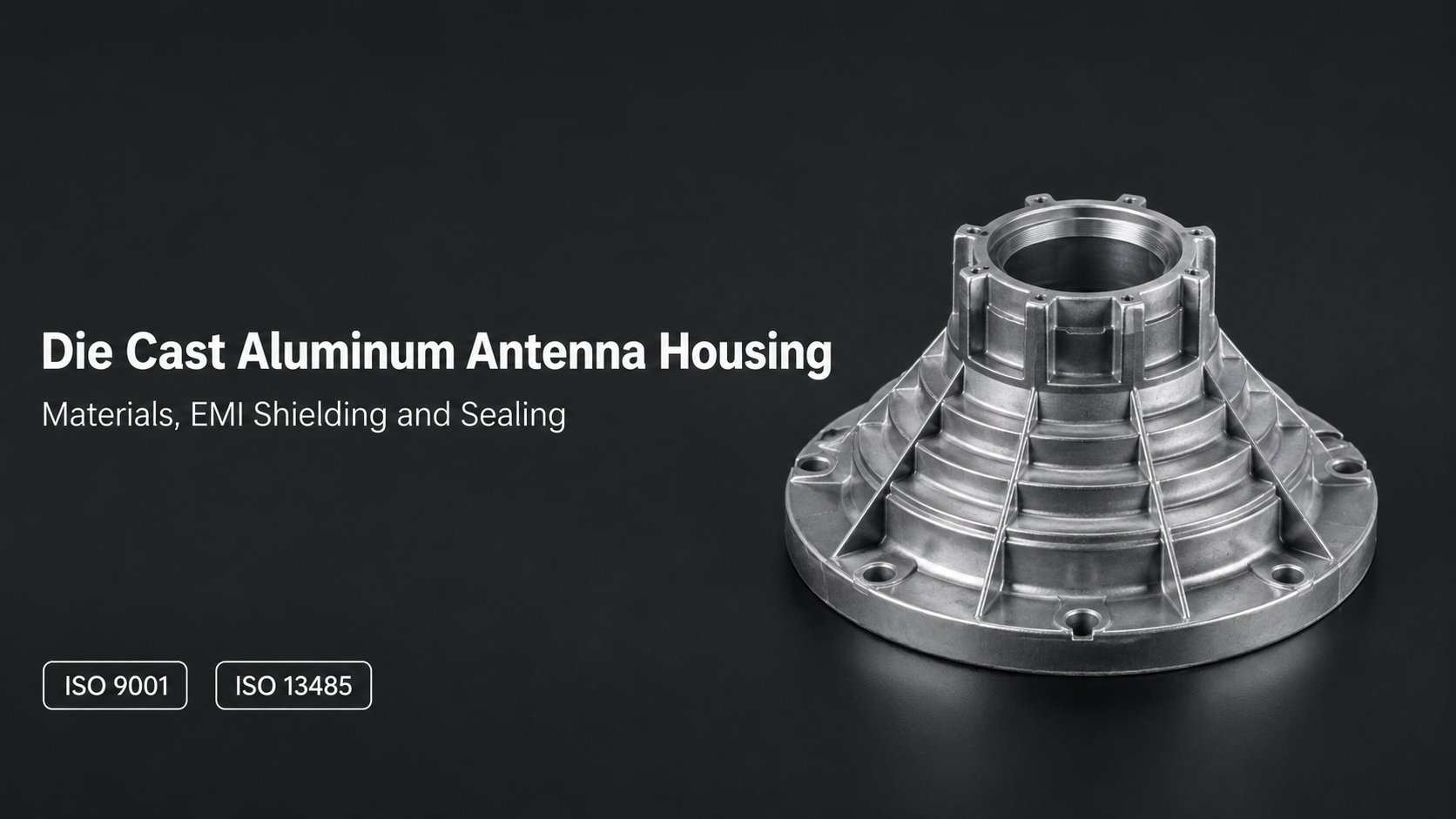
An antenna or base station housing is not just a weatherproof box. It sits outdoors for years, has to keep sensitive radio electronics shielded from electromagnetic interference, and often needs to dissipate heat from active components without a fan. Getting any one of these requirements wrong shows up later as signal degradation, water ingress, or thermal failure in the field.
As 5G networks require several times more base stations and small cells than previous generations, the housings around this equipment have to meet all three requirements — EMI shielding, environmental sealing, and thermal management — in a single manufacturable part rather than a stack of separate components. Aluminum die casting has become the standard process for this because it can deliver all three in one shot.
This article explains why aluminum die casting is used for antenna and communication equipment housings, how EMI shielding and IP-rated sealing are achieved, what alloy and wall thickness considerations apply, and how these housings are inspected before shipment.

Why Aluminum Die Casting for Antenna and Communication Equipment Housings
Aluminum die casting suits communication equipment housings for a specific combination of reasons: aluminum is inherently electrically conductive, which provides a baseline level of EMI shielding without additional treatment; it has strong thermal conductivity, which lets the housing itself act as a heat sink for internal electronics; and die casting can produce complex geometries — mounting bosses, internal ribs, and cooling fins — in a single shot, without the assembly of separate shielding and structural parts.
Material Selection: ADC12 and Wall Thickness
ADC12 is the most common aluminum die casting alloy used for these housings, offering thermal conductivity in the range of 90–120 W/m·K and electrical conductivity of roughly 22–30% IACS — high enough to provide meaningful EMI shielding through the material itself.
Typical wall thickness for die cast aluminum enclosures runs 1.5–2.5 mm, with thinner sections down to around 1.2 mm achievable locally with tuned gating and warm die conditions. Wall thickness affects more than structural strength here — it also influences how effectively the housing conducts heat away from internal components and how consistently the die fills during casting.
EMI Shielding: How It's Achieved
| Shielding Method | Typical Contribution |
|---|---|
| Bare aluminum housing (baseline) | Approximately 50 dB |
| Integrated internal shielding ribs | Additional 40–60 dB |
| Conductive surface treatment (electroless nickel or conductive paint) | Additional 15–30 dB |
One detail that's easy to overlook: standard anodizing is electrically insulating, so it reduces shielding effectiveness at mating surfaces and grounding points if applied without masking. Contact and grounding surfaces are typically left bare or treated with a conductive chromate conversion coating instead, while cosmetic or non-conductive areas can still be anodized for corrosion protection.

Sealing and IP Ratings
| Sealing Approach | Typical IP Rating |
|---|---|
| Machined flat sealing face with standard elastomeric gasket | IP54–IP65 |
| Precision sealing groove with silicone or rubber gasket | IP65–IP68 |
| Vacuum die casting with precision groove and Viton O-ring | Up to IP68 (submersion beyond 1 m) |
Sealing performance in a die cast housing depends heavily on how flat and consistent the mating face is machined after casting, since a gasket can only compress evenly against a surface that is dimensionally consistent around its full perimeter.
Thermal Management Considerations
Because outdoor antenna and base station equipment often can't rely on active cooling fans, the housing itself typically doubles as the heat sink. Die casting allows cooling fins, ribs, and thickened sections to be cast directly into the housing in the same shot as the rest of the part, rather than added as a separate heat sink component.
Typical Applications
Die cast aluminum housings of this type are used across 5G and 4G base stations, remote radio units (RRUs), small cell and outdoor telecom enclosures, antenna mounting and radio equipment housings, and other outdoor communication hardware that needs EMI shielding, IP-rated sealing, and passive thermal management in one part.
Quality Control and Testing
Beyond standard dimensional inspection, antenna and communication housings are typically checked for sealing face flatness before gasket assembly, and may undergo leak testing to confirm the assembled IP rating. Where EMI performance is specified, continuity checks confirm that conductive contact is maintained across mating surfaces and grounding points after any surface treatment.

XY-Global's Capability for Communication Equipment Housings
At XY-Global, aluminum die casting for antenna and communication equipment housings is produced under ISO 9001 certified processes, with high-pressure aluminum die casting supporting the integrated ribs, cooling fins, and mounting features these housings require. CNC post-machining brings sealing faces and grounding surfaces to the tolerance and flatness needed for consistent IP-rated sealing, and our engineering team can review EMI shielding, sealing, and thermal requirements together before tooling begins.
If you are developing an antenna or outdoor communication equipment housing, our team can advise on alloy selection, wall thickness, and shielding strategy based on your specific IP rating and thermal load requirements.
FAQ
Why not use a plastic housing with a conductive coating instead of die cast aluminum?
Plastic housings can achieve EMI shielding with conductive coatings or films, but they don't offer aluminum's inherent thermal conductivity, which matters for passively cooled outdoor equipment carrying active radio components.
Does anodizing an antenna housing hurt its EMI performance?
It can, if applied without masking. Anodizing is electrically insulating, so grounding and mating surfaces are usually left bare or treated with a conductive chromate conversion coating instead, while non-critical surfaces can still be anodized.
What IP rating do most outdoor antenna housings need?
IP65 or IP66 is common for standard outdoor telecom equipment, while IP68 is used for applications with potential submersion or extreme moisture exposure, such as certain underground or marine communication equipment.
What information is needed to quote a die cast antenna housing?
A 2D or 3D drawing with wall thickness, sealing face and gasket details, required IP rating, EMI shielding requirements, and quantity are the key inputs needed for an accurate quote.


Aktie:
CNC Aluminium Extrusion Guide For Custom Industrial Parts
CMM Inspection Explained: How Precision CNC Parts Are Verified