


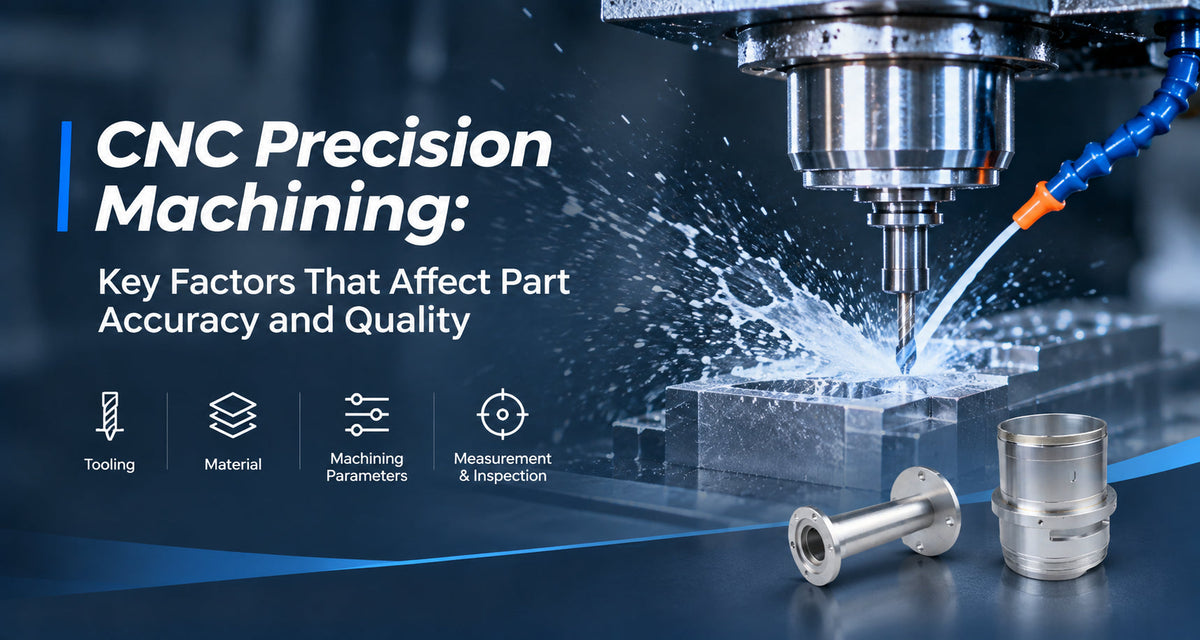
It is easy to assume that a CNC machined part is precise because its dimensions are within tolerance. In practice, that is only part of the story. A part can pass inspection and still fit poorly, wear unevenly, or become difficult to assemble.
The reason is simple: accuracy is affected by more than the cutting process. Material movement, workholding, machining sequence, tool wear, heat, and surface treatment all influence the final result.
CNC precision machining is about managing these factors—not just holding a tight tolerance.
At XY-GLOBAL, we bring over 15 years of expertise in CNC machining for precison metal and plastic components with tight tolerence and consistent quality, from fast prototyping to on-going mass production.
Read this blog, we will figure out what precision CNC machining is and let's explore key factors that affect accuracy and quality for your CNC machined parts with our hands-on experience over the years. 
What Is CNC Precision Machining?
CNC precision machining is a manufacturing process that uses computer-controlled machines to produce parts with closely controlled dimensions and geometric features.
Compared with standard CNC machining, it places greater control over consistency, repeatability, and critical features—tighter tolerances often in the range of ±0.05 mm to ±0.005 mm, depending on the feature and application.
It includes processes such as CNC milling and CNC turning, where cutting tools remove material according to programmed instructions.
The required level of precision depends on the part.
A mounting bracket might only need standard machining tolerances for most of its features. However, a bearing housing may require a closely controlled bore diameter, accurate hole positions, and a flat mounting surface.
These requirements influence how the part is machined and inspected.
Precision CNC machining is widely used to manufacture metal and plastic components for automation equipment, electronics, industrial machinery, and other applications where dimensional accuracy matters.
What Factors Affect CNC Precision Machining Accuracy?
Machining accuracy of a CNC machined part is influenced by several factors, but they don't all affect a part in the same way. Some are related to the machine itself; Others depend on the material, part design, and machining process.
Machine Accuracy and Setup
Modern CNC machines can produce highly accurate parts, but machine capability alone doesn't guarantee the final result.
The machine must be properly maintained, calibrated, and set up for the job. Spindle condition, axis positioning, thermal stability, and workholding all play a role.
Setup becomes especially important when a part needs machining on several sides.
When a workpiece is removed and repositioned, there is a chance of introducing a small positioning error. For parts with closely related features, reducing unnecessary setups can help improve accuracy.
5-axis CNC machining can be useful for complex components to aviod this. It allows manufacturers to access multiple faces of a part with fewer repositioning steps.
However, 5-axis machining isn't automatically more accurate for every job. A well-planned 3-axis process may be the better choice for simpler parts.
Material Properties
Different materials behave differently during machining.
Aluminum alloys such as 6061-T6 are popular because they are relatively easy to machine, lightweight, and suitable for many precision components.
Stainless steel is stronger and often more difficult to cut. It can generate higher cutting forces and more heat, which makes tool selection and cutting conditions important.
Engineering plastics bring another set of challenges. Some materials expand noticeably with temperature or deform under clamping pressure.
| Material | Common Applications | Main Machining Considerations |
| Aluminum 6061-T6 | Housings, brackets, mounting plates | Residual stress, thin-wall deformation |
| Aluminum 7075-T6 | Structural components, precision fixtures | Material stability, tool wear |
| Stainless Steel 304 | Shafts, fittings, mechanical parts | Work hardening, heat, cutting forces |
| Brass | Connectors, bushings, threaded parts | Burr control, dimensional consistency |
| POM (Acetal) | Bushings, guides, plastic components | Thermal expansion, clamping deformation |
| PEEK | High-performance mechanical components | Heat management, material cost |
Choosing a material only because it is easy to machine isn't always the right decision. Strength, corrosion resistance, operating temperature, weight, and assembly requirements also matter.
Cutting Tools and Machining Parameters
Cutting tools directly affect dimensional accuracy and surface finish.
A worn tool may still remove material, but it can produce inconsistent dimensions, rough surfaces, or unwanted burrs.
Tool deflection is another concern, especially when machining deep pockets, narrow slots, or small holes.
Long, slender cutting tools tend to deflect more under cutting forces. This can affect wall straightness and feature dimensions.
To reduce these problems, manufacturers may adjust cutting speed, feed rate, depth of cut, and tool engagement. Roughing and finishing operations are often separated so that the final cuts remove smaller amounts of material under more controlled conditions.
The right settings depend on the material, tool geometry, machine, and part design.
Workholding and Clamping Pressure
A part must be held securely during machining. But holding it too tightly can create another problem.
This is especially common with thin-walled aluminum parts.
Imagine machining a housing with a large internal pocket and relatively thin walls. Excessive clamping force may slightly deform the workpiece.
The machine cuts the part while it is held in that position. Once the clamps are released, the material can spring back. As a result, there may be a wall or mounting surface that no longer meets the required dimensions.
Depending on the part, manufacturers can reduce this risk through controlled clamping pressure, better fixture support, balanced material removal, and a suitable machining sequence.
For delicate components, the way a part is held can matter just as much as the machine performing the cut.
Temperature Changes
Temperature is easy to overlook when discussing machining accuracy.
Metals expand as they heat up. For aluminum 6061, the linear thermal expansion coefficient is approximately 23 × 10⁻⁶/K near room temperature.
A 100 mm aluminum feature exposed to a uniform 10°C temperature increase would expand by roughly 0.023 mm.
That is already larger than a ±0.01 mm dimensional tolerance.
This doesn't mean a CNC machine will automatically produce that amount of error. The calculation simply shows how sensitive some dimensions can be to temperature changes.
Heat from cutting, machine operation, and the surrounding environment can affect the workpiece. For parts with tight tolerances, measurement conditions should be considered alongside machining conditions.
CNC Precision Machining Services at XY GLOBAL
Precision machining isn't just about producing the smallest possible tolerance.
Material behavior, tool selection, workholding, machining sequence, and inspection all need to work together.
Founded in 2010, XY-GLOBAL has been a one-stop on-demand metal componrnts supplier and manufacturer trusted by customers worldwide with manufacturing capabilities including CNC milling, CNC turning, and 5-axis CNC machining, etc. We can manufacture precision, complex parts with consistent quality under ISO 9001:2015 and ISO 1348:2016 certifications, from rapid prototyping with 0 MOQ to mass production with fast lead times.
Besides, we can provide post-processing xx from surface treatments like anodizing and PVD coating to dimensional inspection and CMM measurement when needed.
Our precision CNC machining services support parts from over 45 materials from metal, engineering plastics to technic ceramics with up to ±0.005mm tight tolerences and mirror-like surface finishing.
XY-GLOBAL supports CNC milling, CNC turning, and custom precision machining for prototypes and production parts.
Send us your drawings, material requirements, and project details to discuss manufacturability, tolerances, and production options. Our engineering and sales teams are 24/7 available to provide you free DFM review and competitive quotations.
Frequently Asked Questions About CNC Precision Machining
1. What Is the Difference Between CNC Machining and Precision CNC Machining?
Both use computer-controlled equipment to remove material. Precision CNC machining places greater emphasis on tightly controlled dimensions, feature relationships, repeatability, and inspection. The distinction depends on the requirements of the part rather than a single fixed tolerance value.
2. Which Materials Are Best for Precision CNC Machining?
Common choices include aluminum alloys, stainless steel, brass, and engineering plastics such as POM and PEEK. The best material depends on mechanical requirements, environmental conditions, dimensional stability, and cost.
3. Does 5-Axis CNC Machining Always Provide Better Accuracy?
Not necessarily. Five-axis machining can reduce setups and improve access to complex features, but final accuracy also depends on machine condition, fixtures, tooling, programming, and inspection. Simpler parts may be manufactured accurately and more economically using 3-axis machining.
4. Why Do CNC Machined Parts Sometimes Change Dimensions After Machining?
Residual stress, clamping forces, temperature changes, and material removal can cause dimensional changes. Thin-walled parts are particularly sensitive. A suitable machining sequence and inspection plan can help manage these effects.
5. How Can I Reduce the Cost of Precision CNC Machined Parts?
Start by reviewing tolerances, part geometry, material selection, and surface finish requirements. Avoiding unnecessary tight tolerances, improving tool access, and simplifying difficult features can help reduce machining and inspection time.

Aktie:
What Is Grooving Metal?