


CNC Machining Process: A Comprehensive Guide to Precision Manufacturing
What is CNC Machining?
CNC (Computer Numerical Control) machining is a revolutionary manufacturing process that utilizes computerized controls to operate machine tools capable of cutting, shaping, and creating precision parts from various materials. This subtractive manufacturing method has transformed modern industrial production by enabling unparalleled accuracy, repeatability, and efficiency in part manufacturing across countless industries.
The CNC machining process begins with digital 3D designs and translates them into precise instructions that guide cutting tools to remove material from a solid block, ultimately forming the desired component. This technology has largely replaced manual machining in commercial and industrial applications, offering superior consistency and complex geometrical capabilities that were previously impossible or economically unfeasible.
The CNC Machining Process: Step by Step
1. Design and CAD Model Creation
The process initiates with product design using Computer-Aided Design (CAD) software. Engineers create detailed 2D or 3D models specifying all dimensions, geometries, tolerances, and material requirements. This digital blueprint serves as the foundation for the entire machining operation.
2. CAD to CAM Conversion
The CAD file is imported into Computer-Aided Manufacturing (CAM) software, which translates the design into machine-readable instructions (G-code). This conversion determines tool paths, cutting sequences, spindle speeds, feed rates, and other critical parameters.

3. Machine Setup
Operators prepare the CNC machine by:
-
Installing appropriate cutting tools
-
Securing the raw material (workpiece) in the machine vise or chuck
-
Setting work offsets and tool length measurements
-
Loading the generated program into the machine controller
4. Machining Operation Execution
The automated process begins with the machine following programmed instructions to:
-
Position the cutting tool relative to the workpiece
-
Remove material through various operations (milling, turning, drilling)
-
Continuously monitor and adjust cutting parameters
-
Implement coolant systems to manage heat generation
5. Quality Control and Inspection
Finished parts undergo rigorous inspection using:
-
Coordinate Measuring Machines (CMM)
-
Optical comparators
-
Calipers and micrometers
-
Surface roughness testers
6. Post-Processing (If Required)
Additional treatments may include:
-
Deburring sharp edges
-
Surface finishing (polishing, plating, anodizing)
-
Heat treatment for enhanced properties
-
Assembly with other components
Key CNC Machining Technologies
CNC Milling
Utilizes rotary cutting tools to remove material from a stationary workpiece. Modern machining centers feature 3-5 axes of movement, enabling complex geometries and contours.
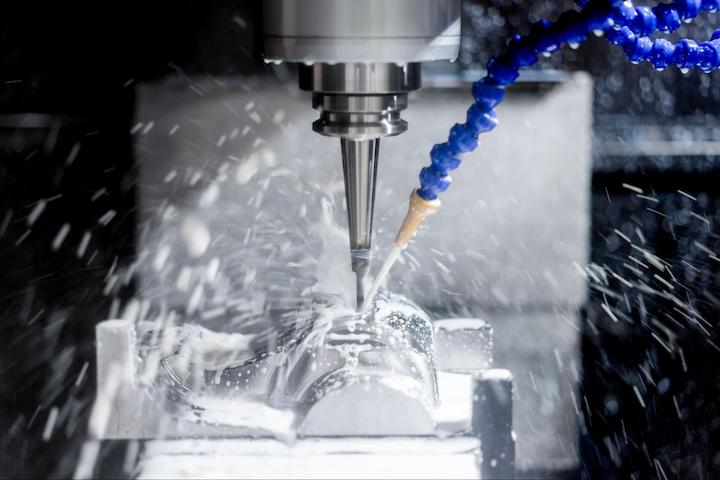
CNC Turning
The workpiece rotates while a stationary cutting tool removes material, ideal for cylindrical parts, shafts, and concentric geometries.
Multi-Axis Machining
Advanced systems (4-axis and 5-axis) allow simultaneous movement along multiple axes, reducing setup time and enabling complex part production in single setups.
Swiss Machining
Specialized turning process particularly effective for small, precision components with tight tolerances, widely used in medical and electronics industries.
Advantages of CNC Machining Process
Precision and Accuracy: Modern CNC machines routinely achieve tolerances within ±0.001 inches (±0.025 mm), with high-end equipment capable of even greater precision.
Repeatability: Once programmed, CNC machines can produce identical parts indefinitely, ensuring consistency across production runs.
Complex Geometries: Capable of manufacturing intricate designs that would be impossible with manual machining methods.
Material Versatility: Processes virtually all engineering materials including metals, plastics, composites, and woods.
Reduced Labor Costs: Automation minimizes manual intervention, requiring fewer operators while maintaining higher output.
Enhanced Safety: Computer control and enclosed workspaces significantly reduce operator exposure to moving parts and cutting tools.
Applications Across Industries
The CNC machining process serves virtually every manufacturing sector:
-
Aerospace: Engine components, structural elements, navigation systems
-
Medical: Surgical instruments, implants, diagnostic equipment
-
Automotive: Engine parts, transmission components, custom modifications
-
Electronics: Housings, heat sinks, connectors, circuit boards
-
Defense: Weapon systems, communication equipment, vehicle components
-
Consumer Products: Prototypes, custom parts, high-end accessories
Future Trends in CNC Machining
Automation Integration: Increased implementation of robotics for loading/unloading and part handling
IoT Connectivity: Smart machines with real-time monitoring and predictive maintenance capabilities
Hybrid Manufacturing: Combining additive and subtractive processes in single platforms
Artificial Intelligence: Machine learning algorithms optimizing cutting parameters and predicting tool wear
Sustainable Practices: Energy-efficient systems and improved recycling of cutting fluids and materials
Choosing a CNC Machining Partner
When selecting a CNC machining service provider, consider:
-
Technical capabilities and equipment range
-
Quality certifications (ISO, AS9100, etc.)
-
Material expertise and inventory
-
Engineering support and design assistance
-
Prototyping and production capacity
-
Quality control processes and documentation
The CNC machining process continues to evolve, offering manufacturers unprecedented capabilities in precision part production. By understanding the fundamental processes, advantages, and applications, businesses can effectively leverage this technology to enhance product quality, reduce costs, and maintain competitive advantage in today’s global marketplace.
Whether producing prototype components or high-volume production parts, CNC machining remains the cornerstone of modern manufacturing, delivering precision, reliability, and efficiency that drive innovation across industries.
