


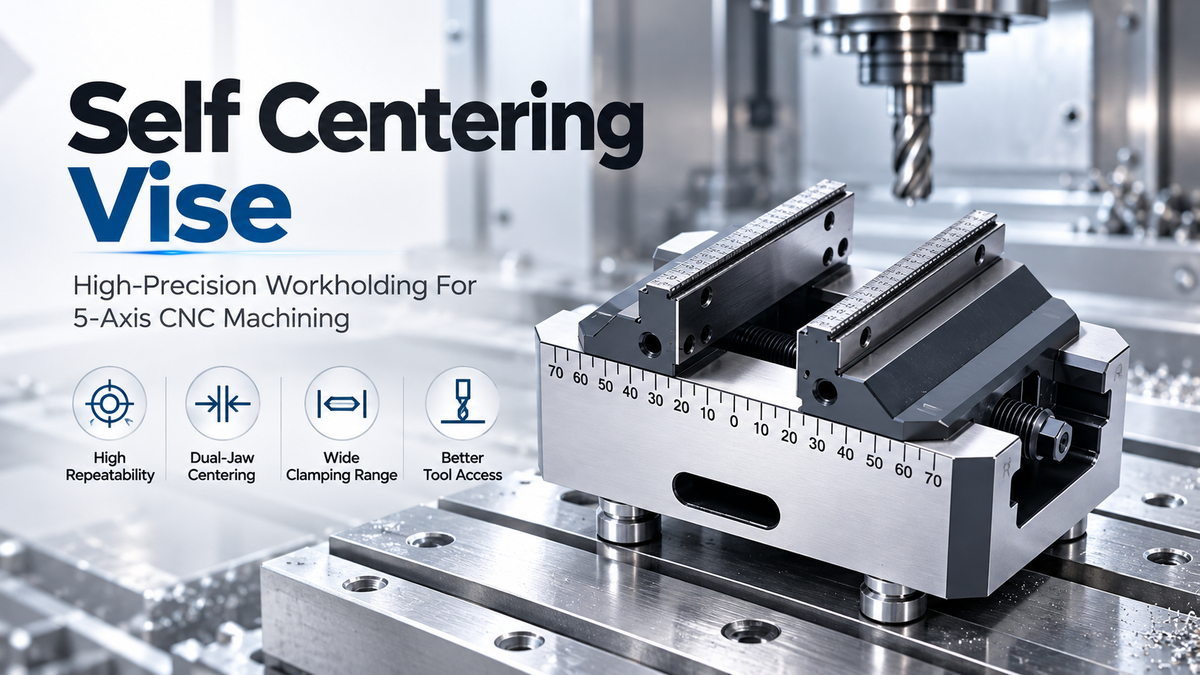
A CNC machine may hold position within a few microns, but that accuracy means little if the workpiece moves every time it is clamped.
This becomes especially noticeable when part sizes change, batches are switched, or a workpiece needs to be machined from several sides. With a conventional vise, every change may require another alignment, and more non-cutting time.
A self centering vise can approach the problem differently. Instead of pushing the workpiece against one fixed jaw, both jaws move toward the center at the same time, so the workpiece stays centered as the jaws close.
In this blog post, we will look at how self centering vise work, why they're widely used in 5-axis machining, what jaw options are available, key factors to consider when choosing one, and high-precision self-centering vises solutions at XY-GLOBAL. To save you time, use the Table of Contents on the left to jump straight to any section.

What Is a Self Centering Vise?
A self centering vise is a CNC workholding device in which both jaws move simultaneously toward or away from the center of the vise. As a result, the workpiece remains close to the same centerline even when its width changes.
This makes self-centering workholding particularly useful for CNC milling, 3-axis machining, 4-axis machining and especially 5-axis machining.
The basic structure normally includes a rigid vise body, two movable jaws, guide surfaces, a central lead screw and jaw carriers. Depending on the design, the vise can be operated manually, pneumatically, hydraulically or through an automated clamping system.
How Does a Self Centering Vise Work?
The key is synchronized jaw movement.
A common mechanical design uses a precision lead screw with opposite thread directions. One side has a right-hand thread and the other has a left-hand thread.
When the screw rotates, one jaw moves in from one side while the other moves in by the same amount from the opposite side.
The two jaws therefore meet around the center of the vise rather than moving the workpiece toward a fixed reference jaw.
For example, suppose a vise is holding a 50 mm wide workpiece. If that workpiece is replaced by one that is 80 mm wide, both jaws move outward symmetrically to accommodate the extra width. The center of the new workpiece remains in essentially the same location.
This is the principle behind the name self centering vise.
The quality of the lead screw, guide surfaces, jaw carriers and vise body all affect how accurately this synchronized movement can be maintained over time.

Self Centering Vise vs Standard CNC Vise
The main difference is not simply that one vise is newer than the other. They use two different workholding concepts.
| Feature | Standard CNC Vise | Self Centering Vise |
| Jaw movement | Usually one fixed jaw and one moving jaw | Both jaws move simultaneously |
| Workpiece position | References one side | References the center |
| Part width changes | Center position changes | Center remains largely unchanged |
| Setup | May require re-alignment | Automatic centering reduces adjustment |
| 5-axis accessibility | Depends heavily on vise design | Compact designs are well suited to multi-side machining |
| Batch changeover | More manual positioning may be required | Repeatable center position simplifies changeover |
| Automation | Possible | Particularly suitable because the clamping position is predictable |
A conventional vise is still a good solution for many machining jobs. If most parts use the same datum face and workpiece dimensions rarely change, there may be little reason to replace it.
The self-centering design becomes more valuable when flexibility, multi-side access and repeatable workpiece positioning matter.
Why Are Self Centering Vises Used in CNC Machining?
One of the main reasons is that they reduce the amount of positioning work required between setups.
When different-width parts are placed in a conventional vise, their center positions can change. The operator may need to adjust work offsets, re-indicate the setup, or account for the changed position in the machining program.
A self-centering vise keeps the workpiece much closer to a consistent central reference.
That can be especially useful in high-mix manufacturing, where a shop may run many different components in relatively small batches.
Faster Setup and Changeover
Machine tools only make money while they are machining parts. Time spent indicating fixtures, adjusting stops, checking work offsets, and repositioning jaws adds no cutting value.
A self-centering vise does not eliminate setup work, but it can reduce part of it.
If several workpieces have different widths but use the same center reference, the operator can often change from one size to another without completely redefining the setup.
This becomes even more useful when the vise is combined with a quick-change or zero-point system.
The entire vise can be removed from the machine, prepared outside the machining area, and returned to a known location.
Consistent Workpiece Positioning
Batch machining depends on consistency.
Each new workpiece should sit in a predictable position before the cycle begins. If the clamping position changes from part to part, machining variation becomes harder to control.
The synchronized movement of a self-centering vise helps keep each workpiece around the same centerline.
For symmetrical parts or operations programmed from the workpiece center, this can simplify both setup and programming.
Access to More Sides of the Workpiece
Modern CNC machining increasingly tries to complete more features in fewer setups.
Every time a part is removed and reclamped, more handling is required and another opportunity for positioning error is introduced.
Compact self-centering vises help expose more of the workpiece.
When the part is held using only a small amount of material near the bottom, tools can reach the top and several sides while the part remains clamped.
This is especially valuable in 4-axis and 5-axis machining.
5 Axis Self Centering Vise
Five-axis machining makes workholding more demanding.
The cutting tool needs access not only from the top but also from the sides and from different angles as the table or spindle rotates.
A large vise body, tall jaws or poor workpiece positioning can quickly become an obstacle.
This is why the 5 axis self centering vise has become a common workholding solution for multi-axis machines.
- Keeping the Workpiece Near the Rotation Center: help the workpiece stay around a predictable centerline even when the part width changes to simplify workholding and make different workpiece sizes easier to manage on the same machine.
- Better Tool Access: help the cutter approach the workpiece from more angles with less interference from the vise, tool holder or machine table, making it easier to machine more faces in one setup.
- Shorter Tools and Better Rigidity: provide more clearance around the workpiece so shorter cutting tools can be used to improve rigidity, reduce vibration and achieve a more stable surface finish.
- A Good Match for Zero-Point Workholding: allow the vise and workpiece to be prepared outside the machine and loaded quickly on a zero-point pallet to reduce setup time and support high-mix or automated production.

Choosing the Right Jaws for a Self Centering Vise
The vise body is only part of the workholding system. Jaw design has a major influence on how securely a part can be held and how accessible it remains during machining.
Smooth jaws are useful when the surface should not be damaged. They are commonly used for pre-machined or finished parts where visible clamping marks are undesirable.
Serrated jaws bite into the material and provide stronger resistance to movement. They are especially useful for raw stock and heavier milling where cutting forces are higher. Because the grip is stronger, some designs can hold a workpiece using only a small amount of material.
Soft jaws can be machined to match a specific component profile. They are useful for thin-wall parts, irregular shapes and second-operation machining.
For round stock, shafts or cylindrical components, V-type or contour jaws can provide a more secure contact geometry.
No single jaw design that is best for every application. The correct choice depends on whether the priority is maximum holding force, surface protection, flexibility or workpiece accessibility.
Types of Self-Centering Vises
Self-centering vises can be classified by how the clamping motion is generated.
Manual Self Centering Vise
A manual vise uses a handle, wrench, or torque wrench to rotate the screw.
This is the most common configuration for general CNC work because it is simple, compact, and does not require an air or hydraulic connection.
Manual models are well suited to prototypes, high-mix production, toolrooms, and small-to-medium batches.
They also give the operator direct control over clamping torque.
Pneumatic Self Centering Vise
A pneumatic vise uses compressed air to open and close the jaws.
Its main advantage is faster and more repeatable actuation.
This is useful in production environments where parts are loaded frequently or where a robot handles workpieces.
Pneumatic vises are therefore common in automated cells and higher-volume manufacturing.
The available clamping force and air pressure requirements should be checked carefully because pneumatic systems are not automatically suitable for every heavy-cutting application.
Hydraulic Self Centering Vise
Hydraulic systems are used when higher and more consistent clamping force is required.
They can be useful for demanding production applications and automated lines where workholding needs to remain stable through repeated cycles.
The trade-off is greater system complexity compared with a simple manual vise.
Electric or Electromechanical Self Centering Vise
Electrically actuated workholding is becoming more relevant in flexible automation.
It can provide programmable control and easier integration with machine or cell automation without requiring a hydraulic power unit.
The best actuation method depends on production volume, cutting load, automation level, available utilities, and how frequently the workpiece is changed.
How to Choose the Right Self Centering Vise
The first specification many buyers look at is the maximum jaw opening.
It matters, but it is only one part of the selection process.
A vise with a very large clamping range may also have a larger body. On a 5-axis machine, that extra size may reduce tool clearance. A smaller vise may actually perform better if it still covers the required workpiece range.
The vise should therefore be selected around the actual workpiece, machine envelope, and machining process.
Workpiece Size and Clamping Range
Start with the smallest and largest parts you expect to hold.
Check both the jaw opening and the usable clamping range with the jaw configuration you plan to use.
Workpiece height also matters.
A tall part creates more leverage above the jaws. Heavy side cutting on a tall workpiece can generate much higher overturning forces than the same operation on a short block.
Vise Body Size
Body width and overall height are especially important for 4-axis and 5-axis machining.
A compact vise gives the spindle and tool holder more room to move around the workpiece.
This can be more valuable than simply choosing the vise with the highest capacity.
The relationship between workpiece size and vise size should therefore be considered carefully.
Clamping Height
Low clamping height leaves more material exposed.
For example, if a jaw can hold raw stock securely using only a few millimeters of material, much more of the workpiece can be machined in the first operation.
This is valuable in 5-sided machining because it reduces the amount of material that needs to be removed later.
Jaw Style
The intended workpiece should guide the jaw choice.
Raw blanks usually benefit from serrated or grip jaws. Finished parts may require smooth jaws. Irregular shapes may need soft or custom jaws. Round components often require V-type jaws.
It is better to consider the vise and jaw system together rather than treating the jaw as a minor accessory.
Cutting Conditions
Light finishing and heavy roughing do not create the same demands on a vise.
High material removal rates, large cutters, hard materials, and interrupted cutting can all increase the loads applied to the workpiece.
The vise must provide enough rigidity and holding capacity for the intended machining process.
Mounting Method
Some users bolt the vise directly to the machine table.
Others install it on a fixture plate, grid plate, pallet, or zero-point clamping system.
If frequent changeovers are expected, the mounting interface can have a large influence on overall setup efficiency.
It is worth considering this before buying the vise rather than trying to adapt the mounting arrangement later.
Machine Type
A vise that works well on a large vertical machining center may not be the best choice for a compact 5-axis machine.
Check the available table area, rotary travel, spindle clearance, and possible collision zones.
CAD models are especially useful for this. The vise and workpiece can be placed into the machine simulation before the physical setup is built.
A simple selection overview looks like this:
| Factor | What to Evaluate |
| Workpiece size | Minimum and maximum width, length, and height |
| Workpiece shape | Block, round, irregular, finished, or raw |
| Machine | 3-axis, 4-axis, or 5-axis |
| Vise dimensions | Width, height, and overall footprint |
| Clamping range | Required travel for current and future parts |
| Jaw type | Serrated, smooth, soft, V-type, or custom |
| Machining load | Finishing, general milling, or heavy roughing |
| Clamping height | Amount of material required for secure holding |
| Mounting | Direct table mounting, pallet, or zero-point system |
| Automation | Manual loading or automatic loading |
Common Applications of Self Centering Vises
Self-centering vises are used across a wide range of CNC machining work.
They are especially common for rectangular raw stock because the centering action makes different blank sizes easy to manage.
They are also widely used for aerospace brackets, robotic components, medical device parts, automotive components, precision housings, mold inserts, tooling components, and general high-value machined parts.
The common factor is usually not the industry itself. It is the manufacturing requirement.
Parts that need several sides machined in one setup are good candidates. So are parts made in many variations, where setup flexibility matters.
The same applies to small and medium production batches where the shop wants to avoid spending too much time building dedicated fixtures.
With appropriate jaws, self-centering vises can also hold round parts, pre-machined components, and irregular geometries.
This makes them useful not only as a vise for one particular product, but as part of a more flexible workholding system.
When a Self Centering Vise May Not Be the Best Choice
Self-centering workholding is useful, but it is not required for every machining job.
For a simple component that always references one finished side, a conventional fixed-jaw vise may be easier and more economical.
Large flat plates may be better suited to toe clamps, vacuum workholding, or modular fixtures.
Thin components can require dedicated soft jaws or special support to avoid distortion.
Large castings and highly irregular parts may need custom fixture points rather than a standard vise.
Production volume also matters.
If the same component will run for years in very high volumes, a dedicated fixture designed specifically around that part may provide faster loading than a flexible general-purpose vise.
The self-centering vise is most useful where flexibility, centered positioning, multi-side access, and quick changeover are important.
Self Centering Vises and Zero-Point Clamping
Self-centering workholding and zero-point clamping solve two different positioning problems.
The vise controls the relationship between the workpiece and the vise.
The zero-point system controls the relationship between the vise and the machine.
When both are used together, the complete workholding setup becomes easier to remove and reinstall.
A vise can be prepared outside the machine, mounted on a pallet or zero-point interface, and then transferred to the machine table.
This reduces the time the spindle sits idle while a new job is being prepared.
It also makes it easier to keep several fixtures ready for different part numbers.
This combination is particularly useful in high-mix machining, automated production, and shops that need to switch between different jobs during the same shift.
Zero-point integration is therefore worth considering when selecting a self-centering vise, even if the shop does not currently use an automated system.
XY-GLOBAL: Your Reliable Partner for Self-Centering Vises
Founded in 2010, XY-GLOBAL has more than 15 years of experience in precision manufacturing and provides high-precision, durable self-centering vises for precision milling, 5-axis CNC machining centers, automated production lines, and other demanding machining applications.
Our self-centering vises use a high-precision lead screw with synchronized dual-jaw movement to keep the workpiece centered during clamping. Depending on the model, repeatability can reach less than 0.01 mm, while clamping force can reach up to 20,000 N.
The double-guide, long-stroke structure helps maintain smooth and stable jaw movement while accommodating a wider range of workpiece sizes on the same vise. Its compact body also leaves more clearance around the workpiece, giving cutting tools better access during multi-axis machining and helping reduce interference in complex setups.
In addition to standard models, XY-GLOBAL can customize self-centering vises based on specific workpiece and machine requirements, including vise dimensions, clamping range, jaw design, mounting interfaces, and other application-specific features.
If you are looking for a self-centering vise for a new machining project or need a customized workholding solution, send us your workpiece dimensions, clamping requirements, and machine interface. Our team can help you evaluate the most suitable vise configuration for your application.
Conclusion
A self centering vise is a relatively simple idea: both jaws move toward the workpiece at the same time.
The value comes from what that movement makes possible.
Different workpiece sizes can remain close to the same center position. Setup becomes easier to repeat. Compact vise designs leave more room around the workpiece. Low clamping heights expose more material to the cutting tool. On 4-axis and 5-axis machines, these advantages can reduce interference and help complete more machining in fewer setups.
Choosing the right vise still requires more than checking jaw opening.
Workpiece size, material, jaw type, machining forces, vise dimensions, clamping height, mounting interface, and machine clearance should all be considered together.
For shops running different part sizes or trying to make better use of multi-axis machines, a properly selected self-centering vise can be a practical way to improve both workholding flexibility and setup efficiency.
Frequently Asked Question(FAQs) for Self Centering Vise
1. What is the difference between centering accuracy and repeatability of self-centering vises?
Centering accuracy describes how closely the vise keeps the workpiece center aligned with the intended centerline. Repeatability describes how consistently the vise returns a part to the same position after repeated clamping. They are related, but they measure different aspects of performance.
2. Is higher clamping force always better?
No. The vise only needs enough force to hold the part securely during machining. Too much force can deform thin-wall parts or mark softer materials. Jaw design and contact area are also important.
3. Is a self centering vise the same as a 5-axis vise?
Not always. Self-centering describes how the jaws move, while a 5-axis vise is designed for tool clearance and multi-side access. Many 5-axis vises use a self-centering mechanism because the two designs work well together.
4. Can a self centering vise hold round parts?
Yes. V-jaws or custom soft jaws can be used for round and irregular parts.
5. How do I choose between a standard vise and a self centering vise?
A standard vise works well when the same datum face is always used. A self-centering vise is more useful when part sizes change, the workpiece needs to stay centered, or several sides need to be machined in one setup.
6. Can a self centering vise be customized?
Yes. Vise dimensions, jaw design, clamping range and mounting interfaces can be adapted for specific machines or workpieces. XY-GLOBAL can provide customized self-centering vise solutions based on application requirements.

Share:
CNC Machining Services for Hydraulic Manifolds: Why Internal Burrs Matter
5-Axis CNC Machining Services: How to Improve Multi-Face Accuracy