


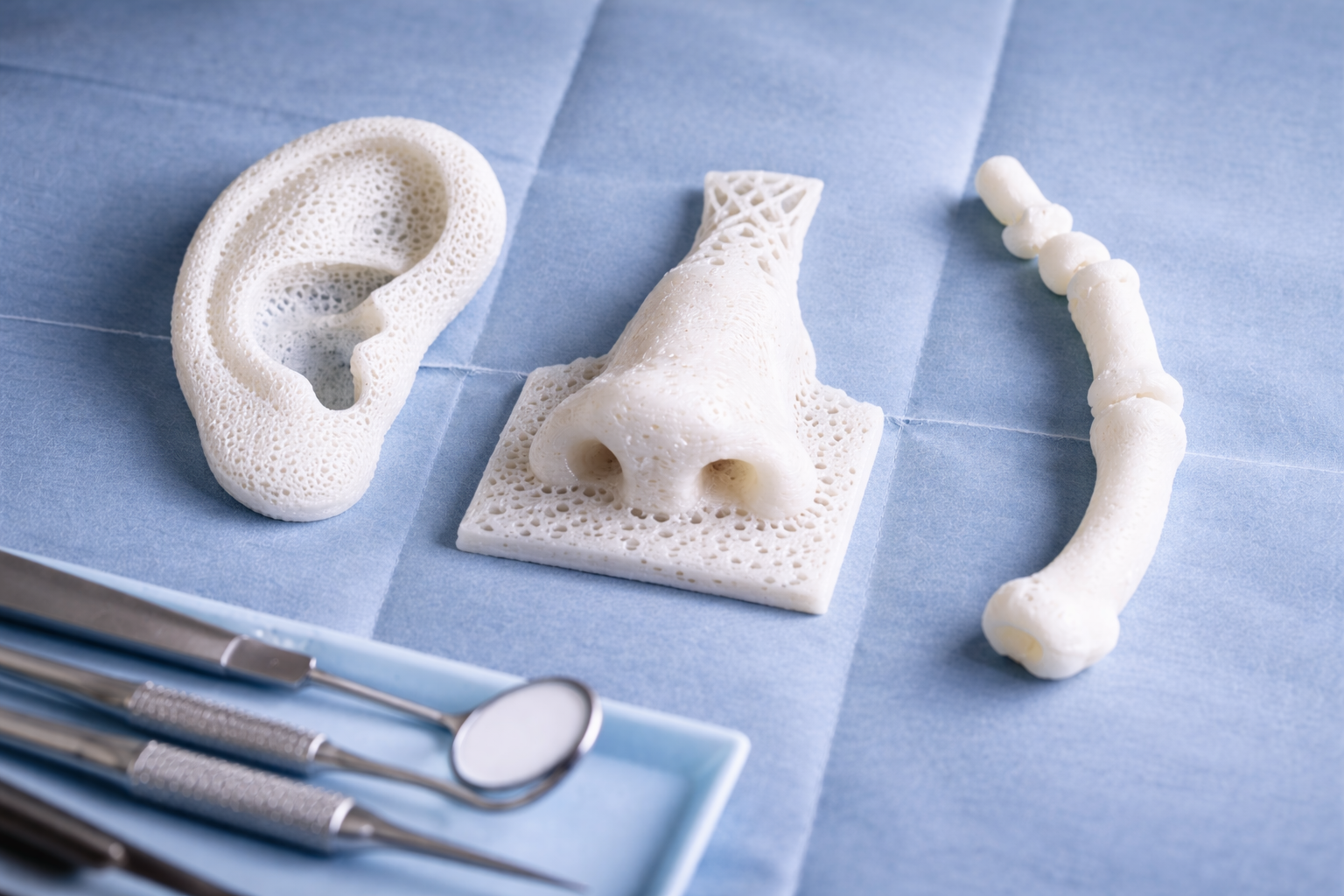
When people hear “3D printing in medicine,” they often imagine futuristic lab-grown organs or science-fiction scenarios.
In reality, the most powerful applications are much more practical — and they are already happening every day in hospitals and medical device companies around the world.
Let’s look at how is really used in medicine — not in theory, but in real-world workflows.

A Surgeon Holding a Patient’s Skull — Before the Surgery
In a complex cranial surgery case, a hospital received CT scan data from a patient with a severe skull defect.
Instead of reviewing the case only on a screen, the medical team printed a full-scale 3D anatomical model of the patient’s skull.
The surgeon could:
-
Study the defect physically
-
Simulate the procedure
-
Pre-bend fixation plates
-
Reduce operating time
The result?
Shorter surgery duration and improved precision.
This is one of the most common real-world applications of medical 3D printing today: surgical planning models.

Custom Implants: When “Standard Size” Is Not Enough
In orthopedics and trauma cases, no two patients are exactly the same.
Traditionally, surgeons choose from standardized implant sizes. But with 3D printing, implants can now be customized based on the patient’s anatomy.
For example:
-
Titanium spinal cages designed to match vertebral curvature
-
Custom cranial plates shaped to fit skull defects
-
Dental implants optimized for bone structure
Metal 3D printing (often using titanium alloys) allows porous structures that promote bone growth — something traditional machining struggles to create internally.
However, this doesn’t mean machining disappears.
In many cases, implants are:
-
3D printed for complex internal structures
-
CNC machined afterward to achieve tight tolerances on critical surfaces
Hybrid manufacturing is becoming common in medical applications.
Where 3D Printing Works Best — And Where It Doesn’t
To understand its real role, it helps to compare 3D printing with precision machining.
| Aspect | 3D Printing | CNC Machining |
|---|---|---|
| Design Complexity | Excellent for complex internal structures | Limited by tool access |
| Customization | Ideal for patient-specific parts | Best for repeat production |
| Surface Finish | Often requires post-processing | Naturally high surface finish |
| Tolerance Control | Moderate (may vary by process) | High precision achievable |
| Volume Production | Slower for large batches | Efficient for repeat orders |
This is why in medical manufacturing, the two technologies often complement each other rather than compete.
Rapid Prototyping in Medical Device Development
Imagine a startup developing a new minimally invasive surgical tool.
Instead of waiting weeks for tooling, engineers can:
-
Print a prototype handle
-
Test ergonomics with surgeons
-
Adjust the design
-
Reprint within days
This shortens development cycles dramatically.
Once the design is finalized, critical structural parts may then transition to:
-
Precision CNC machining
-
Injection molding
-
Or die casting for scale production
3D printing accelerates innovation — but traditional manufacturing ensures stability and scalability.

Prosthetics: Personalization at Lower Cost
Another real-life example is prosthetics.
3D printing enables:
-
Lightweight prosthetic arms
-
Customized sockets for comfort
-
Faster production for growing children
Instead of weeks of manual shaping, digital scans can be converted into print-ready files quickly.
This has made prosthetics more accessible in developing regions.
What About Bioprinting?
Bioprinting — printing living cells — is often mentioned in headlines.
While still in research stages, laboratories are exploring:
-
Skin tissue printing
-
Cartilage scaffolds
-
Organ research models
However, fully functional printed organs are not yet mainstream clinical practice.
The most impactful uses today remain structural models, implants, and device development.
How Manufacturing Partners Fit Into This Picture
While hospitals and research labs focus on innovation, medical device companies must ensure:
-
Dimensional accuracy
-
Regulatory compliance
-
Material traceability
-
Surface quality
-
Mechanical performance
Many components surrounding 3D printed implants still require precision machining:
-
Surgical instrument housings
-
Mounting frames
-
Optical components
-
Robotic surgical system parts
-
Medical imaging structural parts
This is where experienced precision manufacturers play a critical role.
At XY-GLOBAL, we frequently support medical device customers who:
-
Prototype parts using additive methods
-
Then require precision CNC machining for production-grade components
In complex assemblies, both technologies often exist side by side.

The Real Future: Hybrid Manufacturing
The future of 3D printing in medicine is not about replacing traditional manufacturing.
It is about integration.
We are already seeing:
-
Printed titanium structures with machined contact surfaces
-
Printed molds for short-run medical device production
-
Additive tooling inserts combined with precision frames
The goal is not just innovation — but reliable, scalable, high-quality production.
Final Thoughts
3D printing in medicine is no longer experimental — it is practical, accessible, and widely used.
But it works best when combined with precision engineering.
From surgical planning models to customized implants and device prototyping, additive manufacturing expands what is possible.
And when precision, tolerance, and reliability matter, machining remains essential.
In modern medical manufacturing, the future is not additive or subtractive — it is collaborative.


Share:
Self Centering Vise: The Complete Guide to Precision CNC Workholding
Optical Mirror Machining: GD&T-Controlled Precision for High-Stability Optical Systems