


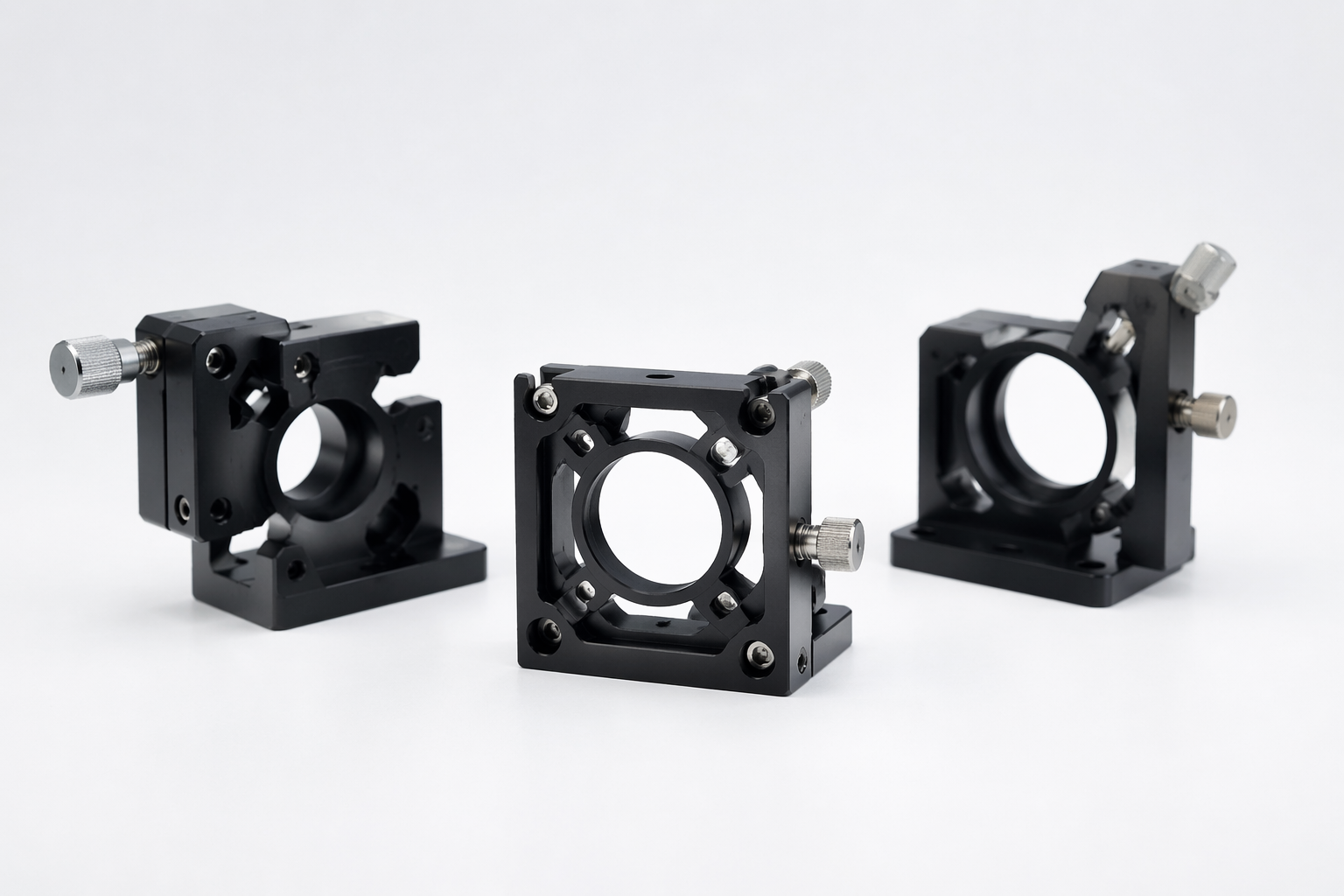
In precision optical systems, mirror mounting is not only about holding an optic in place. It is also about how reliably that optic can be adjusted, aligned, and kept stable over time. This is where the flexure optical mirror mount becomes important.
Unlike conventional mirror mounts that rely on sliding interfaces, clearance fits, springs, or multiple contacting parts, a flexure optical mirror mount uses controlled elastic deformation within the structure itself to create small, precise movement.
This design approach is widely used in applications where fine adjustment, repeatability, and long-term stability matter more than large adjustment travel.
For engineers, sourcing teams, and optical system designers, the value of a flexure-based mirror mount is not simply that it looks more advanced.
Its real value lies in how it behaves mechanically under precise alignment conditions, how it responds to thermal and vibration influences, and how manufacturable the structure is in real production.
What Is a Flexure Optical Mirror Mount
A flexure optical mirror mount is a precision mechanical mount designed to hold and adjust an optical mirror through the elastic deformation of carefully designed thin sections or compliant features.
Instead of depending on conventional mechanical play, it uses the material’s own controlled flexibility to generate motion.
In practical terms, this means the mount can provide very small, predictable adjustments with reduced mechanical looseness. The movement is usually limited to a relatively small range, but within that range the motion can be highly repeatable and stable.
That is why flexure structures are often used in optical systems where tiny angular changes in mirror position can strongly affect beam direction, image quality, or alignment consistency.
This type of mount is commonly used in systems where the mirror must not only be positioned accurately during assembly, but must also maintain that position over time under real operating conditions.

Why Flexure Structures Are Used in Optical Mirror Mounts
The main reason flexure structures are used in optical mirror mounts is that sensitive optical alignment systems do not tolerate mechanical inconsistency well. In laser paths, beam steering assemblies, interferometric setups, and compact imaging modules, even small amounts of backlash or friction can create alignment drift or unstable adjustment behavior.
A flexure-based mirror mount helps address these issues in several ways.
First, it offers low backlash. Because motion is created by deformation rather than by loose mechanical engagement between multiple moving parts, the amount of mechanical play can be greatly reduced. This is especially valuable in fine angular adjustment.
Second, it supports high repeatability. When the compliant structure is designed properly and the operating range stays within the elastic region of the material, the motion behavior can remain highly consistent from one adjustment cycle to the next.
Third, it has low friction compared with mechanisms that depend on sliding contact. Reduced friction often leads to smoother fine adjustment and less stick-slip behavior, which is useful when very small optical corrections are needed.
Fourth, it can provide stable fine adjustment. Flexure structures are well suited for precise, limited-range motion. In optical alignment, that is often more valuable than having a large adjustment envelope.
Finally, a properly designed flexure optical mirror mount can offer good long-term stability. With fewer interfaces subject to wear, looseness, or uneven contact behavior, the structure may maintain alignment more predictably over time.
For these reasons, flexure-based designs are particularly suitable for sensitive optical alignment systems where stability, repeatability, and precision matter more than broad mechanical travel.
Key Design Considerations for Flexure Mirror Mounts
Designing a flexure optical mirror mount is not simply a matter of making a thin section and allowing it to bend. The structure must be designed to achieve the required movement while still maintaining overall stability and manufacturability.
One of the first issues is the balance between stiffness and compliance. The flexure region must be compliant enough to allow the desired adjustment, but the mount as a whole must still be stiff enough to resist drift, distortion, and external disturbance.
If the structure is too rigid, fine adjustment becomes difficult. If it is too compliant, the mount may become sensitive to vibration or lose positional stability.
Another important factor is the adjustment range. Flexure mirror mounts are generally best suited for small, precise motions rather than large adjustment travel. The design should match the real alignment requirement of the optical system. Pushing the structure to achieve more travel than necessary may reduce stability or shorten fatigue life.
The preload strategy also matters. Many precision adjustment systems rely on preload to keep contact conditions consistent and minimize motion uncertainty. In a flexure-based mirror mount, preload can influence adjustment smoothness, return behavior, and long-term repeatability.
The preload approach must be compatible with the mount geometry, the adjustment screw arrangement, and the expected operating environment.
Thermal stability is another critical issue. In optical systems, temperature change can affect alignment even when the dimensional changes are very small. Material expansion, structural asymmetry, and clamping method can all influence how the mount behaves thermally.
For laser systems, imaging assemblies, and precision measurement devices, thermal behavior should be considered early in the design stage.
The structure must also be evaluated for vibration sensitivity. Because flexure sections are intentionally compliant, they can become sensitive if the design is not properly balanced. This is especially relevant in equipment that experiences machine vibration, transport shock, or dynamic operating conditions.
The mirror retention method is equally important. Holding the mirror securely is not enough by itself. The retention design must avoid introducing unwanted stress into the optic while maintaining consistent positioning. In precision optical assemblies, the interface between the mirror and the mount is often just as important as the flexure mechanism itself.
Finally, many real systems have compact space constraints. Standard mirror mounts may be too large, too tall, or too difficult to integrate into the surrounding optical mechanical layout.
A flexure-based design is often selected not just for performance, but because it can be tailored to fit limited installation space while still supporting controlled adjustment.
Material Choices for Precision Optical Mounts
Material selection for a flexure optical mirror mount should be based on mechanical function, thermal behavior, weight, machining difficulty, and cost. It should not be treated as a generic material catalog exercise.
Aluminum(6061-T6) is often a practical first choice for many optical mounts. It is lightweight, machines efficiently, and is widely used in optical mechanical structures such as housings, brackets, and alignment mounts. For projects where prototyping speed, cost control, and reasonable structural performance are all important, aluminum offers a strong balance.
It is also well suited for anodizing, including black anodizing, which is commonly used in optical applications for appearance and stray light control. However, aluminum is not always the best option when the highest stiffness or thermal stability is required.
303, 304, or 316 Stainless steel is often preferred when the design needs greater rigidity, higher strength, or improved dimensional stability under more demanding conditions. It can be a better choice when structural stiffness matters more than weight, or when the operating environment calls for greater durability and corrosion resistance.
The tradeoff is that stainless steel is heavier and more difficult to machine than aluminum, which can increase manufacturing time and cost.
In some specialized designs, titanium may be considered when weight reduction and structural strength are both important. In other cases, Invar may be relevant when thermal expansion must be minimized as much as possible.
These materials are usually reserved for applications with more demanding thermal or weight-related requirements and are not always necessary for general optical mount designs.
In practice, the material decision should be tied directly to the function of the mount. If the main priority is faster machining and lower mass, aluminum may be more suitable. If stiffness and structural stability are more important, stainless steel may be the better option. If thermal drift is highly sensitive, more specialized materials may need to be evaluated.

CNC Machining Challenges in Flexure-Based Optical Components
From a manufacturing perspective, a flexure optical mirror mount is more demanding than a typical rigid bracket or standard optical holder. The design may look simple on paper, but the machining difficulty increases significantly once thin compliant sections and fine adjustment features are introduced.
One of the biggest challenges is the machining of thin flexure sections. These areas are intentionally slender so they can deform elastically during use. During machining, however, that same geometry makes them vulnerable to deformation from clamping force, cutting force, and residual stress release.
A feature that appears dimensionally correct during rough machining can shift once material is removed or the part is unclamped.
This leads directly to the issue of stress control during machining. Flexure-based parts are more sensitive than ordinary rigid parts because small geometric changes can influence motion behavior.
Machining sequence, stock allowance, tool path strategy, and fixturing method all affect how stress is distributed and released. If stress is not managed carefully, the final part may not behave as intended even if individual dimensions seem acceptable.
Another common difficulty is the machining of small slots, fine features, and controlled corner transitions. Flexure mechanisms often rely on narrow cuts, small radii, and precise transitions between stiff and compliant areas.
Tool selection and machining strategy have a direct impact on these features. Poor control in these regions can alter stiffness, motion consistency, and fatigue performance.
Dimensional consistency is also critical. In a prototype, one part may be manually tuned or selectively inspected. In repeated builds or small-batch production, the challenge becomes maintaining consistent behavior across multiple parts. A flexure optical mirror mount must not only be machinable once, but reproducible with stable performance.
Surface finishing must be handled carefully as well. In many optical mechanical projects, black anodizing is used to improve appearance and reduce unwanted reflection.
However, finishing processes can affect dimensionally sensitive areas, especially if the design includes fine compliant sections, tight interfaces, or adjustment-critical surfaces. This means the finishing plan should be considered early rather than treated as a final cosmetic step.
Finally, tolerance and inspection considerations should be defined around function, not just general drawing completeness. For flexure-based optical components, critical inspection items may include thin-section geometry, feature symmetry, mounting flatness, hole position, and the consistency of adjustment-related features.
In many cases, key dimensions should be verified through focused inspection methods such as CMM measurement, not only by standard shop-floor checks.
In short, machining a flexure optical mirror mount is not only about reaching a nominal dimension. It is about producing a part whose geometry, stress condition, and critical features support stable optical alignment in real use.
Typical Applications in Optical and Laser Systems
Flexure optical mirror mounts are used in a range of optical and photonic systems where precise, stable mirror positioning is required.
In laser systems, they are often used where small angular adjustments must remain stable over time. A mirror that shifts slightly can change beam direction, reduce coupling efficiency, or affect overall system performance.
In beam steering assemblies, fine angular control is essential. Flexure-based mounts are useful when the mirror must be positioned with predictable response and minimal motion uncertainty.
In interferometers, repeatability and low mechanical drift are especially important. Because these systems are sensitive to very small positional changes, the stability of the mirror mount can directly influence measurement quality.
In semiconductor optical equipment, structural precision, dimensional consistency, and controlled motion are often necessary. Mounts used in these systems may also need to fit into constrained assemblies where integration matters as much as adjustment precision.
These applications do not all use the same mount geometry, but they share a common need: precise optical alignment supported by stable mechanical behavior.
From Design Review to Precision Manufacturing
At XY-GLOBAL, we know that a flexure optical mirror mount is more than a simple machined component. Its performance depends on how well design intent is carried through manufacturing.
We begin with design review, focusing on thin flexure regions, critical features, material choice, tolerance strategy, and finishing impact. With DFM support, precision CNC machining, prototype validation, and critical dimension inspection, we help make flexure-based optical parts practical for real production.
From fine feature machining to black anodizing coordination, our team supports custom optical mechanical parts with the process control needed for precision optical applications.
If you are looking for custom optical mechanical parts for your project, feel free to visit our optical parts page for more information.
FAQ
How is a flexure optical mirror mount different from a traditional mirror mount?
A traditional mirror mount often relies on springs, screws, and contacting moving parts, while a flexure-based mirror mount uses compliant structural features for motion. This usually helps reduce backlash and improve repeatability in fine optical adjustment.
Why are flexure structures used in optical mirror mounts?
They are used because sensitive optical alignment systems often require low backlash, low friction, stable fine adjustment, and better long-term positioning consistency.
Are flexure optical mirror mounts suitable for large adjustment ranges?
Usually, no. Flexure structures are generally better for small and precise adjustment ranges rather than large travel.

Share:
How CNC Milling Precision Is Maintained in Real Production
Part Manufacturing: Choosing the Right Process for Precision Parts