


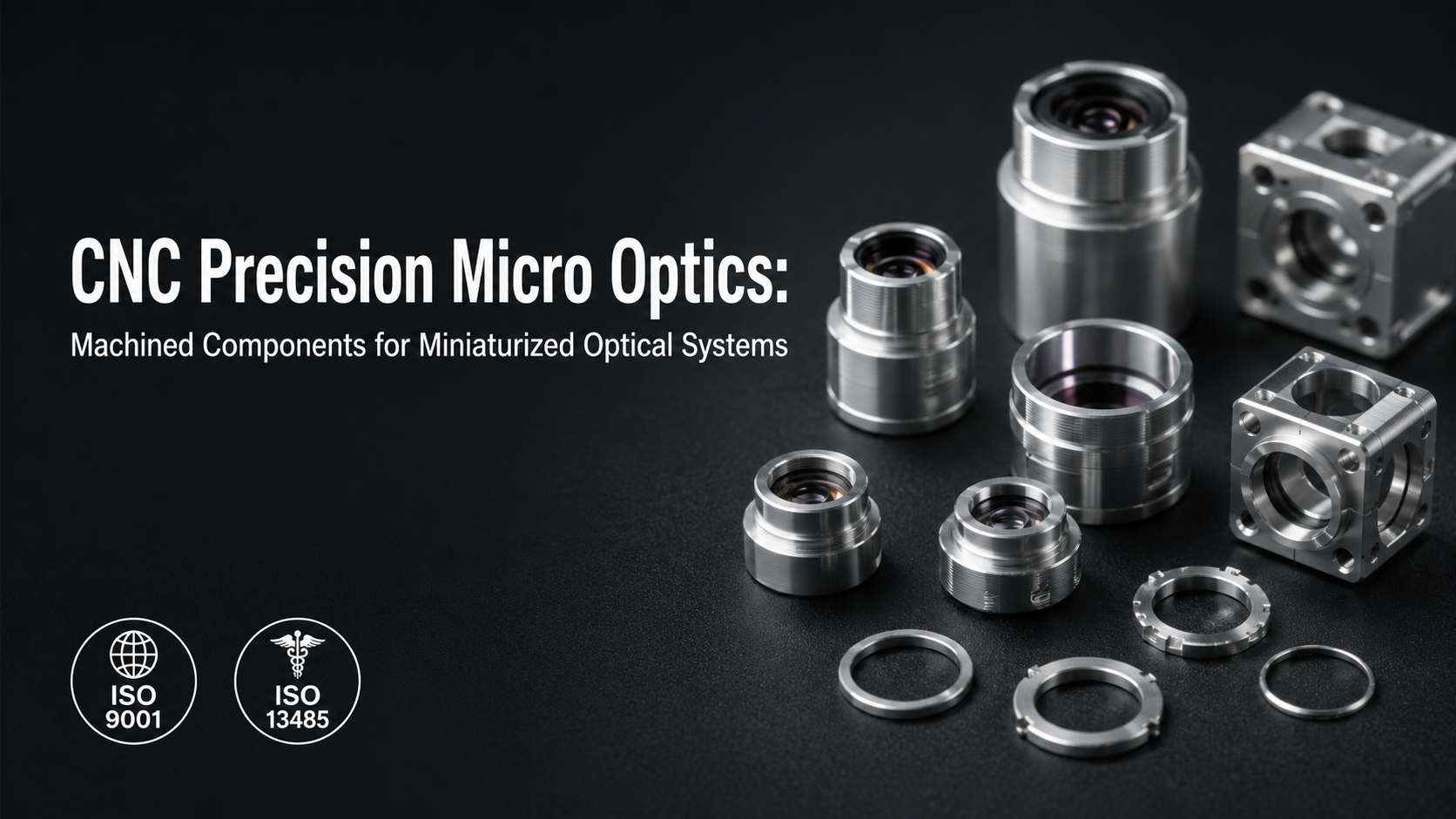
Optical systems are getting smaller. From medical endoscope tips to AR headset modules, drone camera assemblies, and laser collimation units, the mechanical components that hold, align, and protect optical elements must now be produced at miniature scale — and to the same precision tolerances that full-size optical systems have always demanded. CNC machining is the production method that makes this possible, but applying it at small scale requires a significantly different approach than standard precision part work.
CNC precision micro optics is the intersection of miniaturized optical system design and the high-accuracy CNC machining processes that produce the structural components those systems depend on. The glass and crystal elements in a micro optical system get most of the attention, but it is the machined metal barrel, housing, spacer, and mount that determine whether those elements are correctly positioned, properly protected, and dimensionally stable in service.
This article covers what CNC precision micro optics components are, how CNC machining is applied to miniature optical parts, what process challenges arise at small scale, and what tolerance, material, and surface finish requirements typically apply to these components.

What Are CNC Precision Micro Optics Components?
CNC precision micro optics components are the machined mechanical parts that form the structural framework of miniaturized optical systems. They include miniature lens barrels, micro optical housings, thin spacer rings, fine-pitch retaining rings, fiber coupling structures, beam splitter mounts, and custom optomechanical mounting elements — all produced by CNC turning, CNC milling, or 5-axis machining to tight dimensional tolerances at small scale.
These components are distinct from the optical elements themselves. A lens, filter, or aperture is an optical component. The barrel that holds it, the housing that encloses the optical train, the spacer that sets the air gap between elements — these are the CNC machined mechanical components that make a micro optical system work. Their dimensional accuracy, surface quality, and material properties directly determine the optical performance of the assembled system.
At miniature scale, the distinction between "close enough" and "within tolerance" becomes critical. A bore that is 3 μm oversized in a 5 mm lens barrel allows far more lens decentration than the same error in a 50 mm housing. The proportional impact of any dimensional deviation is amplified as feature sizes decrease, which is why CNC precision micro optics components require process capability specifically developed for small-scale high-accuracy work.
Why CNC Machining for Micro Optics Components?
CNC machining — turning and milling — is the dominant production method for precision micro optics mechanical components for several reasons. It produces the tight dimensional tolerances, controlled surface finishes, and complex geometries that micro optical assemblies require. It supports the full range of metals used in optical mechanical design: aluminum alloys, stainless steel, titanium, and brass. And it scales from single prototypes to volume production without requiring dedicated tooling, which is important for the development-heavy, often low-volume programs typical of optical instrumentation.
Alternative processes such as metal injection molding (MIM), investment casting, and plastic injection molding can produce small and complex parts, but they cannot match the dimensional precision and surface quality achievable by CNC machining for optical mechanical applications. Grinding and lapping are used for the highest-precision optical mechanical surfaces, but CNC turning and milling are the primary shaping operations for micro optics housings, barrels, and structural components.
For CNC precision micro optics components, the machining process must be configured specifically for small-scale work. Tool selection, cutting parameters, fixturing approach, and machining sequence all need to account for the unique challenges that arise when producing miniature optical parts to tight tolerances.

Key Mechanical Components in CNC Precision Micro Optics Systems
Miniature lens barrels are the primary structural element in most CNC precision micro optics assemblies. They provide the bore into which lens elements are seated, the threads that engage retaining rings, and the outer geometry that interfaces with the surrounding housing or system structure. At small diameters — 2 mm to 20 mm is a common range — bore tolerance, roundness, and concentricity between the bore and external datum features must all be controlled to ensure optical elements are correctly centered and aligned after assembly.
Micro optical housings enclose the complete optical train and provide the mounting interface to the surrounding instrument or device. In miniaturized systems, the housing may combine structural, thermal, and sealing functions within a tightly constrained envelope. Wall sections as thin as 0.3–0.5 mm are common in compact designs, requiring careful fixturing and machining sequence to avoid distortion.
Spacers and shims control the axial distance between lens elements. Thickness accuracy directly affects back focal distance and, in focused systems, image quality. At miniature scale, even a 3–5 μm error in spacer thickness can produce a measurable performance deviation. Producing spacers to this level of consistency requires careful process control and appropriate thickness verification methods.
Fine-pitch retaining rings secure lens elements within barrels. At small diameters, fine-pitch threads — M1, M2, M3, and custom forms — require specialized tooling and careful process control to produce correct thread form, pitch accuracy, and face flatness. A retaining ring that runs unevenly, bottoms out incorrectly, or introduces tilt on a lens element at 3 mm diameter can degrade optical performance significantly.
Fiber coupling structures and beam components are used in laser module assemblies, fiber optic coupling systems, and optical coherence tomography instruments. These components must position collimating elements or fiber terminations with sub-micron alignment accuracy, maintained across the temperature range of the application environment.
CNC Machining Challenges in Precision Micro Optics
Producing CNC precision micro optics components at acceptable quality levels requires addressing a set of challenges that are qualitatively different from those encountered in standard precision machining.
Tool deflection becomes proportionally more significant as feature sizes decrease. A 0.5 mm end mill deflects far more under cutting load than a 10 mm tool. Miniature tooling is inherently more flexible, which means cutting parameters — depth of cut, feed rate, and cutting speed — must be set conservatively and with consideration of the specific geometry being produced. Aggressive cutting strategies that work well for larger features will produce oversize bores, tapered walls, or poor surface finish at small scale.
Fixturing and clamping at miniature scale must provide adequate support without introducing clamping distortion. Parts with thin walls or small cross-sections can distort under clamping loads, leading to bore geometry errors or surface form errors that only become apparent after release. Purpose-designed fixtures for specific miniature components are often required to achieve consistent dimensional results.
Burr control is more critical in CNC precision micro optics components than in larger parts. A burr that is insignificant on a 50 mm part can block a lens seat, prevent a retaining ring from engaging, or introduce particulate contamination into an optical cavity when it occurs on a 5 mm barrel. Deburring operations for miniature optical components must be planned carefully to ensure complete burr removal from lens seats, thread flanks, and internal features without affecting adjacent surfaces.
Fine-pitch thread production in miniature optical bores requires specialized tooling. Standard taps are available at M1 and above, but for CNC precision micro optics applications — where thread form accuracy, concentricity to the bore, and thread surface quality are all important — single-point thread turning on a precision lathe or thread grinding may be required to achieve consistent results.
Thermal effects during machining can affect dimensional accuracy at the tolerance levels required for CNC precision micro optics components. Cutting heat causes both tool and workpiece to expand; at tolerances of ±1–2 μm, even small temperature changes produce meaningful dimensional effects. Coolant management, thermal stabilization of the machine environment, and appropriate part settling time before final inspection are all important process considerations.

Tolerance and Geometry Requirements
CNC precision micro optics components typically require tighter tolerances in absolute terms than standard precision parts, and the ratio of tolerance to feature size is smaller. The following table shows typical requirements for common component types.
| Component | Critical Tolerance | Relevance to Optical Performance |
|---|---|---|
| Miniature lens barrel bore | ±1–3 μm diameter, roundness ≤ 2 μm | Controls lens centration; errors produce coma and astigmatism |
| Spacer thickness | ±1–5 μm | Directly affects back focal distance and air gap spacing |
| Retaining ring face flatness | ≤ 2–3 μm | Prevents lens tilt at small seating diameters |
| Housing bore coaxiality | ≤ 3–5 μm total | Maintains optical axis alignment across system length |
| Lens seat perpendicularity | ≤ 2 μm relative to bore axis | Prevents systematic lens tilt and associated aberrations |
| Internal surface roughness | Ra ≤ 0.1–0.4 μm | Controls stray light within optical cavity |
Beyond individual feature tolerances, the geometric relationships between features are often the most critical specifications in CNC precision micro optics components. Coaxiality between multiple bores along the optical axis, perpendicularity of lens seats to the bore centerline, and parallelism of spacer end faces must all be controlled to maintain correct optical system geometry in a compact assembly.
Material Selection for CNC Micro Optics Components
Material selection for CNC precision micro optics components involves the same considerations as for larger optical mechanical parts — thermal expansion, machinability, weight, and surface treatment compatibility — with additional attention to how material properties affect process behavior at small cross-sections.
Aluminum alloys (6061-T6, 7075-T6) are the most widely used materials for CNC precision micro optics components. Their excellent machinability supports the fine features, thin walls, and tight bores required in miniature optical assemblies. The high thermal conductivity of aluminum helps dissipate cutting heat during machining. Black anodizing provides a low-reflectance finish that controls stray light within the optical cavity. The relatively high coefficient of thermal expansion (CTE) of aluminum (approximately 23 ppm/°C) must be considered in thermally sensitive designs.
Stainless steel (303, 304) is used where higher strength, lower CTE, or improved corrosion resistance is required, and where the mass penalty of steel over aluminum is acceptable. Stainless steel is the standard material for medical micro optics components that require sterilization compatibility and ISO 13485-compliant manufacturing. At small cross-sections, the higher strength of steel allows thinner wall sections than aluminum for equivalent structural performance.
Titanium alloys (Ti-6Al-4V) are used in CNC precision micro optics components for aerospace, defense, and high-end scientific instrumentation where low CTE, low mass, and high strength are simultaneously required. Titanium's CTE (approximately 8.6 ppm/°C) is considerably lower than aluminum, and its specific strength is excellent. Machining titanium at miniature scale requires careful management of cutting parameters to avoid work hardening and tool wear.
Brass is used for some miniature lens barrel components, particularly in traditional optical instrument designs. It machines cleanly at small diameters, produces good fine-pitch thread quality, and has been used in optical mechanical design for decades. Brass is heavier than aluminum and is not suitable where low mass is a requirement.

Surface Finish and Post-Processing for CNC Micro Optics Parts
Surface finish requirements for CNC precision micro optics components are typically more stringent than for larger optical mechanical parts. In miniaturized optical systems, stray light has limited path length in which to be absorbed, making the absorptance of internal surfaces more important than in larger assemblies.
Internal bore surfaces in miniature lens barrels and housings require Ra ≤ 0.4 μm as a general minimum; for high-performance applications, Ra ≤ 0.1 μm is specified on surfaces directly facing the optical path. Achieving these values at small diameters requires appropriate tool geometry, controlled cutting parameters, and in some cases sequential finishing cuts or internal honing operations.
Black anodizing is the standard surface treatment for aluminum CNC precision micro optics components. It provides a matte black, low-reflectance finish with controlled optical absorptance for stray light management, along with corrosion protection and surface hardness improvement. The critical process consideration at miniature scale is dimensional: anodizing adds approximately 10–25 μm per surface (depending on specification), and for miniature bores this growth must be precisely accounted for in the pre-anodize machining dimensions. For a 3 mm bore with a ±3 μm tolerance, the anodize allowance represents a significant portion of the total tolerance budget.
Lens seats and retaining surfaces require smooth, flat, burr-free finishes to ensure optical elements seat correctly without stress or contamination. These surfaces are typically inspected under magnification before assembly to confirm they are free from machining marks, burrs, or surface defects that could affect lens seating quality.
Applications for CNC Precision Micro Optics Components
Medical devices are among the most demanding application areas for CNC precision micro optics components. Endoscope distal tips, capsule endoscopy camera modules, ophthalmic measurement instruments, and minimally invasive surgical imaging assemblies all require miniature optical components machined to tight tolerances from biocompatible materials, produced under ISO 13485-compliant quality systems with full material and process traceability.
Augmented and virtual reality optical engines use miniature collimating assemblies, display coupling structures, and waveguide interface components that must achieve sub-micron alignment accuracy in lightweight, compact form factors. As AR and VR devices move toward mass-market scales, the mechanical components of their optical trains must balance precision with cost-effective production volume.
Laser diode and fiber optic modules depend on CNC machined micro optics components for collimating lens barrels, fiber coupling assemblies, and beam shaping structures. These components appear in telecommunications equipment, optical coherence tomography systems, laser processing tools, and scientific instrumentation. Alignment stability at the sub-micron level across temperature cycles and mechanical vibration is a standard requirement.
Drone and UAV imaging systems require miniature optical housings and lens barrels that are lightweight, vibration-resistant, and dimensionally stable across outdoor operating temperature ranges. The combination of small size, mechanical robustness, and optical performance required by drone camera systems is well matched to CNC precision micro optics manufacturing capabilities.
Portable analytical and diagnostic instruments — handheld spectrometers, point-of-care medical devices, field-deployable sensing systems — use compact optical assemblies that must perform reliably in variable environmental conditions. CNC machined micro optics components provide the combination of precision and structural integrity these applications require.

Quality Control and Inspection
Quality control for CNC precision micro optics components requires inspection methods matched to the feature sizes and tolerance levels involved. Standard metrology approaches used for larger parts may not be adequate at miniature scale.
CMM inspection with fine ruby styli (1 mm diameter or smaller) is used for bore diameter, roundness, coaxiality, flatness, and position measurements on miniature components. For bore diameters below approximately 1.5 mm, contact measurement may not be feasible and non-contact optical methods are used instead. Air gauging provides fast and highly accurate bore diameter measurement for production inspection of miniature lens barrel bores.
Surface roughness on internal bores at small diameters requires stylus profilometers with fine tip radii, or non-contact optical profilers where stylus access is restricted by bore geometry. Specifying the measurement method alongside Ra requirements is important for miniature components, as different measurement techniques may produce different results on the same surface.
Thread inspection for fine-pitch micro optical threads uses calibrated thread gauges, CMM thread measurement, or optical thread measurement systems depending on the thread size and the required accuracy of conformance verification. Custom thread forms may require purpose-made gauges.
For CNC precision micro optics components produced under ISO 13485, inspection records, measurement system calibration, and material traceability documentation are required elements of the quality plan. First article inspection reports are standard for new component designs and design revisions.
Prototype to Production for Micro Optics Programs
CNC precision micro optics programs typically begin with prototype components to validate the mechanical and optical design before production process development. The prototype phase benefits from early supplier involvement in DFM review, particularly for miniature components where drawing features that appear straightforward at larger scale may present significant machining challenges at small dimensions.
Common DFM issues in CNC precision micro optics components include: thin wall sections that require purpose-designed fixtures to machine without distortion; fine-pitch thread features that require specialized tooling not in standard inventory; surface finish requirements on small bores that require secondary operations not initially factored into lead time; and anodize allowance requirements that affect bore pre-machining dimensions in ways not reflected in the finished drawing tolerances.
Identifying and resolving these issues at the prototype stage — rather than encountering them as production problems — significantly reduces program risk and total development time. A machining supplier with direct experience in CNC precision micro optics components should be able to provide DFM feedback that addresses these issues at first drawing review, before a prototype part is produced.
The transition from prototype to production for CNC micro optics components requires formalized inspection plans, qualified fixtures, and process documentation that ensures dimensional consistency from the first production batch onward. At miniature scale, small process variations that would be inconsequential for larger parts can result in significant yield loss on tight-tolerance micro optical components, making process qualification and capability demonstration important steps before production ramp.
Why XY-GLOBAL for CNC Precision Micro Optics Components
XY-GLOBAL provides CNC precision micro optics machining services for the full range of miniature optical mechanical components — lens barrels, micro housings, spacers, retaining rings, mounting structures, and custom optomechanical assemblies. Our CNC turning, milling, and 5-axis machining capabilities support bore tolerances to ±1 μm, coaxiality and roundness to ≤ 2 μm, and internal surface finishes to Ra ≤ 0.1 μm on optical-grade bores at miniature scale.
We hold ISO 9001 and ISO 13485 certifications, supporting medical CNC precision micro optics programs with the quality management infrastructure, process documentation, and material traceability that regulated device applications require. Surface finishing including black anodizing, passivation, and precision bead blasting is available for CNC micro optics components, with dimensional allowance planning for anodize build-up included in our pre-production DFM review process.
We support programs from initial prototype through low-volume and series production. Production start is within one day of drawing confirmation, free prototype support is available for new component designs, and DFM review is provided at no charge for new programs. If you have a CNC precision micro optics component requirement, contact XY-GLOBAL to discuss your project specifications and timeline.
FAQ
What is the difference between CNC precision micro optics and standard optical machining?
CNC precision micro optics refers specifically to the CNC machining of mechanical components at miniature scale — typically housings, barrels, spacers, and mounts with diameters below approximately 25 mm and wall sections below 1 mm. Standard optical machining typically refers to larger components. At miniature scale, the ratio of tolerance to feature size is tighter, cutting forces have proportionally larger effects, and process parameters must be specifically configured for small-scale work.
What bore sizes and tolerances can XY-GLOBAL achieve for miniature lens barrels?
XY-GLOBAL CNC machines miniature lens barrels with bore diameters from approximately 1 mm, with bore diameter tolerances to ±1 μm, roundness to ≤ 2 μm, and coaxiality between multiple bores to ≤ 3 μm for appropriate component geometries. Achievable tolerances depend on the specific feature, material, and part geometry and are confirmed during DFM review.
How does anodizing affect dimensional accuracy on CNC precision micro optics components?
Black anodizing adds approximately 10–25 μm per surface. For miniature lens barrels with tight bore tolerances, this dimensional growth must be fully accounted for in pre-anodize bore machining dimensions. XY-GLOBAL reviews anodize allowance requirements during DFM and confirms pre-machining dimensions before production to ensure post-anodize dimensions meet specification.
Does XY-GLOBAL support ISO 13485 quality requirements for medical CNC micro optics components?
Yes. XY-GLOBAL holds ISO 13485 certification and supports medical CNC precision micro optics programs with documented process controls, material certification and traceability, first article inspection reports, and quality documentation structured to support medical device quality system requirements.
What is the typical turnaround time for prototype CNC precision micro optics components?
Turnaround for prototype micro optics components depends on part complexity, material availability, and surface treatment requirements. XY-GLOBAL can provide specific lead time estimates after DFM review. Free prototype support is available for new component programs. Production start is within one day of drawing confirmation for parts that have passed DFM review.
Conclusion
CNC precision micro optics components sit at one of the most demanding intersections in precision manufacturing — where the requirements of high-accuracy optical alignment meet the process challenges of machining at miniature scale. Bore tolerances in single-digit micrometers, surface finishes that control stray light in compact optical cavities, fine-pitch threads in millimeter-range bores, and thin wall sections that challenge standard fixturing approaches are all standard requirements for this class of components.
Selecting a CNC machining partner with specific capability and experience in micro optics components reduces prototype risk, shortens DFM cycles, and supports more reliable production transitions for miniature optical system programs. For engineers developing optical systems in medical, AR/VR, laser, drone, or portable instrumentation applications, getting the mechanical component manufacturing right from the first prototype is the most reliable path to program success.
To discuss a CNC precision micro optics component requirement with XY-GLOBAL, contact our engineering team with your drawing or design brief. Free DFM review and prototype support are available for new projects.

Share:
CNC Machining Surface Finish: Why It Matters for Precision Parts
Custom Lens Barrel Manufacturer: What to Look for and How the Process Works